The Reverse Megxit: What Meghan's Return to Acting Reveals About the Sussex Business Model
A reported UK relocation, a Netflix role in the works, and a $47 million legal bill looming: the Sussex empire is being rebuilt from scratch, and this time Meghan Markle's screen career is the load-bearing wall.
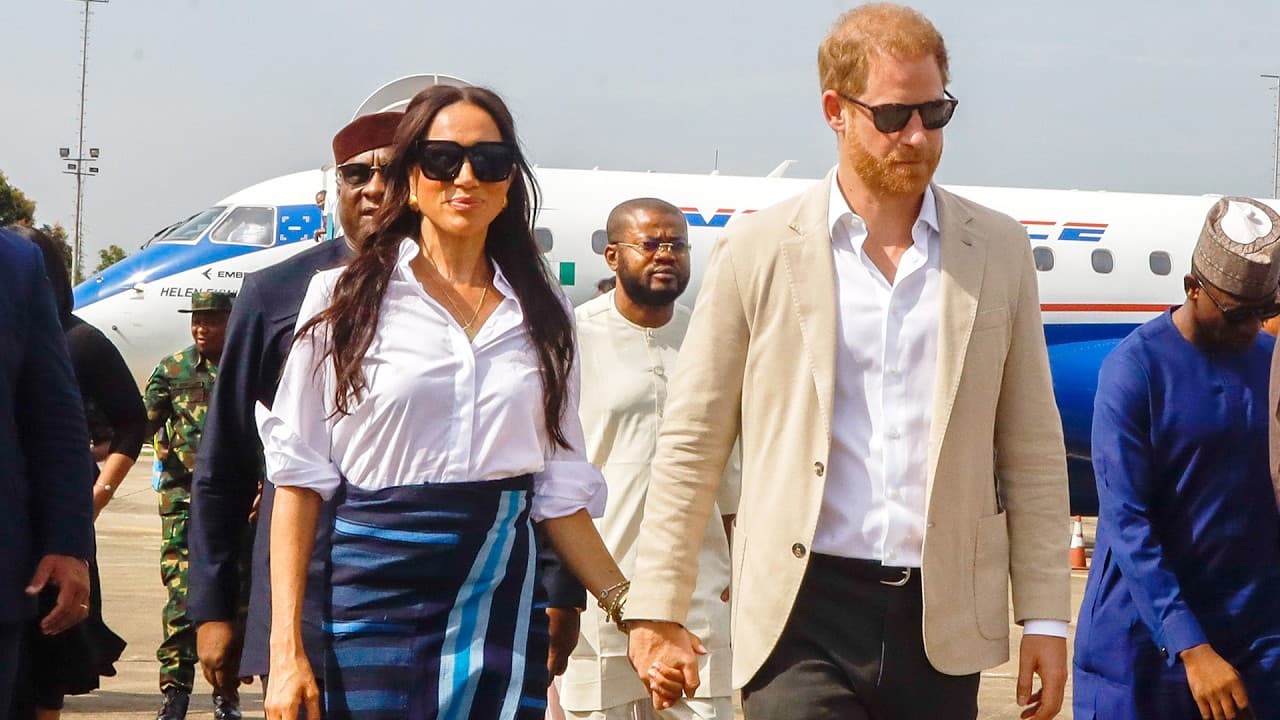
Six years ago, Harry and Meghan boarded what they called their freedom flight and touched down in California with the apparent intention of never looking back. The docuseries came. The Spotify deal came. The Netflix lifestyle show came. And then, more or less, it all fizzled. A word People's reporters used this week without apparent irony, and without apparent contradiction from Sussex-adjacent sources. Now the family is packing again, this time eastward, with Archie and Lilibet enrolled in British schools for September and a relocation expected within a fortnight.
The framing circulating across entertainment media this week. That Meghan's desire to return to acting drove the decision. Is almost certainly too clean. Major household relocations, especially ones involving a king's grandchildren and a dormant security negotiation with the British Home Office, do not get triggered by a single script offer. But the acting angle is not a distraction either. It is, arguably, the most commercially legible part of a move that is overdetermined by personal, financial, and dynastic pressures all arriving at once.
What the Sussex relocation actually reveals is the degree to which the California experiment. Conceived as a declaration of independence. Has quietly become a liability. The mansion in Montecito reportedly costs up to $600,000 a year to maintain. A British judge recently ruled that Harry and a cohort of high-profile claimants, including Elton John and Liz Hurley, could owe more than £47 million in costs after losing a tabloid privacy case against Associated Newspapers. Potentially the largest such payout in British legal history. And the streaming deals that were supposed to fund the new life are, by every public account, spent. The move to the UK is not a retreat. It is a restructuring.
Why the Sussex move is happening now, not later
Harry and Meghan are relocating to the UK within weeks of the 2026 autumn school term, with Archie and Lilibet already enrolled in British schools and the family's California mansion reported to be heading toward a sale at a potential listing price of £25–30 million.
The timing is not accidental, and it is not purely sentimental. King Charles, now 77 and continuing cancer treatment, has been publicly acknowledged by Queen Camilla as someone who has had to find his own way of coping with a serious illness. Harry's father's health was among the reasons cited by People's senior royal editor Aaron Hill when Access Hollywood pressed its sources on what is pulling the Sussexes back. Family gravity. Literal, biological, the kind that operates independently of press strategy. Is real, and it would be reductive to dismiss it.
But the financial architecture of the decision is just as significant. The Montecito estate. Nine bedrooms, a spa, a home theater, a gym, 7 acres. Cost $14.7 million when the Sussexes purchased it. Carrying costs of up to $600,000 annually make it a drag on any income statement, particularly one that no longer has nine-figure streaming deals incoming. Montecito realtor Steve Epstein told Extra TV the property could list in the $25 to $30 million range. A substantial gain that would free up capital for whatever the next chapter requires.
The school enrollment detail is the tell. You do not quietly register your children in British schools for September and then wait to see how people feel about it. That is a committed logistical act. The family's spokesperson did not deny the move when contacted by NBC News, and a source told the network that the relocation is expected within two weeks. Whatever the emotional and financial drivers, the decision has already been executed at the operational level.
King Charles was told on August 16th. Not during the summer visit
King Charles was first informed of Harry and Meghan's relocation plans on Sunday, August 16th, 2026. Weeks after the Sussex family's summer reunion with the King and Queen Camilla, confirming the move was not discussed during that visit.
The sequencing matters enormously for the palace's public posture. A source told NBC News that Charles was not informed during the Sussex family's summer visit. Their first reunion in four years. But rather was told separately on August 16th. The King, per that same source, welcomes the opportunity to see more of the family in a private and personal capacity. The operative phrase that followed, however, was delivered with the precision of a legal document: there will be no change to the Duke and Duchess' status as private individuals and non-working members of the royal family. 'There remains no half-in, half-out option.'
That language is the palace doing what it does best. Absorbing a disruptive development by reframing it as something that was always within the existing rules. Harry and Meghan can move to Britain. They just cannot move back into the institution. The distinction protects Charles from looking like he brokered a reconciliation deal, and it protects William and Kate from any suggestion that the hierarchy has shifted.
Extra TV's reporting characterized Charles as 'blindsided,' and that framing spread rapidly. The reality, as the sourcing clarifies, is more textured: he was told, he accepted the information, and he drew a firm line. Being told two weeks before the move is not quite the same as being consulted. The palace's careful syntax around 'private and personal capacity' is not warmth. It is a boundary dressed in civil language.
"The California chapter was not a failure. But the market for the exit story was eventually satisfied, and what comes next has to be built on something other than the departure itself."
What Harry and William's ongoing silence means for the return
Harry and Prince William have not spoken in years, according to The Telegraph's royal correspondent India McTaggart, meaning the UK relocation will not automatically repair the brothers' fractured relationship despite geographic proximity.
India McTaggart of The Telegraph told NBC News that while Harry has resumed more frequent contact with Charles, he and William have not spoken in years. That gap is the most politically volatile element of the return. William and Kate were reportedly notified of the move in advance. A courtesy rather than a conversation. But geographic proximity does not dissolve years of documented estrangement.
The observation from McTaggart that Meghan appears to be 'taking one for the team' is pointed. It implies that the move is, at some level, a sacrifice of Meghan's California life in service of Harry's desire to be closer to his roots, his father, and the possibility of repairing some version of a family relationship. Whether that reading is accurate or a convenient narrative for sources who want to shape sympathy toward Harry is impossible to determine from the outside.
What it does establish is that the return to Britain will not be quietly domestic. Every school run, every public appearance in London, every fashion week sighting will be measured against the unresolved question of whether William and Harry are in the same room, and whether they are speaking. The paparazzi dimension. Raised with some urgency by royal commentators this week, including the explicit invocation of how the press pursued Diana. Is not hyperbole. It is a genuine logistical and safety concern that the UK Home Office has, characteristically, declined to address specifically.
The Netflix role in The Gentlemen: what Meghan's acting comeback would actually mean
Meghan Markle is reportedly in talks for a role in Season 3 of Guy Ritchie's Netflix series The Gentlemen, with a source close to Ritchie telling Entertainment Tonight that the role is 'on the cards' and being written into the script.
A contact of Guy Ritchie's told Entertainment Tonight that a role for Meghan in the third season of The Gentlemen is 'absolutely on the cards' and is actively being written into the script. Attributing the connection to mutual friends between Markle and Ritchie. The Gentlemen is a Netflix production, which matters: the Sussexes still hold a deal with the streamer, making the institutional geography of the arrangement relatively uncomplicated. A royal adjacent figure appearing in a prestige crime drama on the platform that already carries their documentary is tidy, commercially legible, and almost certainly intentional.
Entertainment Tonight's reporting also noted that Meghan has already shot a cameo as herself in Close Personal Friends, an upcoming comedy starring Lily Collins and Brie Larson. That project, which has not yet been released, reads less as a career pivot than as a proof-of-concept. A low-stakes return to camera to establish that she can do it, that she is still recognizable in that context, and that the industry will take her calls.
The Gentlemen role, if it materializes, would be a different order of ambition. Guy Ritchie's series is a genuinely popular global property, with the kind of male-skewing international audience that is entirely distinct from Meghan's existing fanbase. A scripted dramatic role. Not a cameo, not a lifestyle segment, not herself. Would reactivate something that has been dormant since Suits, and it would do so on terms Meghan controls rather than those the palace once set. The 2017 engagement interview clip, in which she described her acting departure as 'a new chapter,' now functions as ironic prologue. The chapter appears to have another chapter.
There are also reports, noted by Entertainment Tonight's sources, of talks around a West End stage role. If accurate, that would be a bolder gambit still. Live theatre carries prestige that screen work cannot manufacture, and a successful West End run would land Meghan inside a British cultural conversation that is entirely separate from her royal history. It would also require the kind of sustained, un-airbrushed public presence in London that no amount of security planning fully insulates.
How the $47 million legal ruling changes the Sussex financial calculus
A British judge ruled that Prince Harry and co-claimants including Elton John and Liz Hurley could owe more than £47 million in costs after losing a high-profile privacy case against Associated Newspapers. A potential record payout in British legal history.
The legal exposure is the number that reframes everything else — see Dolly Parton Is Dead at 80. Her Family's Farewell Was as Intentional as Everything Else She Did.. A judge ruled that Harry and several co-claimants. Elton John, Liz Hurley, and others. Could collectively owe more than £47 million after losing their tabloid privacy case against Associated Newspapers, the UK's largest tabloid publisher. If paid in full, it would be the largest cost award in British legal history. The exact apportionment across claimants is not yet established in public reporting, but any material share of that liability, landing on top of the ongoing costs of maintaining a California estate and funding a production company without active major deals, would be clarifying.
The Montecito mansion's potential sale. At a projected listing of $25 to $30 million against a $14.7 million purchase price. Begins to look less like a lifestyle choice and more like a balance-sheet decision. Real estate gains are not income, but they are liquidity, and liquidity is what you need when a legal bill of historic proportion may be arriving. The acting work, the Netflix role, the West End speculation, the fashion week visibility: each of these is also a revenue signal. Meghan Markle returning to paid creative work is not incidental to the UK move. It may be the point.
For a fuller picture of how celebrity net worths shift under this kind of pressure, the patterns are visible across the Atlas. And the Sussex trajectory, whatever its precise figures, fits a recognizable shape: a period of high-multiple deal-making followed by a consolidation phase in which the underlying asset (talent, IP, public attention) has to be reactivated to service what the deals left behind.
Why Suits on Netflix in 2023 matters more than it seems
Suits became a massive streaming hit on Netflix in 2023, years after its original run ended, reviving mainstream awareness of Meghan Markle as an actress and making her return to scripted television commercially plausible in a way it would not have been otherwise.
The 2023 Suits phenomenon on Netflix was not a minor footnote. The show. Which had completed its original run in 2019. Became one of the most-watched library titles on the platform, logging hundreds of millions of viewing hours and introducing Meghan's performance as Rachel Zane to an audience that largely knew her only as the Duchess of Sussex. That is a significant distinction. It means her acting credential is not abstract or archival; it was stress-tested against a contemporary streaming audience and found to hold.
From a talent-market perspective, the Suits revival is the reason The Gentlemen conversation is possible at all. A production company developing a prestige drama can point to demonstrated audience appetite for Meghan Markle the actress as recently as 2023. That data exists. It is not simply nostalgia or novelty. It is a measurable signal that the IP attached to her name extends into the entertainment vertical, not just the lifestyle and media verticals she has occupied since 2020 — see Dolly Parton Is Laid to Rest. Her Nieces Carry the Weight of Her Name Forward..
The architecture of this comeback, whether conscious or not, follows a logic that is well-documented among film industry talent who step away and return: absence creates scarcity, scarcity sustains value, and when the return is timed to coincide with renewed public attention. Which a transatlantic relocation at scale, with royal family drama attached, certainly provides. The re-entry terms tend to be favorable. The Gentlemen is not a charitable offer. It is a business calculation on Ritchie's side too.
The royal hierarchy problem: London fashion week and the William-Kate tension
Meghan Markle's potential attendance at London Fashion Week risks creating a public visibility clash with Princess Kate, because the royal family operates on a strict public hierarchy in which William and Catherine must remain the dominant presences.
The fashion week question, raised by royal commentators this week, is not trivial even if it sounds like it. The British royal family's public image operates on what one commentator described plainly as 'a pecking order,' and William and Catherine sit at its top. Meghan appearing at London Fashion Week. Seated front row, surrounded by cameras, wearing something that will be dissected and search-optimized within the hour. Generates the kind of visibility that competes with the heir apparent's household whether anyone intends it to or not.
Kate Middleton's own carefully managed public re-emergence after her cancer treatment in 2024 and 2025 was built on controlled appearances and intentional image sequencing. A Meghan return to the British fashion circuit, even as a private individual, disrupts that sequencing. The palace's insistence that Harry and Meghan remain non-working private individuals is partly about institutional clarity, but it is also about managing the attention economy in a family where attention is, effectively, the product.
The paparazzi dimension complicates this further. Commentators this week invoked the press pursuit of Diana explicitly. Not as a rhetorical flourish but as a genuine precedent. The British tabloid press has a commercial incentive to photograph the Sussex family that is entirely independent of palace relations, and no amount of 'private individual' status changes that. The Home Office's careful non-answer on security arrangements is its own kind of answer: the state knows this is coming, and it is not going to say what it is doing about it.
What the American experiment actually produced. And what it didn't
Harry and Meghan's California years produced a reported $100 million Netflix deal and a $20 million Spotify deal, both of which have now concluded, along with Meghan's lifestyle brand As Ever and their production company Archewell Productions, which remain active.
The California chapter was not a failure in the simple sense. A $100 million Netflix arrangement and a $20 million Spotify deal — see Survivor Greece Contestant Lost His Leg. Now He's Suing for $100 Million.. The latter producing 12 episodes of Meghan's Archetypes podcast. Represent a significant capture of the commercial value attached to the Sussex exit from royal life. The docuseries was watched by enormous audiences. The tell-all with Oprah was a cultural event. These were not nothing.
But the deals are done. The Spotify relationship ended without renewal. The Netflix output, beyond the docuseries, did not produce the kind of sustained creative enterprise that justifies an ongoing arrangement at comparable scale. Meghan's lifestyle show was short-lived. The production company, Archewell Productions, and the lifestyle brand As Ever remain in operation. Extra TV's sources said this week that both are 'business as usual'. But they are operating in a different financial environment than the one that birthed them.
The lesson embedded in the Sussex California story is one that applies broadly to celebrity business ventures: the exit moment from a legacy platform generates maximum use, and that use is time-limited. The Sussexes monetized their departure from the royal family at scale, and then the market for that particular story. The raw, processed, insider account of leaving. Was largely satisfied. What comes next has to be built on something other than the exit itself. The UK return, and the acting work attached to it, represents an attempt to find that something.
For context on how other public figures have navigated the transition from institutional identity to independent enterprise, the business wealth profiles on this site map the patterns. And the Sussex arc, however unusual its royal dimensions, rhymes with a number of them. The challenge is always the same: what do you sell once the origin story is no longer the product?
Who profits from the Sussex return. And who doesn't
Netflix, Guy Ritchie's production, and the British tabloid press all stand to benefit commercially from Meghan Markle's return to the UK, while the Sussexes themselves are attempting to convert royal adjacency and acting credibility into a sustainable long-term income structure.
The beneficiaries of this moment are distributed, and not all of them are rooting for the same outcome. Netflix gets renewed relevance for its Sussex relationship at a moment when the original deal has concluded. If The Gentlemen role materializes, the streamer has a high-profile cast addition for one of its prestige properties, and it gets the promotional value of the Meghan Markle return-to-acting narrative essentially for free. Guy Ritchie gets casting that guarantees global media coverage for a season that would otherwise compete for attention in an overcrowded drama landscape.
The British press. Tabloid and broadsheet alike. Gets a continuous, inexhaustible subject. The Sussex family in California was distant, manageable, occasionally scoopable. The Sussex family in Britain, getting through schools and fashion weeks and an unresolved royal family relationship while a historic legal cost award hangs overhead, is a daily story. That is not a complaint about press behavior; it is a structural observation about incentives.
For Harry and Meghan themselves, the win condition is harder to define. The legal exposure needs to be managed. The income needs to be rebuilt on a foundation that is not dependent on relitigating their exit from the palace. The children need schooling and, per Harry's own stated wishes, roots in Britain and relationships with their British family. And Meghan needs to establish, credibly, that she is an actress again. Not a former actress who married into royalty, not a duchess who once had a Netflix show, but a working creative professional whose next project is worth covering on its own terms. That is the most difficult part of the restructuring, and it is the part that can't be solved by selling a house.