The Gold Band on Tom Holland's Hand Is the Whole Story. And Isn't
A ring spotted on a coffee run in London unlocks a study in how two of Hollywood's biggest stars have turned radical privacy into a brand premium. And why that restraint pays off at scale.
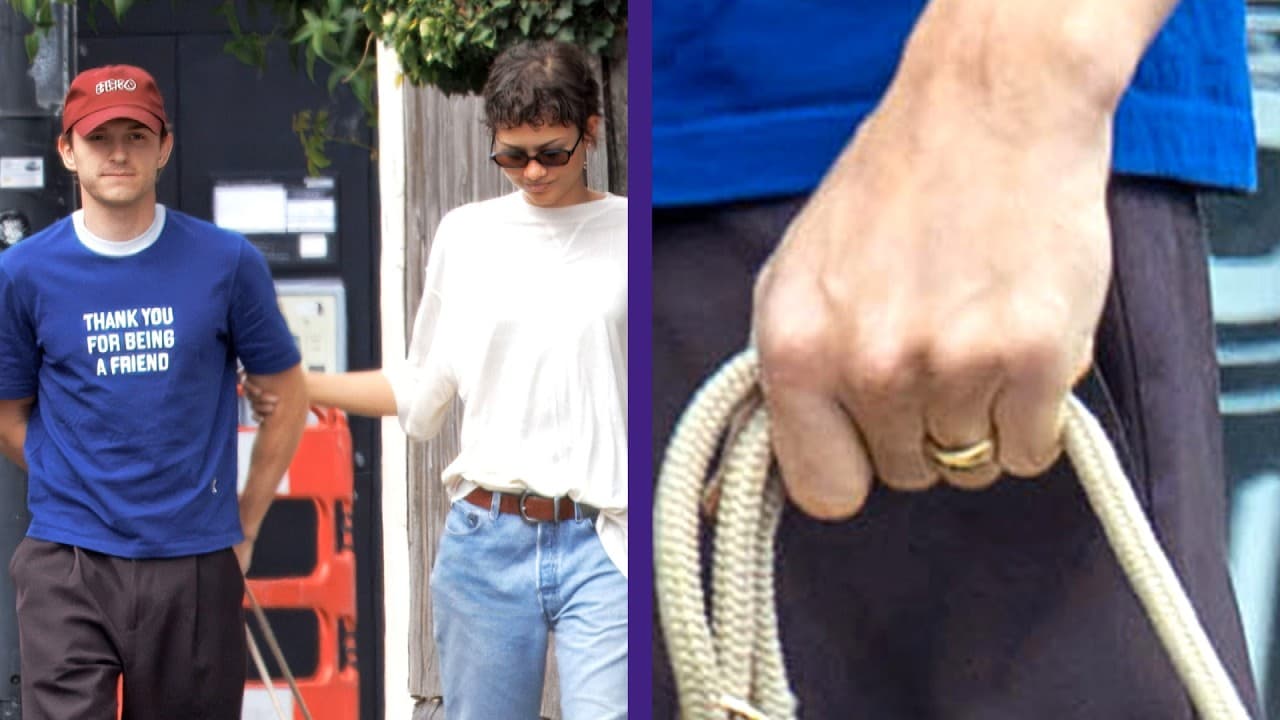
Thursday morning in London. Tom Holland, ball cap pulled low, pleated trousers, a new bulldog named Phil trotting at his side. Zendaya next to him in an oversized tee and jeans, nails still carrying the pale gloss of a bride. A casual coffee run, by all appearances. Except for the gold band sitting on his left hand. Worn in public, caught by cameras, and suddenly doing more communicative work than any press release could.
The ring confirms what Holland had already said aloud. He told reporters weeks ago that Zendaya was his wife. He acknowledged the wedding in June. But there is a meaningful difference between a verbal confirmation and a visible one, and the distance between those two things. Filled with Surrey countryside, a five-star country estate, and what a source told Entertainment Tonight was a security apparatus heavy enough to keep a 470-acre celebration essentially invisible to the public. Is where the real story lives.
This is a couple who just closed out what their camp has called a $2 billion summer at the box office. They are, by any measure, among the most commercially potent pairings in the entertainment industry right now. And yet the biggest personal event of their year was handled with the kind of operational secrecy that governments would envy. That is not accident. It is strategy. And it is worth unpacking what it costs, what it earns, and who is watching most carefully.
Where the reception happened and why Surrey matters
Tom Holland and Zendaya held their wedding reception on a Tuesday at the Beaverbrook Hotel, a five-star country estate in Surrey, England, approximately 20 minutes outside London and close to Holland's hometown.
The Beaverbrook is not an accidental choice. Set on 470 acres of Surrey countryside, it operates at the precise intersection of discretion and luxury that serious privacy strategy demands: grand enough to host a blowout celebration, remote enough that the perimeter is manageable. Surrey itself has long been the default for British celebrity events precisely because its estate geography. Sprawling grounds, separated cottages, gated approaches. Maps neatly onto the requirements of a security-heavy guest list — see Jordyn Woods and Karl-Anthony Towns Got Married. And the Guest List Told the Whole Story.
Entertainment Tonight obtained photographs of the venue and of what appeared to be a crew dismantling an outdoor dance floor in the hours after the party concluded. That detail lands differently once you register that Holland is currently training for a Fred Astaire biopic. The man has blisters on his toes from dance rehearsals, by his own account. The outdoor floor was presumably well-used.
Family members. Including Holland's three younger brothers, Sam, Harry, and Paddy. Stayed overnight in cottages across the estate. A source noted the brothers leaned into the wildflower theme the couple appears to have chosen, threading balloons through their buttonholes. It is a small, specific detail, but it matters to the wider read of the event: this was not a minimalist, low-key affair dressed up as private. It was a genuine celebration, elaborately staged, that simply chose to be invisible to the outside world.
How the couple has engineered a privacy-first public image
Tom Holland and Zendaya have consistently confirmed personal milestones only after the fact and in minimal terms, using controlled revelations rather than proactive announcements to manage public attention on their relationship.
The sequencing of information around this marriage has been intentional at every step. Zendaya debuted her ring publicly back in March. A visible signal that served as implicit confirmation of an engagement or marriage without requiring either party to issue a statement. Holland followed by verbally acknowledging the marriage weeks later. The gold band appearing on his hand during a coffee run in London on Thursday is the third data point in a chain that the couple controls entirely. Each release is calibrated, none is staged in the traditional sense, and the cumulative effect is that the public receives the story in fragments. Which keeps it alive far longer than a single announcement would.
Holland addressed the exhaustion of this approach with characteristic self-awareness, describing secret-keeping as 'absolutely exhausting' in footage that circulated this week. Zendaya's framing was more strategic: 'We want people to be surprised.' That line is doing heavy lifting. It reframes information control not as defensiveness but as a gift to the audience. An act of generosity toward the fan who still gets to feel the shock of discovery.
This architecture is not unique to them, but few couples at their level of commercial exposure have executed it this cleanly. The temptation at their stature is to monetize the announcement. The magazine cover, the coordinated exclusive, the timed reveal ahead of a press cycle. Holland and Zendaya have, at least so far, declined that transaction. The question worth asking is whether that restraint is permanent philosophy or a finite asset they are holding in reserve.
"Radical privacy, managed correctly, generates more coverage than a red-carpet announcement ever could."
What the $2 billion box office summer actually means for their use
Tom Holland and Zendaya's combined film projects generated approximately $2 billion at the global box office this summer, a performance that substantially increases both stars' individual negotiating power with studios for future projects.
The $2 billion figure, floated in coverage of their post-wedding week, is the kind of number that restructures conversations. Studios negotiate from data, and two stars whose shared cultural footprint can drive that kind of combined gross are not approaching their next contract discussions from the same position as they occupied five years ago. Holland built his commercial identity inside the Marvel machine; Zendaya has spent the past several years demonstrating that she can anchor franchise tentpoles. Dune, in particular. That don't depend on his presence at all.
That independence is significant. The risk for any high-profile couple in the entertainment industry is co-dependency of brand: the assumption, inside and outside the business, that they are a unit rather than two distinct careers. The $2 billion summer, if it holds up to scrutiny, suggests both are generating gravitational pull on their own terms. Their relationship amplifies the cultural conversation around them. It does not define their commercial value.
For a deeper read on how celebrity wealth builds up at this level of franchise exposure, the film wealth profiles across our coverage track the mechanics of how box office use translates. Or fails to translate. Into lasting financial architecture. Holland's trajectory through the Spider-Man cycle and into prestige biopics like the Fred Astaire project is a case study in that transition happening in real time.
The Fred Astaire biopic and what it signals about Holland's next career phase
Tom Holland is currently in physical training for a Fred Astaire biopic, a project that represents a intentional pivot from franchise superhero work toward prestige character study. A transition the biggest action stars typically attempt in their early-to-mid thirties.
The outdoor dance floor at the Surrey reception may double as rehearsal motivation, but the Astaire biopic represents something more built that way important for Holland's career. The Spider-Man run made him a global star. It did not, by itself, make him an actor with the kind of awards-season credibility that reshapes long-term earning power and creative control. The Astaire project is an attempt to close that gap.
Fred Astaire is also, as a subject, a technically demanding choice. The physicality required. Holland has already spoken about blisters from early dance work. Is extreme, and the performance will be assessed against a cultural memory that is unusually precise. Audiences have seen Astaire. They know the standard. That pressure is, from a career-management perspective, both the risk and the point: you do not choose Fred Astaire if you are playing it safe.
The timing, landing directly after the commercial validation of a $2 billion summer, is textbook. You spend franchise capital on prestige risk when the capital is at its highest. Holland's team appears to understand that the window for this kind of transition is specific and time-limited. The Astaire film is not a departure from his career strategy. It is the logical next move inside it.
Why Zendaya's cultural longevity extends well beyond any single franchise
Zendaya has built a multi-platform cultural identity spanning music, fashion, film, and television that insulates her commercial value against the boom-and-bust cycles that typically follow the end of a single franchise run.
There is a version of this story that centers Zendaya entirely as half of a celebrity couple. That version misreads her position in the industry. She has spent the past decade constructing a career architecture that is on purpose harder to categorize. And therefore harder to commodify. Than most stars at her level. Euphoria established her as a serious dramatic actor. The Dune films put her inside a franchise she does not have to carry alone. Her fashion presence is treated by the industry as a creative output in its own right, not merely celebrity endorsement.
Our earlier analysis of what Keke Palmer's longest-running joke reveals about cultural longevity touched on precisely this dynamic: Zendaya's name has become a byword for sustained relevance in a media environment that churns through celebrity narratives at a speed that destroys most careers within a decade. The mechanisms behind that longevity are worth examining here. She makes news when she chooses to. The ring debut in March, the coffee run this week. And goes quiet when the press cycle would otherwise flatten the story.
The marriage to Holland, and the manner in which it has been revealed, fits cleanly into that operating model. A coordinated magazine announcement would have handed control of the narrative to a third party. The current approach keeps the couple as the only authoritative source, which means every photograph of a coffee run and every glimpse of a gold band carries the weight of an official statement. That is not a small thing in the attention economy.
The security and logistics of a celebrity wedding done right
The Surrey reception employed heavy security, housed guests in on-site estate cottages to prevent information leaks, and was staged at a venue whose scale and remoteness made external observation effectively impossible.
Running a truly private event at this level of celebrity requires the same logistical thinking as a corporate product launch with a strict embargo. Except the stakes are personal rather than commercial, and the penalties for leaks are measured in tabloid covers rather than stock price. The Beaverbrook's 470-acre footprint gave the couple something most event venues cannot offer: genuine physical buffer. Guests sleeping on-site in cottages rather than dispersing to nearby hotels dramatically reduces the number of potential leak vectors. Every person who leaves the property is a potential photograph. Containing guests on site is not hospitality; it is information management.
The security presence, described by the ET source as heavy, is the other layer. Professional event security at a gathering of this visibility costs serious money. The kind of expenditure that most people would find difficult to justify for what is, functionally, a party. For Holland and Zendaya, it is closer to business infrastructure. Their privacy is not a personal preference; it is a brand asset. Protecting it has a calculable return.
The breakdown crew photographed dismantling the outdoor dance floor in the hours after the reception is, in retrospect, about the most revealing thing anyone outside the event managed to capture. It is a testament to how thoroughly the operation was locked down that the most newsworthy image is of folding chairs being loaded into a van.
What the strategic drip of information reveals about modern celebrity PR
Holland and Zendaya's approach. Verbal confirmation first, visible confirmation later, no formal announcement. Reflects a broader shift in high-level celebrity PR away from coordinated exclusive reveals and toward a model of managed organic discovery.
The entertainment publicity industry built its infrastructure around the coordinated exclusive: one outlet, one photograph, one moment of total control in exchange for a cover and a favorable framing. That model still exists, and it still pays. But a subset of A-list talent has discovered that withholding the exclusive and releasing information in fragmentary, seemingly uncontrolled moments generates more aggregate coverage. And crucially, more sympathetic coverage. Than the magazine deal ever could.
Radical privacy, managed correctly, generates more coverage than a red-carpet announcement ever could. The coffee run photograph is worth ten times a posed couple's shoot because it arrives unmediated. The audience believes it is seeing something real. That belief is the product. Whether the couple actually walked past that photographer by accident or by design is, commercially speaking, irrelevant. The effect is the same.
This dynamic has implications beyond Holland and Zendaya. As we've tracked in our latest reporting, the celebrities who have most successfully navigated the post-social-media attention landscape are largely those who understood that scarcity drives value. And that the most powerful form of scarcity, for a global star in 2026, is not a limited product run but a limited revelation. You can see a version of the opposite failure in talent who overexposed their personal crises in real time and found that the resulting coverage, however voluminous, ultimately eroded rather than built the brand.
The mechanics here also intersect with a broader point about how stars manage the invisible architecture of celebrity influence. The gap between visibility and actual use. Holland and Zendaya have, through this marriage rollout, demonstrated that the two are not the same thing.
Who profits from the coverage this generates
The primary commercial beneficiaries of the wedding coverage are the couple's studio partners and the Beaverbrook Hotel, whose profile as a luxury events venue has been substantially elevated by its association with one of Hollywood's highest-profile couples.
Let's follow the money, or at least where it goes. Entertainment outlets benefit from the story in the obvious way. Traffic, engagement, the reliable click-through of a celebrity marriage confirmation. But the secondary beneficiaries are more interesting. The Beaverbrook Hotel, a property that was already positioned in the upper tier of British country estate venues, has now been photographed and named in entertainment coverage reaching a global audience. That placement is worth considerably more in marketing terms than any paid campaign. Surrey as a luxury destination gets a quiet nudge in the same direction.
The studios behind Holland and Zendaya's summer releases benefit from the ongoing cultural conversation keeping both names prominent at a moment when the theatrical window is still open and streaming releases are imminent. There is no direct line from wedding coverage to ticket sales, but there is a diffuse halo effect. The couple is in the news, and the news reminds audiences that they have work in theaters.
The deepest long-term beneficiary, though, is the couple's own future negotiating position. Every piece of coverage like this week's. The ring, the coffee run, the Surrey cottages. Reinforces the public's emotional investment in them as a unit. That investment translates into opening weekend numbers, into streaming debut viewership, into the kind of guaranteed audience that allows agents to open conversations with studios from a position of strength. Their privacy strategy is not anti-commercial. It is, in the end, one of the most commercially sophisticated moves available to them. The full scope of their financial position relative to their peers in the industry will become clearer as the summer's box office totals are finally audited. But the structural bet they are making is already visible.