Maura Higgins, Mark Ballas, and the New Architecture of Reality TV Cross-Pollination
The Irish Love Island export and the veteran DWTS pro were handed the same casting brief: build a partnership on a show where trust is currency. What their pairing on Dancing with the Stars reveals about how reality franchises now feed each other, and who profits when they do.
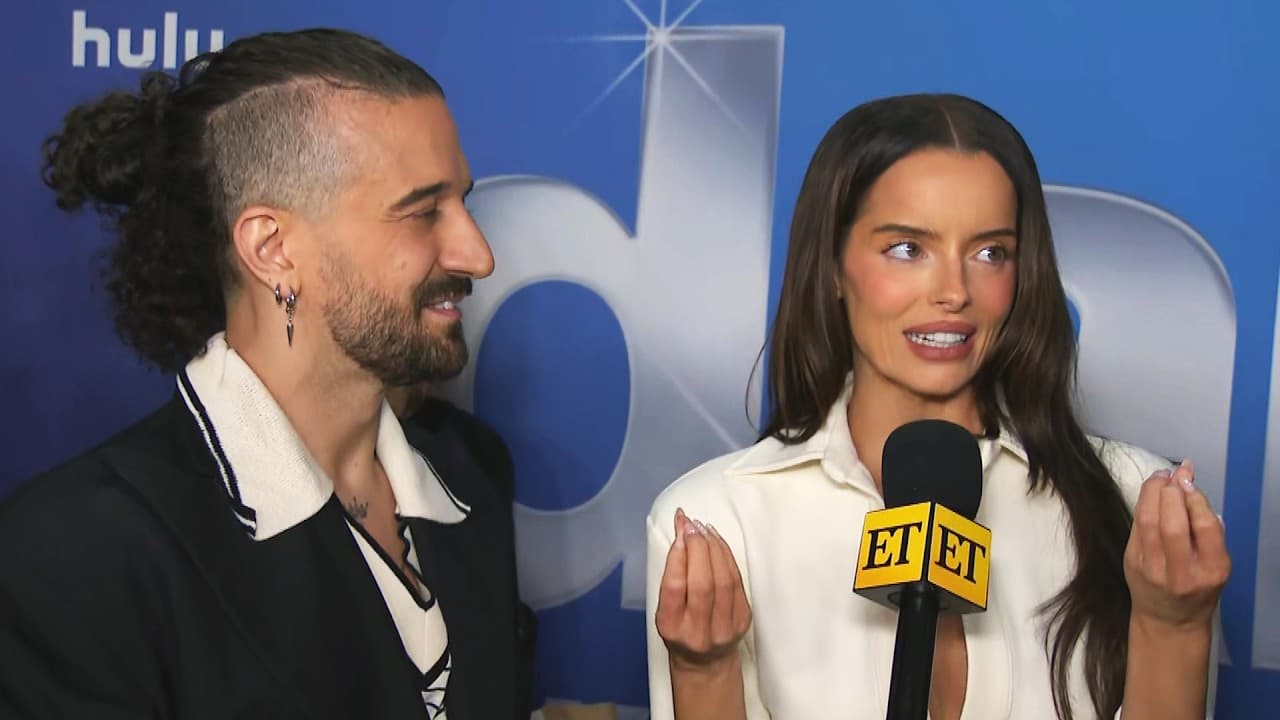
The word 'manifested' lands differently when the person saying it has spent the better part of a decade learning exactly how to say the right thing on camera. Maura Higgins used it this week in a sit-down with Entertainment Tonight, breezy, warm, the kind of line that reads as spontaneous but lands with surgical precision, to describe how she ended up partnered with Mark Ballas on Season 34 of Dancing with the Stars. She wanted him. She said so publicly. And then the casting gods, or the producers, or both, obliged.
That is not a small thing. DWTS partnerships are not random draws. They are constructed, negotiated, and stress-tested for narrative potential before a single camera rolls on the ballroom floor. When a contestant arrives having already named her desired partner to the press, and that partner materialises, you are watching not luck but alignment, between a celebrity's team, the show's producers, and the underlying logic of what makes good television.
The more interesting story, though, is not the pairing itself. It is what the pairing represents: a intentional cross-franchise stitch between two of the biggest reality formats on American and British television right now. Higgins and Ballas both passed through The Traitors US this year. Their DWTS partnership is, in commercial terms, a sequel that nobody had to greenlight separately. The audience already exists. The chemistry was already established on screen, however guarded, because on The Traitors, as Ballas pointed out this week, trusting someone is tactically stupid. Now they get to perform the trust they could never quite afford to show.
Why Maura Higgins Is on DWTS at All, The Career Calculus
Maura Higgins joined Dancing with the Stars Season 34 as part of a intentional pivot: the Love Island Ireland star has spent three years converting British reality fame into a viable American media presence, using competition formats as the primary vehicle.
Higgins became famous in the United Kingdom and Ireland through Love Island 2019, a season that produced several durable celebrity careers and at least one genuine cultural moment. She was not the winner. She has always been, in the technical language of the format, a fan favourite who departed before the finale, which is a different kind of fame, and in some ways a more flexible one. Winners are contractually and narratively tidied away. Fan favourites are free to iterate.
The iteration, for Higgins, has been methodical. UK brand partnerships, a Boohoo clothing line, tabloid relationships that kept her name in the gossip rotation, the standard infrastructure of a Love Island graduate who is serious about longevity. But the ceiling on that model, for someone whose ambition clearly runs transatlantic, is well understood. British reality celebrity does not travel automatically. The American market requires a separate proof of concept.
The Traitors US was that proof. It is one of the few formats genuinely capable of conferring legitimacy across both markets simultaneously, partly because the Peacock version draws on a cast of mixed British and American talent, and partly because the game itself demands a different register of performance than most reality television. You cannot be merely likeable on The Traitors. You have to be strategically interesting. Higgins, who is very good at being likeable, needed to demonstrate she could hold the screen in that more demanding mode. She did. DWTS is the reward, and the next rung.
The Traitors Effect: How One Format Is Now Casting Two Others
The Traitors US has functioned as an unofficial talent pipeline for DWTS Season 34 and other high-profile bookings, with at least two cast members from the same Traitors cycle landing visible reality platform slots within months of the show airing.
This is the part of the story the press release does not spell out but the booking sheet makes obvious. When Higgins told Entertainment Tonight this week that she and Ballas had barely spent time together during The Traitors, 'twice, maybe three times,' she offered, she was inadvertently describing the format's peculiar mechanics as a talent show. You do not need deep relationships to demonstrate screen presence. The Traitors strips away socialising and replaces it with high-stakes performance under pressure. Producers watching that footage see, essentially, an audition reel.
Ballas was explicit about how little the two actually connected during that shoot. The cameras, he noted, were always oriented around suspicion rather than connection. No downtime. No off-camera rapport-building. The relationship that a DWTS season requires, close physical proximity, extended trust, the willingness to be embarrassed in front of each other during rehearsal, is almost the photographic negative of what The Traitors demands. That gap is the show's real premise. The audience already has a rooting interest, and the transformation of guarded competitors into genuine collaborators is the dramatic arc built into the casting before week one.
From a production standpoint, this cross-pollination is efficient in ways that deserve serious attention. DWTS does not have to spend five weeks building audience investment in a celebrity contestant from scratch. If a meaningful slice of the viewership already watched that celebrity outmaneuver a table full of suspicious strangers over several weeks of The Traitors, the emotional shorthand is already in place. That pre-existing familiarity is worth something concrete, in ratings momentum, in social media engagement out of the gate, in the volume of press generated by the first week's rehearsal clip. The pairing of Higgins and Ballas is, among other things, a content asset that arrives pre-loaded.
"The 'manifestation' is not a throwaway quote. It is the season's emotional spine, and the show's casting department wrote it before Higgins ever said it aloud."
Mark Ballas's Position in the DWTS Ecosystem After a Decade as Pro
Mark Ballas, a two-time DWTS champion and longtime professional on the show, has cultivated a reputation for handling genuine beginners with both technical rigour and warmth, a positioning that makes him the natural assignment for a high-profile international celebrity with no dance background.
Ballas is not the flashiest assignment on the DWTS roster in terms of career-building opportunity, and he knows it. The pros on that show occupy a spectrum: some are paired with ringers or semi-professional movers and chased for competitive wins; others are paired with compelling personalities whose journey, the stumbles, the breakthroughs, the near-falls, is the product. Ballas has, over the years, become expert at the second category. His comment this week that Higgins is 'a true beginner' who has 'never danced before,' delivered with visible warmth rather than frustration, is a kind of professional signature.
His other significant relationship to emerge from this conversation is his history with Whitney, whose partner Connor is now competing in the same season. That triangulation, Ballas mentored or closely supported Connor throughout his own DWTS run, and now Connor dances with Whitney while Ballas dances with Higgins, is the kind of internal continuity that DWTS depends on for its long-form audience. People who have watched multiple seasons understand the web of relationships. They bring accumulated loyalty to each new cycle.
His reference to having 'pushed all his chips in on Kristen Kish' during The Traitors was also, in its own quiet way, a piece of brand management. He was performing the same lesson he now teaches in the ballroom: to succeed in any high-stakes collaborative environment, you choose your alliance carefully and commit to it. He is saying, in effect, that his decision-making architecture is consistent across contexts. That consistency is what turns a reality TV veteran into something closer to a recognisable character, and recognisable characters drive tune-in — see The 78th Emmys Belonged to Widow's Bay, and the Woman Who Dared to Host.
The Traitors Debrief Inside DWTS: Why Easter Eggs Are a Calculated Move
Producers and the celebrity-pro pair have confirmed that Easter eggs referencing The Traitors are embedded in their Season 34 debut performance, a strategy that turns one franchise's audience into a conversion funnel for another, with minimal additional spend.
When Higgins confirmed that Traitors fans would find Easter eggs 'in the first one, out the gate,' she was not just being playful. She was describing a specific content strategy that reality television has refined over the past several years: the intertextual callback that rewards loyal viewers and gives entertainment press a peg for a second wave of coverage. The clip of the dance becomes the story for one outlet; the Easter egg hunt becomes the story for a second; the TikTok breakdown of every hidden detail becomes the story for a third. One performance generates three distinct content cycles, each reaching a slightly different corner of the audience.
This is not accidental. The decision about whether and how to embed those references will have involved conversations between Higgins's team and the DWTS production. It serves the show's promotional interests, the Traitors fan demographic skews toward exactly the engaged, streaming-native viewer that Disney's ABC broadcast needs to demonstrate it can still capture. And it serves Higgins's interests by positioning her not as a UK import who requires context-setting, but as someone with a shared history with the American viewer who already spent weeks watching her on Peacock.
The deeper point is about how modern celebrity image management treats each platform appearance as a node in a larger network rather than a standalone event. Higgins is not simply 'doing DWTS.' She is running a linked campaign across at least three distinct audience pools: Love Island viewers who have followed her for years, Traitors fans who are newly invested, and DWTS's core audience who will meet her fresh. The Easter eggs are the suture between the first two groups and the third. For more on how reality formats build these cross-platform audience bridges, our latest reporting tracks the pattern across several 2026 bookings.
What the 'Manifestation' Narrative Does for Higgins's Personal Brand
By framing her DWTS partnership as something she willed into existence, Maura Higgins positions herself as the agent of her own career trajectory, a narrative that is commercially valuable because it suggests intentionality, and personally resonant because her audience is accustomed to rooting for her to get what she wants.
The manifestation story is worth unpacking carefully, because it operates on several registers at once. At the most literal level, Higgins said publicly that she wanted to be paired with Ballas, and then she was. That is a fact. But the word 'manifested' does specific cultural work that 'requested' or 'lobbied for' would not. It places the outcome in a framework of intention and positive energy rather than negotiation and use. That distinction is important for an audience that follows her in part because she models a kind of aspirational confidence.
It also, crucially, positions the relationship between Higgins and the show as collaborative rather than contractual. She is not a product being packaged. She is a person who dreamed something and watched it come true — see Kamri Peterson's DWTS Moment Is Bigger Than a Dream Come True. That is a much more compelling story to tell across nineteen weeks of competition television, and the entertainment press already knows how to tell it. Every good rehearsal clip will carry this origin. Every breakthrough moment on the dance floor will reference it. The 'manifestation' is not a throwaway quote. It is the season's emotional spine for her story arc.
There is a business logic underneath the sentiment, too. Higgins's core audience, young, majority female, accustomed to following her personal life as a semi-serialised narrative across social platforms, responds well to the idea that she is finally getting what she deserves. The relationship arc, the career breakthrough, the right partnership: these are recurring motifs in the story her audience has been watching since 2019. DWTS is, for that audience, another chapter in an ongoing story. The manifestation framing stitches the new chapter to all the ones before it.
The Connor-Whitney Side Plot and Why DWTS Keeps Its Extended Family Close
Connor, the partner of Ballas's former celebrity contestant Whitney, is competing in the same DWTS season, a casting decision that deepens the show's internal mythology and gives longtime viewers a secondary emotional investment beyond the primary pairings.
The detail about Connor competing with Whitney this season, while Ballas takes on Higgins, is easy to read as gossip-column texture and easy to undervalue as a result. It is neither. DWTS has always understood that its most devoted audience does not watch for the competition. It watches for the relationships, between pros, between celebrity contestants, between the two, and across multiple seasons. When Ballas said this week that Connor 'was front row in costume every week' during his own season and 'nine times out of ten was the camera man' for their TikTok content, he was describing an emotional investment that the audience shared.
Casting Connor with Whitney in the same season as Ballas-Higgins creates a relational lattice that gives longtime viewers something to track beyond the scoreboard. The pros are connected. The celebrity contestants orbit the same professional and personal circles. The show is, in this sense, a continuing serial whose cast rotates but whose emotional continuity accumulates. That is a fundamentally different product from a singing competition where each season's contestants vanish entirely at the end. The DWTS infrastructure persists, and the casting department tends it deliberately.
For the talent involved, proximity to that infrastructure has career value. Being spoken of warmly by Ballas, 'a sweetheart, a good guy,' 'a dear friend', on a widely distributed Entertainment Tonight clip is not nothing. It is the kind of endorsement that travels through the reality TV community and signals a certain quality of person to future casting directors, brand partners, and event bookers. The extended family framing is, among other things, a mutual PR system.
Where Higgins Sits in the Broader Market for International Reality Talent
Maura Higgins occupies a specific and increasingly competitive niche: the British-Irish reality television export who has built enough transatlantic recognition to command US bookings without yet becoming fully domesticated within the American celebrity economy.
This is a precarious position, and it is worth being honest about what it requires to hold. The American television market has genuine appetite for British and Irish reality talent, the accents travel, the presenting style tends to read as slightly more self-aware than domestic equivalents, and the talent arrives with a pre-existing international fan base that adds to rather than substituting for the domestic audience. But American audiences also have a tolerance threshold for celebrity contestants who require too much contextualisation. The booking has to carry its own introduction.
Higgins has, through The Traitors, largely solved that problem. She does not need a lengthy explainer segment before her first DWTS performance — see Sandra Bullock's Comeback Is Quieter Than Her First Act, and Smarter. The Peacock viewership that followed her through The Traitors provides the proof of concept: American audiences found her compelling enough to watch across a multi-week competition in an unfamiliar format. That is the prerequisite for a DWTS slot with genuine commercial upside rather than novelty-act energy.
The comparable career trajectory, though none is perfectly analogous, runs through figures like Mel B and Naomi Campbell, who arrived in American markets with enough international mythology to command serious bookings without full domestication. Higgins is operating at a different scale, in a different era of fragmented media, but the underlying logic is the same: she needs to convert awareness into affection before the novelty premium expires. DWTS, with its sustained weekly exposure and its built-in emotional arc, is close to the ideal vehicle for that conversion. You can follow Higgins's net worth trajectory as her US profile builds on our Atlas alongside other reality television personalities we track across the other wealth profiles.
What makes this season a genuine inflection point rather than just another booking is the convergence of timing and casting. She has the right partner, the right cross-promotional asset in The Traitors, and a show that rewards exactly the qualities, warmth, self-deprecating humour, willingness to be genuinely bad at something on camera, that define her appeal. The question is whether the DWTS audience, which skews older than either Love Island or The Traitors demographics, finds those qualities as compelling as the audiences that already know her. Week one will answer part of that question. The Easter eggs will help.
Who Actually Profits: The Business Architecture Behind the Pairing
The primary commercial beneficiaries of the Higgins-Ballas DWTS pairing are the show's producers, who gain cross-franchise promotional value at no additional cost, and Higgins herself, who gains prolonged US prime-time exposure, the single resource her career most needs right now.
It is worth being clinical about the incentive structure, because the 'manifestation' narrative tends to obscure it. DWTS's producers are not in the business of granting wishes. They are in the business of building a show that generates advertising revenue, streaming subscribers, and press coverage for twenty-plus weeks. The Higgins-Ballas pairing serves all three objectives simultaneously, and it does so in part because of the groundwork laid by The Traitors. That is a business decision dressed in a fairy tale.
Ballas profits in a more subtle way. His reputation within the show's ecosystem, as the pro who can handle beginners with grace, who generates good press, whose partnerships become stories rather than just results, is burnished by every season that goes well. The Higgins booking is consistent with a strategic positioning that suits a veteran professional who is no longer in the phase of his career where a competitive win is the primary goal. Narrative wins matter more at that stage, and this pairing is built for narrative.
The broader winner, if the season delivers, is the model itself: the idea that reality television franchises can function as a loose confederation of talent pipelines, with each show's alumni serving as pre-qualified candidates for the next. That model reduces casting risk, reduces the promotional spend required to introduce new personalities to the audience, and deepens the loyalty of a certain engaged viewership that follows the talent across formats. It is the same logic that governs the relationship between prestige drama and streaming casting in the scripted world, applied to the unscripted economy. When it works, which it increasingly does, everyone in the pipeline profits. The audience included, which is perhaps why the word 'manifested' lands so cleanly. The system is designed to make it feel like fate.