Keri Russell and Matthew Rhys Know Exactly What They're Doing
A Variety couples quiz looks like a lark. Look closer and it's a masterclass in how two Emmy-nominated actors manage shared celebrity without letting the machinery eat them alive.
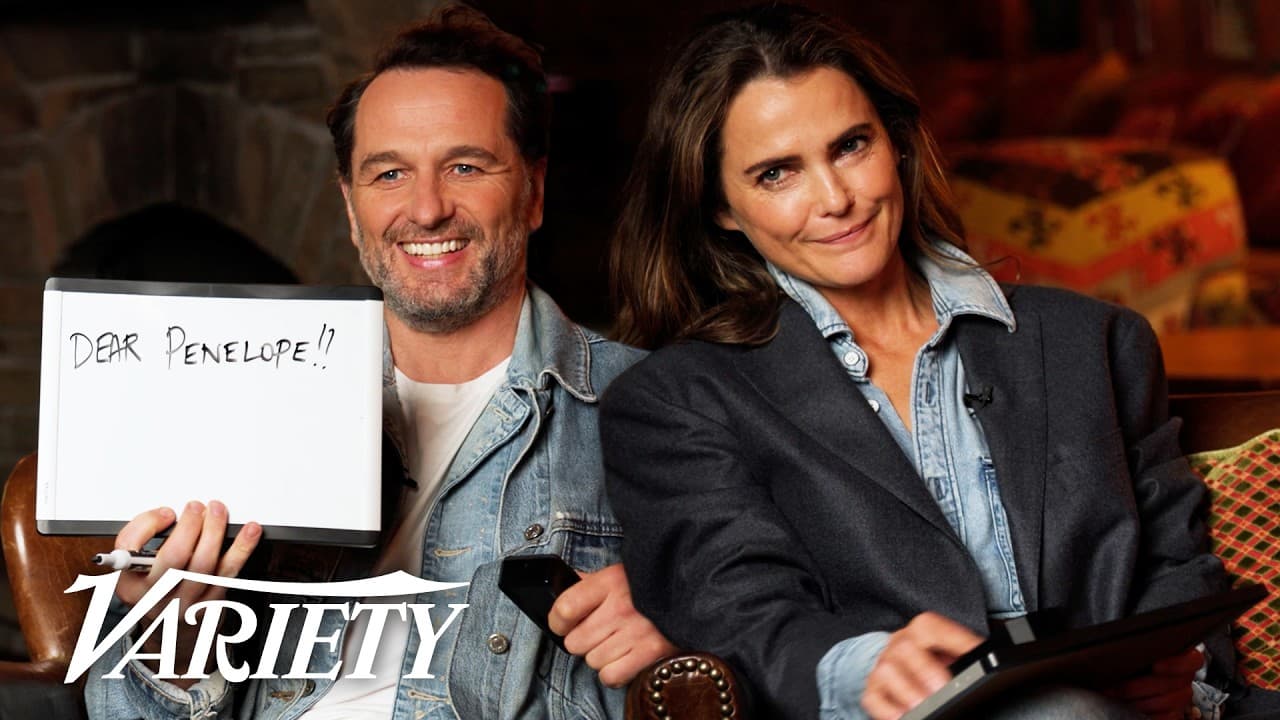
The nomination call came on a day Keri Russell had already planned as a date. She'd booked the art spaces, sourced a bar cool enough that she needed someone to pull strings to get them in, and timed the whole thing so they arrived at 5:30, right when the doors opened. What Matthew Rhys, deadpan as ever, called arriving 'like good Parisians.' The Emmy news landed somewhere in the middle of all that, almost incidental. Which is, of course, the point.
That detail. The date planned first, the nominations a coincidence. Is the most revealing thing either of them said across the entire Variety sit-down this week. In a business where double nominations are typically staged as synchronized press moments, coordinated to the hour with publicists on three-way calls, Russell and Rhys managed to collect the news in a bar they almost couldn't get into. The image works because it's probably true. And because they know, with the precision of two people who have spent a decade and a half building careers in public, that the image working is exactly the point.
Fame is a material to be shaped. Russell and Rhys shape theirs with unusual care. Guarded where most couples perform, warm where most co-stars stay professional. The Variety quiz format, which pairs celebrity chemistry against a scorecard of trivia, is the kind of soft press most A-list names do on autopilot. These two used it to say something real about how they actually run their lives. That is worth unpacking.
Why the Variety Quiz Format Rewards Stars Who Know Themselves
The Variety couples-quiz format strips away talking points and forces genuine reaction. Stars who know themselves well come across as authentic, while those who rely on PR polish get exposed. Russell and Rhys thrived because they arrived with real answers, not rehearsed ones.
Variety's 'How Well Do You Know Each Other' format is, built that way, a stress test. The questions are light. Favorite films, Emmy counts, childhood trivia. But the format penalizes the unprepared. Two people who have practiced a unified press persona will sync too neatly, landing in uncanny-valley territory where every answer feels like a joint statement. Two people who have no idea what the other thinks will fumble in ways an audience reads as distance. The sweet spot, the one Russell and Rhys hit across the whole video, is confident disagreement followed by genuine delight.
When they diverged. On episode counts for The Americans, on Emmy tallies, on the exact wording of Felicity's tape-diary address. Neither flinched. Russell laughed. Rhys raised an eyebrow. The effect was two people who are comfortable enough in their own accounts of events that they don't need to harmonize. That reads as intimacy. It also reads, for an audience tracking a shared career, as independence. Each of them has their own mind. They just happen to be in the same room.
The quiz also gave both a chance to demonstrate the thing that makes them genuinely good at long-form television: they pay attention. When the conversation turned to Welsh dialects. Rhys walking through the Cardiff vowel shift, Russell picking it up and running with a comparison to American regional accents. It wasn't a celebrity proving a fun fact. It was two people who think carefully about language and accent because their work requires it. The camera stays on. So do they.
The Americans Gave Them 75 Episodes and One Very Useful Exit
Russell and Rhys shot 75 episodes of The Americans across six seasons, a run long enough to cement both as prestige-drama leads. The show's conclusion gave each of them a clean platform from which to build distinct solo careers rather than being trapped as a matched pair.
Seventy-five episodes. Neither of them got there on instinct. Rhys guessed 78, Russell was in the same neighborhood, and both worked backward through seasons-times-episodes math with the kind of casual confidence that actually signals the number never mattered much to them while they were making it. That is the tell of a long run done right: when the actors stop counting, they're inside the work.
The Americans, which ran on FX from 2013 through 2018, was the kind of show that doesn't happen twice for most people. Soviet spies hiding in a Washington suburb, married cover identities that paralleled real intimacy. The show's central metaphor was performance within performance, which for two actors who would eventually become a real couple added a layer that critics spent years trying to articulate. What it gave them practically was something equally valuable: prestige-drama authority without franchise dependency. No cape, no sequel, no IP chain.
The show ended on its own terms. That mattered. For film and television careers built on character drama rather than blockbuster IP, the exit is as important as the entry. A show that gets cancelled leaves actors fielding questions about what went wrong. A show that ends cleanly, on a note that critics and audiences remember. Which The Americans did. Leaves them with a body of work that accrues value rather than depreciates. Both Russell and Rhys stepped off that platform into a market that knew exactly what they could do.
"The date was planned first. The nominations were a coincidence. In this business, that is the whole story."
How Keri Russell Turned The Diplomat Into an Emmy Machine
Keri Russell has earned at least eight Emmy nominations across her career, with multiple nods for The Diplomat on Netflix, turning a post-Americans streaming bet into one of the defining prestige roles of her mid-career. The show made her a streaming-era lead at a moment when that distinction carries real market weight.
Eight nominations, by Rhys's tally. Cross-checked mid-quiz, argued about briefly, then settled. For Felicity, which launched Russell in the late 1990s as a broadcast ingenue, there was at least a Globe. For The Americans, three more. For The Diplomat, the count is still building, because the Netflix political thriller has become one of the more durable awards-conversation titles in recent memory.
The career math is clean. Russell spent her twenties as a broadcast star, her thirties and forties as a prestige-cable one, and is now, in her late forties, running the center of a major Netflix drama with the kind of authority that gets described as 'finally getting her due'. Which is industry shorthand for the recognition catching up to the work. The Diplomat gave her a character she plays, by her own account, as if the character already knows she's the most important person in every room. It's working.
Russell joined the Mickey Mouse Club at an age she and Rhys turned into a running joke. He guessed 22, she was younger, and the fellow auditionees included names that now fill their own Wikipedia disambiguation pages: Britney Spears, Christina Aguilera, Justin Timberlake, Ryan Gosling. She did not get the part. She was, by her own description, not one of the talented kids in that room. The gap between that rejection and eight Emmy nominations is the actual story of her career, and it's one she's comfortable enough to tell straight, without retrofitting it into destiny.
Matthew Rhys's Career Strategy: Say Yes to the Swing
Matthew Rhys has pursued an approach of taking on projects that feel like genuine creative risks. Including a recent film he described as 'a big swing'. Rather than optimizing for commercial safety. His Emmy nomination count sits around six, reflecting consistent recognition across serious dramatic work.
Rhys's own account of how he picks projects is the most honest thing said in the video. 'Cash,' he offered, straight-faced. 'Cash basis. Like what pays most wins. Very simple. Three children and a mortgage.' The room laughed. Then he immediately walked it back toward the truth: the script for his most recent project, directed by Hiro Murai, was unlike anything he'd read, and he wanted it badly. The joke was armor. The desire was real.
This is a pattern worth noting in how Rhys handles his own image. He deflects with self-deprecation, then reveals genuine enthusiasm through the deflection. Russell is his translator: she told the story of how he came home from that project. A man who typically says 'it was fine' about everything. And she could tell he'd loved it. That asymmetry between his stated indifference and his actual investment is, in a way, his brand. The Cardiff-boy-who-doesn't-make-a-fuss posture has served him across three decades of work in a business that usually rewards louder self-promotion.
Six Emmy nominations, by the quiz's accounting. All of them earned in American television, for a Welsh actor who broke through in Welsh-language and British productions before The Americans changed his market position entirely. The trajectory matters for understanding the economics. Rhys came into the American prestige-TV market without the name-recognition premium that protects younger stars from failure. He built his standing on a single show, then had to convert it into a solo career. The Murai project. Discussed obliquely but with real feeling. Suggests the conversion is going well.
What the Wild Mustang Story Actually Reveals About Rhys
Matthew Rhys bought two wild mustangs through a U.S. Prison rehabilitation program, then hired a horse psychic via Zoom when one proved difficult. Ultimately changing his hat color and switching from Welsh to English to calm the animal.
The horse psychic is the best story in the video. Not because it's funny. It is. But because of the internal logic Rhys applied to trusting her. His source was a rodeo cowboy, he explained. 'So I thought he must be legit.' The psychic, operating from Britain via Zoom, told him the wild mustang was spooked by his white cowboy hat: it reminded the horse of the men who'd done the roundup. So Rhys changed hats. Switched languages. Eventually started riding in sweatpants. The horse came around.
The mustangs came from a prison system rehabilitation program. There are about five U.S. Prisons that run them, he noted. Which is itself a detail that tells you something. This wasn't a vanity purchase of a thoroughbred. It was a commitment to an animal with a specific, complicated history, acquired through a system designed around second chances. One of the mustangs has since died; the other lives with a friend in Malibu and is, Rhys says, having the time of its life.
Russell's footnote to the whole story was that the 'difficult' horse gave her no trouble at all when she rode it — see Jordyn Woods and Karl-Anthony Towns Got Married. And the Guest List Told the Whole Story. She delivered this quietly, without emphasis, which made it land harder than if she'd made a production of it. This is also her general mode. She doesn't push. She just states the thing that is true and lets the air do the work.
The Emmy Double Nomination and What It Does to Their Market Position
Both Russell and Rhys receiving Emmy nominations in the same cycle. In different categories and for different projects. Significantly raises the commercial value of each as a solo lead, since the recognition is demonstrably independent rather than a shared halo effect from one acclaimed show.
The day they found out was, by both accounts, a good one. And for good reason: simultaneous nominations from separate projects are a different category of recognition than two leads from the same show receiving simultaneous nods, which is common enough to be almost expected. Russell is nominated for The Diplomat. Rhys for his own project. Different shows, different networks, different creative teams. The Academy is, in effect, certifying each of them twice.
That separation has direct market consequences. A streaming platform or studio negotiating with either of them now has to reckon with an actor whose most recent Emmy recognition is entirely their own. Not a tidal effect from a shared hit. Salaries get anchored to individual marketability. That anchor just moved up.
There's also the competitive angle they handled with characteristic directness: 'Now we don't have to hate each other,' Russell said. 'For now,' Rhys added. The joke acknowledges something real. Awards cycles inside a relationship are genuinely strange territory. Both hoping the other wins while both hoping they win more. They made it a punchline, which is the only dignified way through it. For two actors who have built careers on playing people who say one thing while meaning another, the joke might be the most honest moment in the whole video.
For a longer look at where prestige-drama talent sits in the broader landscape of celebrity wealth and earning power, our latest reporting tracks how the streaming era has reshuffled the income ceiling for actors who built their names in cable. The Russell-Rhys trajectory. From FX to Netflix, from cult prestige to mainstream recognition. Is one of the cleaner examples of that shift playing out in real time.
What the Mickey Mouse Club Audition Story Says About Where Both Stars Started
Keri Russell auditioned for the Mickey Mouse Club as a child alongside eventual stars including Britney Spears, Christina Aguilera, Justin Timberlake, and Ryan Gosling, and was not selected. She recounts this without bitterness, which is itself a marker of how secure her current standing is.
She called herself 'not one of the talented kids.' Then, almost as an aside, rattled off the names of the children who were selected: Spears, Aguilera, Timberlake, Gosling. Sutton Foster, too. She'd started to name her and Rhys jumped in with a wrong guess, and Russell corrected him, and the sidebar on Foster's Broadway career opened and closed in about thirty seconds. The point was made without being labored: the room she didn't make it into produced an extraordinary number of significant careers.
That fact, worn as lightly as she wore it, is a useful frame for understanding how Russell reads her own trajectory. She did not get the early platform. She found Felicity instead, a different kind of young-woman-finding-herself story, on a different network, and built from there. The absence of the Mickey Mouse Club shaped her career as much as its presence shaped Spears's or Timberlake's. It pushed her toward a different register, a different kind of audience, a different sense of what she was for.
Rhys has no equivalent childhood-fame story. He came up through Welsh theater and television, moved into British productions, and arrived in American prestige TV as a fully formed adult actor rather than a former child star repositioning. This difference in origin. Child-star-who-wasn't versus theater-trained late arrival. May be part of why they read so differently on screen and handle fame so differently in public. Neither came in through the standard door. Both found their own way through.
The Honest Career Lesson Buried in the Joke About Watching Survival TV Alone
Rhys's admission that he watches survival and wilderness television alone. Because no one else will join him. Is a small but telling detail about how seriously he takes the study of physical capability and self-sufficiency, a sensibility that tracks directly with the kinds of morally complex, physically demanding roles he…
He watches shows about people who don't wear makeup for a living. His words, delivered at his own expense, with full awareness that he does wear makeup for a living. He described the appeal in terms of process: people who can cut down things, build shelters, process animals, handle terrain. Then he added, almost as a confession, 'I played a hunter once. I like to talk about it. It's stupid.'
This kind of studied self-awareness about what you're drawn to and why is not nothing. Actors who understand their own appetites. For certain kinds of stories, certain kinds of physical worlds, certain kinds of moral weight. Tend to make better choices than those who follow market signals. Rhys's obvious pull toward toughness-under-pressure narratives, refracted through the safe distance of a survival-TV screen, maps onto a career full of characters who are competent, careful, and emotionally contained. He's not watching those shows by accident.
Russell, per his account, has impeccable taste in the 'road less traveled' direction. Films that are hard to find, that she arrives home excited about, that he initially doubts and then comes around on. Except for one film she watches most often, which is a straight romantic comedy she loves precisely because the ending is actually good. She didn't name it. The specificity of her defense. 'the music is fun, the comedy is good, I like that it's a straightforward romantic comedy but the end is actually good'. Was more interesting than the title would have been anyway. She knows what she likes. So does he. They just like different things. That, more than any Emmy count or quiz score, is the real measure of two careers that have stayed alive this long.
For more on how long-game career management plays out across the industry. And what it looks like when actors make the calculus visible. Our analysis of John Goodman's sustained presence and the quieter strategic moves of Aubrey Plaza and Christopher Abbott offer useful comparisons in how performers at different stages handle the gap between public image and private life. The gap, as Russell and Rhys demonstrated in a bar they barely got into at 5:30 on a Wednesday, is where the real work happens.