John Goodman at 74: What a Grocery-Store Snapshot Tells Us About the Long Game
A candid Instagram photo of a visibly transformed Goodman reignited a conversation that has followed him for two decades. The real story is what sobriety, discipline, and a refusal to disappear did for one of television's most durable careers.
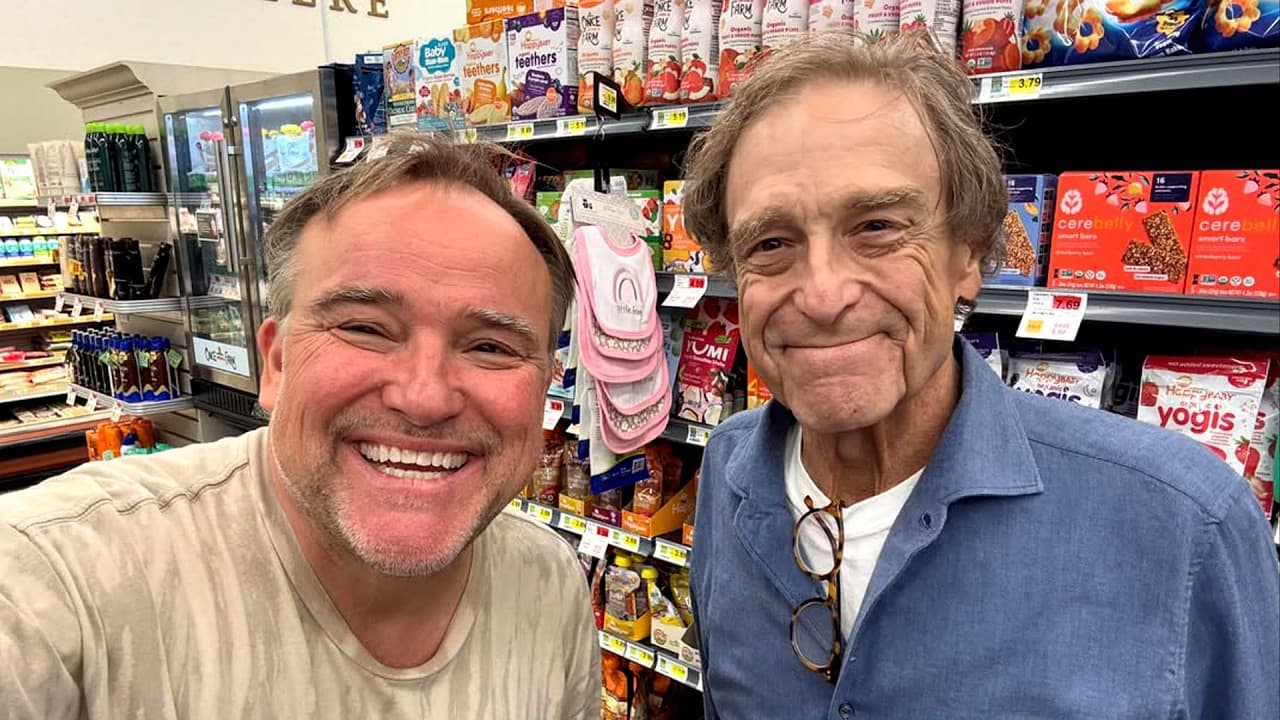
The photograph did not come from a publicist. There was no red carpet, no carefully lit press junket, no stylist hovering at the frame's edge. It came from David Deloies. A young actor best known from the Wizards of Waverly Place reboot. Who ran into John Goodman in a grocery store and posted the snap to Instagram because, plainly, he could not believe what he was seeing. Neither could the internet.
Fans called Goodman 'nearly unrecognizable.' That word. Unrecognizable. Is worth sitting with, because John Goodman has spent the better part of fifty years being one of the most recognizable character presences in American film and television. The Roseanne patriarch. Walter Sobchak. Dan Conner, again, on The Conners. A man whose physical enormity was for a long time treated as inseparable from his persona, his comic timing, his sheer gravitational pull on screen. To be unrecognizable, in his case, is not a loss of identity. It is the latest chapter in a very intentional rewrite.
The moment that told Entertainment Tonight everything it needed to know came when Goodman was asked, simply, what the key to thriving looks like at 74. He laughed, deflected, and said he just tries to put one foot in front of the other and not trip. It sounds like a brush-off. It is actually a precise description of how he has navigated the last two decades. One quiet, grinding, undramatic step at a time.
What John Goodman's weight loss actually involved
John Goodman has lost more than 200 pounds over approximately two decades, a process he has described as gradual and rooted primarily in quitting alcohol in 2007, cutting compulsive eating habits, and adding consistent exercise as he aged.
The headline number. More than 200 pounds over roughly twenty years — see Why That House M.D. Airplane Scene Still Lands Twenty Years Later. Is the kind of figure that sounds almost too large to be real. But Goodman himself, speaking to ABC News as far back as 2016, was disarmingly specific about the mechanics. There was no surgical intervention he has publicly disclosed, no single dramatic intervention. What he described was the slow, unglamorous work of adjusting behavior: stopping what he called 'eating alcoholically,' meaning the compulsive, unconscious shoveling of food that mirrored the logic of his drinking.
Sobriety, which he has traced to 2007, was the structural change that made everything else possible. Goodman has said plainly that alcohol was the motivation, the thing that got him ready to make a real change. Drink and compulsive eating were entangled for him. One fed the other in a cycle that, by his own account, had been running since long before he was famous. Breaking one thread pulled at the whole knot.
What followed was methodical rather than dramatic. Exercise, introduced gradually. A rule about not eating mindlessly. His description of having 'a handful of food go to my mouth' at any free moment is one of the more honest accounts of disordered eating you will hear from a public figure. And crucially, he has consistently refused to package any of this as advice. 'It's different for everybody,' he told interviewers. 'It's tough.' That refusal to evangelize is itself notable in a media environment that treats every celebrity body transformation as a prescription.
Why 2007 sobriety was the hinge point of Goodman's later career
Goodman's decision to stop drinking in 2007 preceded the most sustained and critically recognized stretch of his later career, including his return to prestige television and continued high-profile film work. Suggesting sobriety was as much a professional recalibration as a personal one.
It is worth mapping the timeline carefully, because the professional data tracks closely with the personal turning point. Goodman got sober in 2007. The years that followed brought a quietly remarkable run: 10 Cloverfield Lane, the Coen Brothers' continued affection for him, The Righteous Gemstones, his return to The Conners. None of these were coasting-on-reputation gigs. They were roles that required him to show up fully. Physically, emotionally, with the kind of presence you cannot fake when you are not well.
Hollywood has a complicated relationship with actors who struggle with substance abuse. The industry is simultaneously tolerant of dysfunction when it produces marketable chaos and brutally indifferent when that chaos curdles into unreliability. Goodman, for most of his career, managed to remain on the right side of that line. But those closest to his work in the 1990s and early 2000s have noted, in various forums over the years, that there were periods of real uncertainty. The 2007 pivot changed the actuarial calculation that casting directors and producers make, consciously or not, about whether a 60-something actor is a safe bet.
There is also the energy question, which Goodman himself raised in his 2016 ABC interview. He said directly that he exercises because he can no longer afford to sit still. That work is draining and physical health gives him the fuel to meet its demands. For a character actor working in prestige television, where shooting schedules are brutal and the creative bar has never been higher, that is not a philosophical point. It is a practical one. Staying healthy was, at least in part, a career decision.
"The grocery-store photo is the perfect expression of this: it was not staged, not released through a publicist. And that is exactly why money cannot buy it."
The economics of durability: what staying on The Conners is actually worth
Long-running network television, even in the streaming era, remains one of the most financially reliable income streams an actor can hold. Residuals, consistent fees, and the profile maintenance that comes from tens of millions of weekly viewers make a show like The Conners a significant economic anchor.
The Conners is not a prestige cable drama. It does not generate the kind of awards-season conversation that lands on magazine covers. But it does something that prestige cable rarely does: it delivers a massive, consistent, demographically broad audience week after week, on a broadcast network, in a time slot that advertisers pay real money to occupy. For an actor of Goodman's vintage, that consistency is worth more than almost any single film fee.
The original Roseanne reboot, before its 2018 implosion, was drawing audiences that most broadcast networks had stopped expecting. The Conners, reconstituted after Roseanne Barr's exit, has held a meaningful share of that audience. Goodman's Dan Conner is its moral and emotional center. The character around whom the family's coherence is organized. That is not a replaceable role. His use, as a result, is structural rather than merely reputational.
Residuals from decades of Roseanne episodes, combined with ongoing Conners fees and whatever film work he selects, put Goodman in the category of actors whose income is genuinely diversified across time. Past work paying forward while current work adds to the pile. For a deeper look at how wealth accrues in the film and television world, our film wealth profiles track the mechanics across a range of careers. The broader point is that Goodman's health transformation directly protects an income stream that depends on him being present, reliable, and capable of the physical and emotional demands of weekly television production.
Why the celebrity health-transformation genre usually fails. And why Goodman sidesteps it
Most celebrity weight-loss narratives are monetized through book deals, supplement partnerships, or fitness-brand endorsements, creating a structural incentive to overstate the simplicity of the change. Goodman has consistently resisted that framework, framing his transformation as private, slow, and non-transferable.
The celebrity health-transformation industrial complex is well-established and, by now, reasonably well-understood by the people it targets. An actor loses significant weight; within months there is a book proposal, a partnership with a meal-delivery company, an appearance at a wellness summit. The transformation becomes a product. The person becomes a brand. The actual experience. The shame, the relapse, the daily negotiation. Gets smoothed into a narrative arc with a tidy three-step framework attached.
Goodman has, notably, not done any of this. His comments over the years have been the opposite of marketable. He says he does not have advice because it is different for everybody. He describes his eating in terms that are uncomfortable rather than aspirational. The image of a hand moving compulsively to a mouth is not the language of a wellness influencer. He credits stopping drinking as the central move, which is not a message that sells protein powder. The whole texture of how he talks about his health is resistant to monetization.
That resistance has a cost. There is genuine money left on the table. But it also has a reputational payoff that is harder to quantify. Audiences and critics respond to Goodman with a warmth that goes beyond professional respect. Part of that is talent. Part of it is decades of consistent work. But part of it, increasingly, is the sense that he is not performing his life for commercial gain. In an era when celebrity authenticity is itself a product category. A point our recent piece on Perez Hilton's reckoning examined from a very different angle. Genuine refusal to perform reads as a kind of integrity.
The grocery-store photo is the perfect expression of this. It was not staged. It was not released through his publicist. It happened because a younger actor ran into him in the produce aisle and was moved enough to share it. That is the kind of image money cannot buy, and Goodman's entire post-2007 public posture has been, whether consciously or not, calibrated to make exactly that kind of moment possible.
How Goodman's physical transformation changes his castability going forward
A significantly leaner Goodman at 74 opens casting categories. Leading-man-adjacent drama, physically demanding roles. That his earlier body type closed off, while potentially complicating the working-class everyman archetype that made him a television institution.
Casting is, among other things, a business of physical type. Hollywood has always known what to do with a very large John Goodman: he was imposing, he was funny, he was warm in a way that read as specifically American and specifically working-class. His size was narrative shorthand. Producers and directors used it. Sometimes cynically, often brilliantly. To establish character before he had said a word. The Coen Brothers understood this more precisely than most.
A significantly transformed Goodman at 74 presents a different set of possibilities. The imposing authority is still there. It lives in his voice, his timing, the particular quality of attention he brings to a scene. But the physical shorthand has shifted. He reads differently now, and that is not a neutral fact. Roles that were written with his older silhouette in mind may need rethinking. Roles that were previously unthinkable. The careworn patriarch who is also visibly, physically diminished by age, the elder statesman whose body no longer announces itself ahead of him. Become newly available.
There is a precedent for this kind of late-career physical transformation opening new creative territory. When Charlize Theron gained weight for Monster, the physical change was the key that unlocked a performance. When Matthew McConaughey lost weight for Dallas Buyers Club, the same logic applied in reverse. Goodman's transformation is slower and more organic than either of those intentional choices, but the casting math still applies. His agents and the producers who have built long relationships with him will be thinking about what the new version of John Goodman is capable of, and the answer is probably broader than it has been in years. Our latest reporting continues to track how mid-career and late-career pivots reshape the economics of major Hollywood names.
The Conners, Goodman, and the question of what happens when the show ends
If The Conners concludes in the next one to three seasons, Goodman will face the same transition every anchor actor of a long-running show eventually confronts: converting accumulated goodwill and profile into a sustainable post-series slate of work.
Long-running network television has a specific gravity that is easy to underestimate while you are inside it and difficult to replace once it ends. When a show like The Conners wraps, the actor at its center does not simply walk into an equivalent situation. The consistent audience exposure, the reliable creative home, the weekly reinforcement of a beloved character. All of that evaporates at once. What remains is reputation, relationships, and whatever the actor has done to position themselves for what comes next.
Goodman is better positioned than most. His film career never stopped entirely during the Conners years. He has worked steadily across projects, maintaining relationships with directors and studios that value his particular gifts. His sobriety and evident physical health mean the insurance underwriters who assess risk on major productions have fewer reasons to balk. And his age, paradoxically, works in his direction: character actors in their mid-seventies who are visibly healthy and demonstrably reliable are not common. The supply is constrained.
The transition will still require management. The Conners audience is real, but it is a broadcast television audience. Older, less likely to follow an actor into prestige streaming unless the project has the kind of marketing weight that brings them along. Goodman's team will need to think carefully about which post-Conners projects reinforce his brand as a serious dramatic talent and which risk reducing him to a supporting presence in other people's vehicles. The grocery-store moment is, in miniature, a useful reminder of how much cultural capital he still holds. The question is how on purpose he deploys it.
What the 'unrecognizable' reaction reveals about how audiences process celebrity aging
When audiences call a celebrity 'unrecognizable' after a health transformation, they are registering a disruption to the fixed image they hold of that person. A fixed image that, in Goodman's case, was locked in during his Roseanne years and has persisted for three decades despite continuous evolution.
The 'unrecognizable' response is worth examining as a cultural phenomenon, not just a fan reaction. What it reveals is that audiences hold a snapshot of a celebrity. Usually the version that first made them famous or the version that persisted longest in peak cultural saturation. And measure every subsequent image against that snapshot. For Goodman, the snapshot is Dan Conner from the original Roseanne run: large, rumpled, instantly legible as a specific kind of American man. That image has been remarkably sticky.
The grocery-store photograph disrupts it. The man in that photograph is trim, lighter on his feet, visibly older in the way healthy older men look. The lines in the face, the quality of the smile. The shock is not that Goodman changed; all people change over time. The shock is that the change is now visible in a way that forces the audience to update the mental image they have been carrying, sometimes for thirty years. That is genuinely disorienting, and the 'unrecognizable' language is the emotional register of that disorientation.
This dynamic plays out differently for men and women in Hollywood. A point worth naming directly. When a female actor's body changes significantly, the response is often more fraught: more moralized, more scrutinized, more likely to be framed as either failure or desperate vanity depending on the direction of the change. Goodman's transformation has been received largely as triumph. The gender asymmetry there is real, and it shapes the commercial opportunities available to him in the aftermath in ways that would not apply equally to an actress in an equivalent position. Compare, for instance, the very different public reception that has followed the career pivots examined in our piece on Lea Thompson's forty-year reckoning. A woman whose image has been scrutinized through an entirely different lens.
None of which diminishes what Goodman has done. Two decades of sustained behavioral change, quietly, without converting it into a personal brand, at an age when most of his peers have either plateaued or contracted. That is a genuine achievement. The internet's stunned reaction is, in a roundabout way, its highest compliment.
The broader lesson: sobriety as career infrastructure in Hollywood
In Hollywood, long-term sobriety functions as career infrastructure. It affects insurance eligibility, on-set reliability, director relationships, and the stacking of opportunities over decades in ways that are rarely discussed as frankly as Goodman has discussed them.
Hollywood's relationship with substance abuse is built that way contradictory. The industry generates the conditions for addiction. Erratic schedules, isolation, enormous financial stakes, the particular psychological pressure of performing identity for a living. And then quietly penalizes the people whose addiction becomes visible enough to affect production. The conversation about sobriety in the industry tends to happen in AA meetings and private conversations rather than in the trade press, which is why Goodman's openness about his own history is unusual and why it lands with the weight it does.
What sobriety actually provides, in practical terms, is reliability. Producers can schedule around a sober actor. Insurers can cover a sober actor at standard rates. Directors can plan on a sober actor being present, clear-headed, and capable of the kind of sustained concentration that difficult work demands. Over a twenty-year career, those stacking factors. More hires, better rates, longer relationships with the people who control access to serious work. Add up to something that resembles a structural advantage, even though it is simply the baseline condition that working people in every other industry take for granted.
Goodman has been frank enough about this that the lesson is available to anyone paying attention. 'Stop drinking,' he told one interviewer, when asked what advice he would give a younger man. It was a joke, but it was not only a joke. It was the distillation of what he has actually found to be true over two decades of evidence. For the actors, agents, and studio executives who track long-career trajectories. And the analysts who follow the business from the outside, as we do across our wealth atlas. Goodman's arc is a case study in how personal health decisions function as business decisions when your body and mind are the instruments of your trade.
At 74, looking happy in a grocery store, declining to offer advice because he knows it is different for everybody. John Goodman is, in his own low-key way, making a fairly radical argument. That the long game is not about peak moments. That durability is itself a form of excellence. And that the most valuable transformations are the ones you do not do for the camera.