The Sheriff Who Frames People and the FBI That Pushes Back: What Blaine Rutherford's New Drama Reveals
A small-county lawman with a taser habit and a disappearing-complainants problem sits at the center of Blaine Rutherford's latest project. And the show's real subject is institutional capture, not crime.
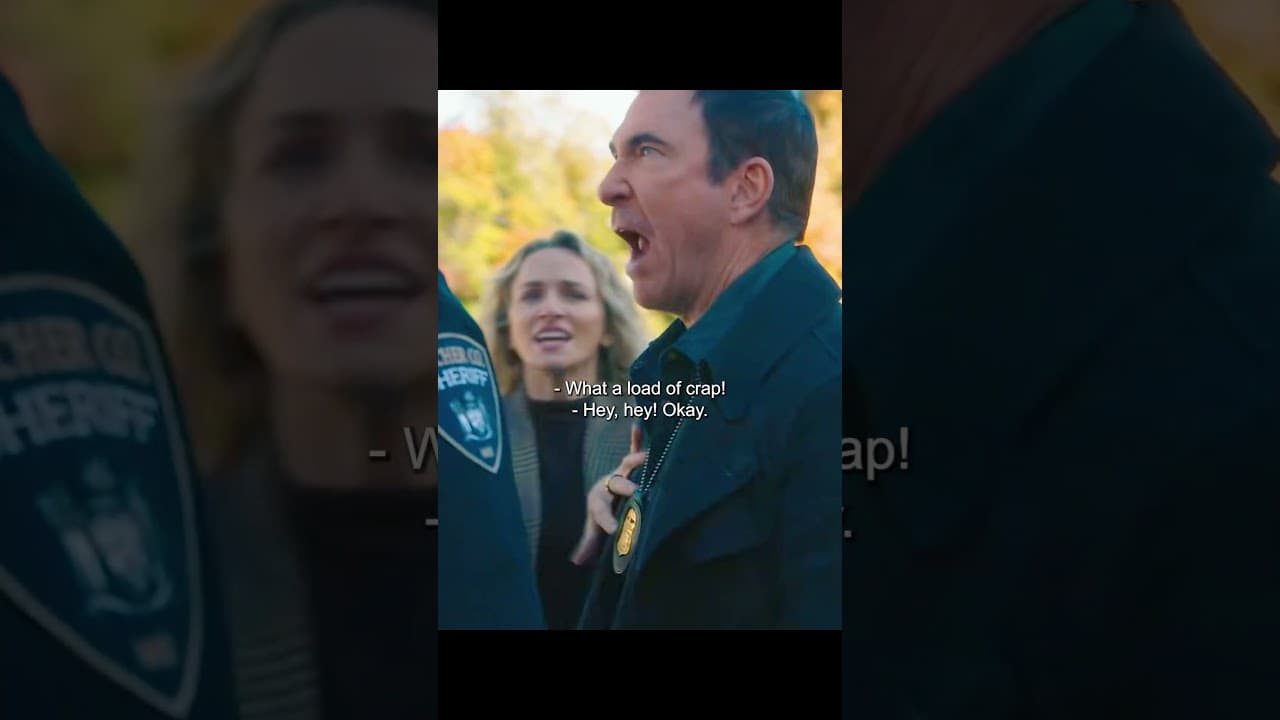
The first thing Sheriff Blake's people do when they pull over FBI agents is demand they exit the vehicle. The second thing they do is tase one of them. That sequence. Local authority asserting dominance over federal authority, with physical force as the punctuation. Is not a cold open designed to shock. It is a thesis statement.
The project Blaine Rutherford has been building toward arrives with a very specific premise: a county where law enforcement doesn't just bend the rules but has step by step replaced them with something else entirely. The sheriff's crew runs what locals call 'the electric company.' Tasers. Beat-downs. Bodies along the road. And, as one character puts it flatly in footage published this week, 'the last person to complain to Sheriff Blake disappeared.' That line lands quietly. It is meant to.
What Rutherford is constructing here is not a procedural. It is an anatomy of institutional capture. The specific, suffocating condition in which the people charged with public safety have become the primary threat to it. The FBI's Fugitive Task Force arrives in Archer County and immediately discovers that the courthouse, the street, and the jail all answer to the same man. That is the engine. Everything else. The murder charge against Ronnie McCaffrey, the framed evidence, the anonymous tip. Is fuel.
What the show is actually about: institutional capture, not crime drama
Rutherford's project uses a murder frame-up as the entry point into a deeper story about a county sheriff who has absorbed every lever of local power. Courts, streets, and the silence of anyone who might complain.
Frame-up narratives are television's oldest machinery. An innocent man, planted evidence, a public defender who doesn't return calls — see D4VD Had $11 Million and Now Has a Public Defender. The Music Business Explains Both Facts.. These are familiar grooves. What distinguishes Rutherford's approach is the specific texture of the corruption he is depicting. Sheriff Blake and his crew are not lazy or merely greedy. They are organized. The 'electric company' nickname is not ironic slang; it is a brand. A method. A community has watched it operate long enough to give it a name, which means the community has also watched long enough to know that naming it changes nothing.
That detail. The nickname, the resigned familiarity. Is where the real storytelling lives. James McCaffrey, Ronnie's son, doesn't say his father was framed with outrage. He says it the way people describe weather. 'Nobody's going to believe us.' The FBI agents are the outsiders who don't yet understand the local atmosphere. Special Agent Remy Scott arrives expecting the normal physics of federal authority. Show credentials, assert jurisdiction, things resolve. They don't.
The courthouse scene crystallizes this. Scott interrupts a hearing to defend his agents, and the judge shuts him down in three words, threatening contempt. The charges are eventually dismissed, but only because the court decides it wants them dismissed. Not because federal authority compelled anything. That is a careful, pointed choice on Rutherford's part. The system yields when it chooses to. It is not broken. It is working exactly as its operators intend — see The Lindsay Clancy Mistrial Was Not an Accident, It Was a System Working Exactly as Designed.
Who is Blaine Rutherford and why this project fits his track record
Blaine Rutherford is a writer-producer whose work has consistently gravitated toward stories about power imbalances between institutions and individuals. This project extends that through-line into law enforcement corruption territory.
Rutherford does not belong to the school of creators who arrive at difficult material accidentally. His track record suggests a intentional, sustained interest in the gap between what institutions claim to do and what they actually do. That thematic consistency is a career strategy as much as it is an artistic temperament. It builds a recognizable signature. Audiences find their way to a creator's next project partly because they trust the sensibility behind it.
The FBI framing here is worth noting specifically. Rutherford is not positioning his federal agents as heroes in any uncomplicated sense. Scott and his team speed through a 45-mile-per-hour zone, acknowledge it when pressed, and spend the first act of the story embarrassed by a local sheriff's deputy. The show earns its sympathy for the federal characters by making them fallible first. That is disciplined writing. It also makes the corruption story land harder. If the FBI, with all its institutional weight, can be humiliated and outmaneuvered in Archer County, the picture of what ordinary residents face becomes considerably darker.
For context on how entertainment figures build franchises around specific social themes, our latest reporting has tracked several similar career pivots. Creators who plant a flag on a particular kind of story and then build infrastructure around it.
"Rutherford isn't writing a villain. He's mapping a system. Which is the harder, more dangerous creative choice."
The business logic behind sheriff-corruption narratives in 2026
Local law enforcement corruption has become one of the most commercially reliable premises in prestige television and streaming, partly because it operates in a political register that attracts broad audiences without the polarization of explicitly partisan content.
There is a reason this well never runs dry. Stories about bent small-town sheriffs occupy a specific ideological no-man's land. They are legible to audiences across the political spectrum, because distrust of local authority is not a partisan sentiment. It is, in America, nearly universal. A Blue county and a Red county can both name a sheriff they wouldn't trust. That breadth of identification is commercially valuable in a way that explicitly coded political content is not.
Streaming economics have accelerated this. The prestige-cable era produced landmark sheriff-corruption narratives. Shows that built entire seasons around institutional rot in a single geography. The streaming era has expanded that template by lowering the barrier to serialized storytelling and raising the appetite for procedural genre content with literary ambition. What once required an HBO greenlight can now be developed through several different doors. The market for this material is real, deep, and not obviously saturated.
Rutherford's specific iteration adds the federal-versus-local jurisdictional layer, which is its own distinct genre tradition. That tradition has its own audience. People who follow real-world FBI-local law enforcement tensions, who watched the debates around federal oversight of municipal police departments, who have opinions about consent decrees. That audience reads the courthouse scene not as drama but as documentary shorthand. They know exactly what it means when a judge threatens contempt rather than extending professional courtesy to federal agents. It means the judge is inside the machine.
Emanuel Birdsong's death and what it signals about the show's moral architecture
The murder of Emanuel Birdsong. Pinned on Ronnie McCaffrey through planted evidence. Functions as the show's moral anchor: Birdsong's death is never just a plot device but the human cost of an enforcement regime that uses violence to manage, rather than solve, a drug problem.
The word on the street, as James McCaffrey relays it, is that Manny Birdsong was dealing. The show does not confirm or deny that. It holds the ambiguity on purpose. Whether Birdsong was dealing or not is less important to the narrative than the fact that Sheriff Blake's crew treats the drug problem in Archer County as territory to be managed with tasers and fear, not addressed. The 'cleaning up' language James uses. Quoting the sheriff's own framing. Is loaded. Cleaning up. As in, removing. Not treating, not diverting, not rebuilding.
That distinction points to the show's real moral argument. It is not that the sheriff is wrong to address drug activity. It is that 'the electric company' approach produces dead and broken bodies as a matter of routine, and then uses the criminal justice system to launder accountability. Birdsong dies. McCaffrey gets charged. The machinery keeps moving. One character describes it as 'how they roll with that situation'. The casual present tense of something that has happened before and will happen again.
The decision to name the victim. Emanuel Birdsong. Matters. He is not 'the deceased' or 'the body.' He has a full name, and someone called him Manny — see King Charles Called Him 'Dear Cousin.' What That Word Costs in Royal Diplomacy.. That choice, small as it is, signals that Rutherford intends to hold the show accountable to the weight of the death at its center. The murder is the cost. Everything else is the mechanism that produced it and now protects itself.
The taser as symbol: why Rutherford keeps returning to that specific weapon
In the world of the show, the taser is the signature instrument of Sheriff Blake's crew. Used on FBI agents, on James McCaffrey during a pretextual search, and implicated in Emanuel Birdsong's death. Making it the clearest emblem of authority deployed as punishment rather than safety.
The choice to center the taser is precise. It is a weapon that carries a specific contemporary resonance. Associated in public discourse with the substitution of pain compliance for de-escalation, and with deaths that occur when its deployment is characterized as 'non-lethal' despite outcomes. Rutherford uses it three times in the material so far: against Cheryl Barnes (FBI agent, tased during the traffic stop), against James McCaffrey (tased during a pretextual vehicle search for meth), and implied in Birdsong's death through the 'electric company' name itself.
That pattern is not accidental. Rutherford is making the taser do symbolic work. Marking every encounter with the sheriff's apparatus as an encounter with the same logic, the same outcome, regardless of who you are. An FBI agent and a young local man get the same treatment. Federal credentials do not protect you. That formal equivalence is the point.
Short sentences work here because the show earns them. Tased. Arrested. Released. The rhythm of that sequence. How quickly the violence becomes bureaucracy. Is part of what Rutherford is dramatizing. The system is fast. The accountability is not.
Agent Remy Scott's character logic and why his anger is the show's emotional spine
Special Agent Remy Scott functions as the show's moral barometer. His fury at the tasing of his colleagues is the audience's entry point into the scale of the injustice, and his repeated failure to immediately fix things is what distinguishes this from a conventional federal-hero narrative.
Scott's line. 'You tased and arrested two of my people'. Is delivered not as a procedural objection but as something closer to personal outrage. That emotional register is intentional. The show needs Scott to be angry in a way that is recognizably human, because everything else about the story risks becoming abstract. Institutional corruption, jurisdictional authority, the drug economy of a small county: these are concepts. Scott's rage is a body.
What is more interesting is what Scott cannot do. He goes to the courthouse and gets three sentences out before a judge threatens him with contempt. He gets the charges dismissed, eventually. But through the court's discretion, not through his authority. He is powerful within the federal system and nearly powerless in Archer County. That gap, between what his badge should mean and what it actually means inside Sheriff Blake's territory, is the engine that will drive him through the season.
The character also carries a specific management responsibility. Cheryl Barnes and Ray Cannon are his people. He recruited them, he oversees them, and they were physically harmed on what he describes as official business. His investment in Ronnie McCaffrey's case is not altruistic. It is the extension of that protective instinct, broadened to encompass a community that has been living under Blake's version of law for long enough to have stopped expecting anything different.
What the alibi subplot reveals about the show's evidentiary strategy
Ronnie McCaffrey's alibi. Home with his son watching a West Coast Wizards game. Is credible, verifiable, and almost certainly going to be dismissed by the local system, which is precisely the point: the show is demonstrating how good evidence gets swallowed by a compromised process.
Game records. A sofa. A son who fell asleep watching basketball on the West Coast. These are the kinds of alibi details that are, in theory, checkable. Cable records, game logs, the son's testimony. The public defender has been told. He has not acted. James McCaffrey says 'it doesn't matter' with the certainty of someone who has watched the local system absorb evidence before and produce nothing.
That skepticism is the show's most pointed critique of what happens when institutional capture reaches the defense side of criminal proceedings. The problem is not just that the sheriff plants evidence. The problem is that a defendant's only formal advocate within the system. The public defender. Has apparently concluded that advocacy is futile. Whether that is corruption, burnout, or simple resource exhaustion is left open. Any of those explanations is damning.
The FBI's interest changes the calculus. Scott's team now has questions about the case. Plural, serious questions. That is the procedural lifeline the narrative needs to function. But Rutherford is careful not to make it a rescue. The FBI can investigate. It cannot retroactively undo a community's relationship with a system that has been working this way for years. James McCaffrey's fatalism is not going to dissolve because a federal task force showed up. That earned distrust is part of what the show is trying to hold honestly.
The career and wealth implications for Rutherford if the project lands
A prestige law enforcement drama with a clear social thesis and serialized structure represents the highest-value creative asset a writer-producer can control. If it finds its audience, it generates not just income but the development use that funds the next several projects.
The business of creative capital in television works like compound interest. One project that lands with critics and generates subscriber conversation does not just earn its own revenue. It becomes the argument you make in every pitch meeting for the next five years. Rutherford's positioning. A creator with a consistent thematic signature, working in a genre with demonstrated commercial viability. Is exactly the profile that streaming platforms are currently paying to lock up.
The specific shape of the IP matters too. A story built around a recurring federal task force, operating across different counties and different flavors of institutional corruption, is a franchise chassis. Each season is a new geography, a new sheriff, a new community. The core characters travel. The theme scales. That architecture has proven its commercial durability across decades of American television, and the streaming era has not made it less valuable. It has made it more so, because serialized genre shows are among the most reliable subscriber retention tools the platforms have identified — see The Interview the FCC Tried to Kill, and Why That Made It More Powerful.
For a broader map of how entertainment figures translate creative use into lasting wealth, the Atlas tracks the financial architecture behind careers at this level. The pattern is consistent: the creators who build thematic franchises with repeatable structure accrue development deals, production overhead arrangements, and first-look agreements that together constitute something closer to a portfolio than a salary. Rutherford is building toward that architecture. This project is the argument he is making for it.
Who profits from this story being told. And who would prefer it wasn't
Prestige corruption narratives profit the platforms that carry them, the creators who control the IP, and audiences who want their structural concerns about law enforcement dramatized with specificity. The implicit losers are the real-world institutions whose methods the fiction renders visible.
Television has always been most uncomfortable for institutions when it is most specific. Vague villainy is safe. A sheriff who runs a crew called 'the electric company,' who has made a complainant disappear, whose deputies tase people during pretextual searches. That is not vague. That is a detailed operational portrait. The specificity is what gives the show its teeth and its cultural utility.
The platforms that carry prestige crime drama benefit from the reputational association with serious subject matter as much as from the subscriber numbers. A show that generates critical conversation about institutional accountability is doing brand work for a streaming service. Positioning it as a place where important television lives. That calculus has driven acquisition decisions for a decade. It does not appear to be changing.
For Rutherford personally, the risk-reward is asymmetric in the right direction. A show this specific about law enforcement methods will attract scrutiny. From the institutions it depicts, from critics who will debate its accuracy, from audiences who will compare it to real cases they know. All of that scrutiny is, in the field, publicity. The controversy that can hurt a project is the kind that attacks its craft or its honesty. A show being called 'too hard on sheriffs' by the organizations those sheriffs belong to is a show that has already won the argument about whether it matters. For more on how public figures get through that kind of institutional friction, our coverage of career strategy tracks the pattern across the industry.