King Charles Called Him 'Dear Cousin.' What That Word Costs in Royal Diplomacy.
Harald V of Norway died at 89 on August 28, 2026. Charles's tribute was warm, precise, and strategically loaded, a masterclass in how Europe's surviving monarchies use grief to do the quiet work of soft power.
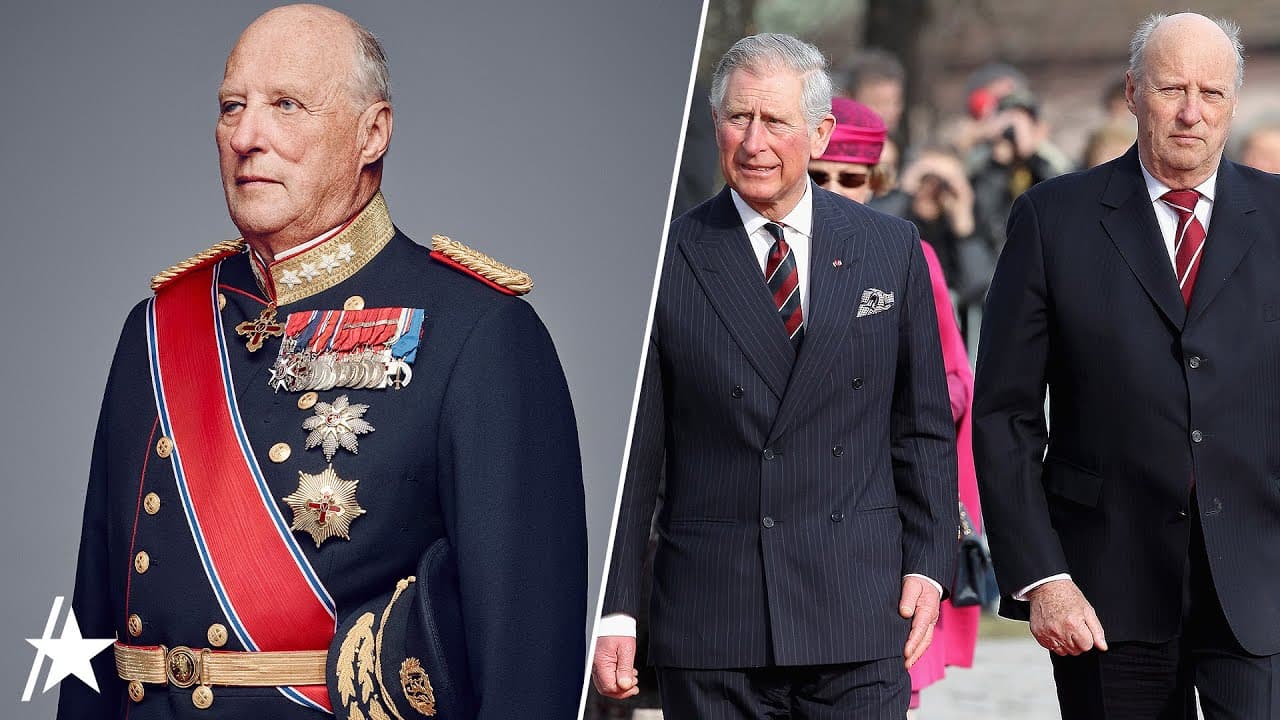
The word Charles chose was not 'ally.' It was not 'fellow sovereign.' It was 'cousin', and in the grammar of royal statecraft, that single syllable carries more freight than most heads of state pack into a whole speech. When Buckingham Palace released Charles's tribute to King Harald V of Norway on the morning of August 28th, the statement was brief and it was careful. It was also, for anyone fluent in the dialect of European monarchy, a precision instrument.
Harald V had died peacefully that morning at a national hospital in Oslo, the Royal Palace announced. He was 89, and he had been Europe's oldest reigning monarch. He had also been, as Access Hollywood reported Friday, the man who guided Norway through thirty-five years of change with what Charles described as 'warmth and humility.' That phrase matters. Charles does not use superlatives carelessly. His communications team knows that the tributes monarchs write for one another are read not just by grieving publics but by courts, foreign ministries, and the historians who will eventually score the reign.
The flags came down at Buckingham Palace, Clarence House, Windsor Castle, and the Palace of Holyroodhouse almost immediately. Norway's Royal Palace and government offices did the same. The symmetry was not accidental. It was choreography, the kind of choreography that keeps a network of constitutional monarchies functioning as a coherent, if loose, bloc inside a Europe that has been short on stable institutions for a decade.
King Harald V died at 89 after 35 years on Norway's throne
King Harald V of Norway died peacefully on August 28, 2026, at a national hospital in Oslo at the age of 89. He had reigned for 35 years and was Europe's oldest monarch at the time of his death.
Thirty-five years is a long time to hold any job. On a European throne, it is long enough to span the fall of the Berlin Wall, the rise and partial fracture of the European Union, the digital revolution, and two global health crises. Harald V absorbed all of it and, by the accounts of his contemporaries, managed the Norwegian monarchy's passage through those decades without the kind of institutional rupture that tested the British, Spanish, and Dutch royal houses in the same period.
His death leaves a vacancy at the top of a relatively small but disproportionately influential Nordic court. Norway punches above its weight in international diplomacy, in energy markets, and in the soft-power game that royal families still play more effectively than most elected governments. The king was a visible part of that ecosystem. His absence will be felt in ways that extend beyond national mourning.
The succession is clear and orderly. Crown Prince Haakon, 53, becomes king. His daughter, 22-year-old Princess Ingrid Alexandra, steps into the role of heir to the throne — see Jada Star Steps Into the Light After Dolly Parton's Death. The Norwegian model of equal primogeniture, which Ingrid Alexandra benefits from, has been in place since 1990, and it makes the transition structurally uncomplicated. What is less certain is the tone Haakon will set, and how quickly he will establish the kind of personal relationships with peer monarchs that Harald spent decades building.
Why Charles used the word 'cousin', and what it signals in royal protocol
European monarchs routinely address one another as 'cousin' to signal dynastic kinship and shared institutional identity, but Charles's use of the term for Harald V reflected a genuine genealogical connection dating to the Victorian era of intermarried royal houses.
The kinship claim is real. The crowned heads of Europe's constitutional monarchies are, to a remarkable degree, descendants of Queen Victoria and her Danish contemporary King Christian IX. Norway's royal house traces directly through that network. So does the British royal family. When Charles writes 'my dear cousin,' he is not reaching for a diplomatic euphemism. He is invoking a bloodline that connects Oslo to London through more than a century of marriages across borders.
But the word does more than establish genealogy. It places Charles and Harald in a category apart from elected leaders and appointed heads of state. It signals continuity, shared memory, and, critically, shared vulnerability. Constitutional monarchies need each other. Each surviving throne is, in some sense, an argument for the institution's legitimacy. When one thrives, the case for all of them is marginally stronger. When one falls into scandal or irrelevance, the others feel the tremor.
Charles's statement leaned into the bilateral history between Britain and Norway with specific purpose. He highlighted the 'particularly close historical and family ties' and noted that those bonds were 'further strengthened during the Second World War.' That reference is not decorative. Norway's government in exile operated from London during the German occupation, and the British-Norwegian relationship that emerged from those years became one of the more durable partnerships in European diplomacy. Charles was, in effect, reminding both publics that this grief has a shared history behind it.
"When Charles writes 'my dear cousin,' he collapses the distance between personal grief and state function in a way republics simply cannot replicate."
How Harald V modernized the Norwegian monarchy, and why that legacy matters now
Harald V is credited with deliberately modernizing the Norwegian monarchy by maintaining accessibility and democratic sensibility, which gave the institution unusually high public approval ratings and established a template that other European royal houses studied.
Modernizing a monarchy is harder than it sounds. The institution's legitimacy rests, paradoxically, on tradition, on the sense that some things do not change. Move too fast and you look desperate. Move too slowly and you look anachronistic. Harald's record suggests he found the calibration. He was a competitive sailor who competed at the Olympic level before he took the throne. He spoke in public about personal faith in ways that felt candid rather than scripted. He was present at national moments without making those moments about himself.
The result was a monarchy with broad popular support inside a country that is, by temperament and political culture, deeply skeptical of hierarchy. Norway is a social democracy with one of the world's highest standards of living and a strong national preference for flat organizational structures. The fact that the royal family maintained genuine public affection there is not a given. It is an achievement. Harald's personal style, warm, unguarded, and apparently humble in a way that read as authentic rather than performed, was central to it.
For the broader network of European monarchies, this matters as a case study. The Dutch, Danish, Swedish, Spanish, and British royal houses have all wrestled with how to stay relevant inside modern democracies without becoming either celebrity brands or museum pieces. Harald's Norway offered one answer. Haakon now inherits both the throne and the obligation to sustain that answer under conditions his father never faced, including a global media environment where every misstep circulates before the palace communications team can respond.
The half-staff flags at Buckingham Palace, what the protocol signals
Flying flags at half-staff at Buckingham Palace, Clarence House, Windsor Castle, and the Palace of Holyroodhouse for a foreign sovereign is a formal mark of mourning reserved for heads of state with whom Britain maintains close diplomatic and personal ties.
Flag protocol is one of the least glamorous and most precise tools in a monarchy's communication kit. The decision to lower flags does not happen automatically. It is a conscious choice by the palace, in consultation with the Foreign Office, and it carries a clear message: this death is Britain's grief too, not merely Norway's.
The symmetry on August 28th, British royal residences and Norwegian government offices both at half-staff, on the same day, in the same gesture, reinforced Charles's written tribute. It turned words into visible, public architecture. Anyone passing Buckingham Palace that Friday saw a piece of foreign policy. They may not have read it that way, but that is what it was.
This kind of coordinated mourning is one of the things constitutional monarchies do more elegantly than republics. Elected governments can issue statements. They can attend funerals. What they cannot easily do is signal personal grief at a state level, because personal grief and state function are, in a republic, held in separate boxes. A monarch collapses that distinction. When Charles says the death is 'heartbreaking,' the flags behind him confirm it. The effect is a kind of institutional sincerity that is genuinely difficult to manufacture.
Which European royals paid tribute, and what the list reveals about the bloc's cohesion
King Willem-Alexander and Queen Máxima of the Netherlands, King Felipe VI and Queen Letizia of Spain, King Frederik X and Queen Mary of Denmark, and King Carl XVI Gustaf of Sweden all issued tributes to Harald V, forming a near-complete picture of Europe's remaining constitutional monarchies acting in unison.
The roll call of European royals who publicly mourned Harald V reads almost like a census of the institution's survivors. The Netherlands, Spain, Denmark, Sweden, and Britain, five constitutional monarchies, five sets of tributes, all arriving within hours of the Oslo announcement. The coordination was not formal. It did not need to be. These houses know the playbook, and they understand that a unified response projects the kind of institutional solidity that each of them individually benefits from.
It is worth noting who is not on that list. The continent's republics were represented by heads of state and government, but those tributes, however sincere, carry a different institutional weight. The monarchies' collective response was a reminder that they function, on occasions like this, as something close to a club, one with shared history, shared protocols, and a shared interest in demonstrating that the institution of hereditary monarchy remains a coherent and functional part of European public life.
Queen Mary of Denmark is worth a specific note here. She is Australian-born, which means she came to the royal network as an outsider who learned its codes. Her presence in the list of mourners underscores how effectively the Danish royal house has integrated her into the bloc's fabric. It is a small data point, but it says something about how these networks absorb and credential new members, a process that will be relevant as Haakon's family steps into a larger role on the European stage.
Crown Prince Haakon becomes king at 53, what the transition means for Norway's royal…
Haakon Magnus, now King of Norway at 53, inherits a monarchy with strong public approval and a 22-year-old heir in Princess Ingrid Alexandra, giving the institution generational depth but also placing it in the hands of a relatively untested sovereign during a turbulent period in European politics.
Fifty-three is not young for a new king. It is, however, young enough for a long reign, one that could extend to the 2050s if Haakon's health holds. That longevity is both an asset and a pressure. He has the time to build his own style, establish his own relationships with peer monarchs, and put his stamp on an institution that his father shaped for more than three decades. He also has time to make the kind of errors that compound.
Haakon's public image has been cultivated carefully over the years. He is seen as warm and approachable, attributes he shares with his late father. His wife, Crown Princess Mette-Marit, brought her own complications to the royal family when they married in 2001, including a son from a previous relationship and a social background that was distinctly outside royal convention. The Norwegian public accepted that. It was, again, a testament to the monarchy's confidence in its own legitimacy and its willingness to modernize without performing modernization.
Princess Ingrid Alexandra's position as heir is significant beyond the personal. She represents the full normalization of female succession in the Norwegian line, not as an exception or a workaround, but as the natural consequence of equal primogeniture working exactly as designed. At 22, she is a generation removed from her great-grandfather's world. How she develops that role will be one of the more interesting institutional stories in European royal politics over the coming decade. For students of how royal families manage their wealth, influence, and public profiles, Norway under Haakon and eventually Ingrid Alexandra will be a live case study worth watching.
Charles's own position, how this tribute fits his evolving role as monarchy's senior…
Charles III, who acceded to the British throne in 2022 after decades as heir apparent, has worked to position himself as a unifying figure among Europe's constitutional monarchies, and his Harald tribute reinforces that posture at a moment when the institution needs visible, articulate advocacy.
Charles came to the throne late. He was 73 when his mother died, which meant that his reign began at an age when most monarchs are already deep into their third decade on the job. That late start has shaped his approach. He does not have time for a long period of institution-building. He has to arrive at elder statesman status faster than most of his predecessors needed to.
The Harald tribute fits that strategy. It is the kind of statement a senior figure issues, not a peer grieving a peer, but a custodian of the institution marking the loss of one of its exemplars. The phrase 'so towering a figure' is doing real work in that framing. It elevates Harald, which in turn elevates the network of monarchies that Harald belonged to, which in turn elevates Charles as the network's most prominent surviving voice — see Maria Bartiromo Is Out at Fox News. What Twelve Years Built, and What Ended It..
This is not cynical. Grief can be genuine and strategically useful at the same time. Charles almost certainly did mourn Harald as a kinsman and friend. The two men shared a world, a specific, rarefied, and increasingly rare world of hereditary sovereignty in democratic states, that very few people alive today understand from the inside. That shared world generates real bonds. It also generates real institutional logic, and Charles is practiced enough to let both operate simultaneously.
For anyone tracking the latest moves inside Europe's royal houses, the August 28th tribute is a small but telling data point. Charles is building a record of these moments, calibrated, historically grounded, emotionally credible statements that position Britain's monarchy as the network's anchor. It is a long game. He is playing it with some skill.
The business of royal soft power, why this moment has economic and diplomatic stakes
Constitutional monarchies generate measurable economic value through tourism, bilateral trade relationships, and diplomatic credibility that elected governments cannot easily replicate, making the coherence of the royal network a genuine, if rarely quantified, national interest.
The economics of monarchy are real and they are underanalyzed. Britain's royal family generates billions in tourism revenue annually. The brand value of the Crown, as distinct from the cost of maintaining it, is a subject of ongoing academic and policy debate, but the direction of the argument is not seriously in question. Monarchies with high public approval ratings and stable institutional records outperform republics on several soft-power metrics that eventually translate into trade and diplomatic outcomes.
Norway's sovereign wealth fund, the largest in the world, operates at some remove from the royal house, but the two institutions share a national brand. When Harald was alive, that brand included a monarchy that the world generally saw as progressive, stable, and benign. That perception has value. It lubricates the relationships that allow a small Nordic country to punch well above its weight in international forums. Haakon now carries that brand asset forward, which is why the smoothness of this transition is not only a domestic Norwegian story.
For Britain, the connection is more direct. The UK-Norway relationship includes significant energy ties, Norwegian gas has been a critical supply source for European markets, and that relevance has only grown since 2022. The warmth Charles expressed in his tribute is not unrelated to those material facts. Royal diplomacy is not a substitute for foreign policy, but it is a lubricant. It creates goodwill at a personal level that makes hard conversations easier. Charles's 'dear cousin' is part of that infrastructure, invisible when it is working, costly when it is not.
The broader business and diplomatic context of European royal families rarely gets the analytical attention it deserves, in part because the players involved are discreet by training and the metrics are hard to isolate. But this week's events are a reminder that the network is active, that it serves functions that elected governments value, and that moments of royal grief are never purely personal. They are also, quietly, professional.