Tom Holland's Odyssey Joke and the Careful Art of Going Public
A single throwaway line in a Wired autocomplete video reveals the precise calculus behind how Hollywood's most guarded celebrity couple is finally. And on purpose. Letting the world in.
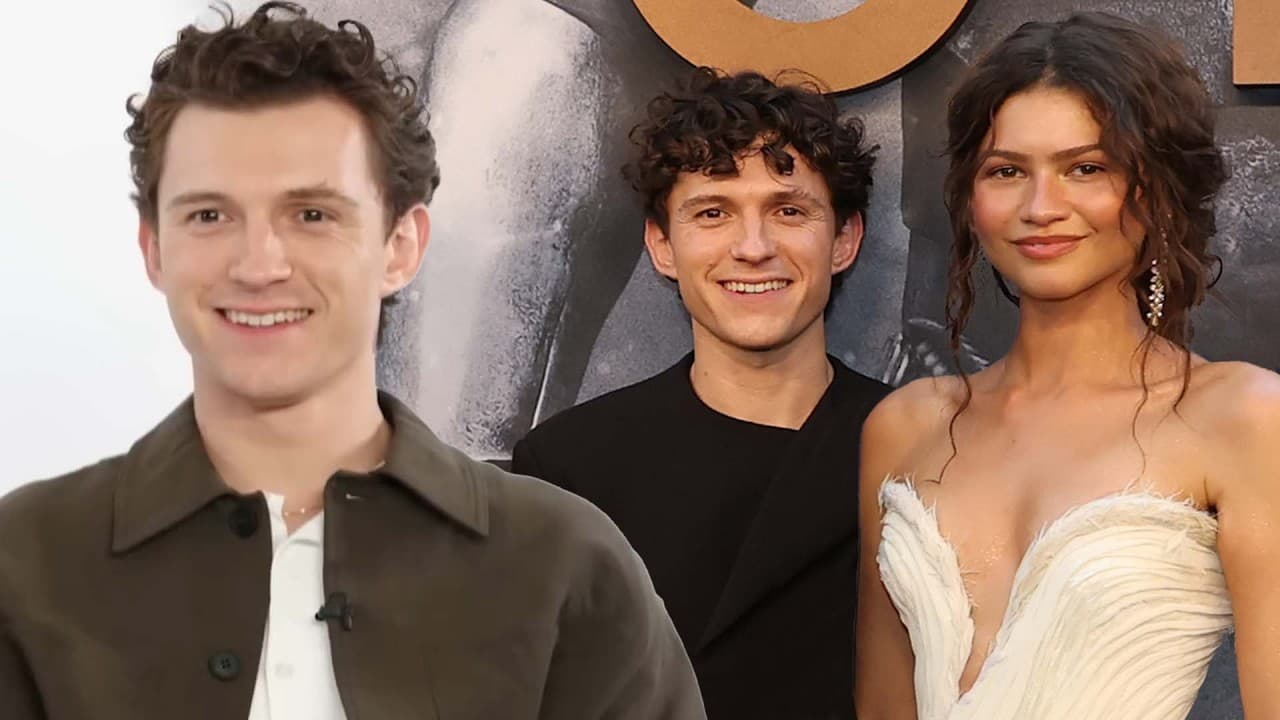
The question was about Greek mythology. The answer was about something else entirely. Asked during a Wired autocomplete segment whether Athena loved Odysseus romantically, Tom Holland didn't skip a beat: "No, because she's married to me." The room laughed. Matt Damon, seated beside him, nodded approvingly. And somewhere in that four-second exchange, one of the most carefully managed privacy strategies in contemporary celebrity culture quietly shifted gears.
Holland and Zendaya have been together, by most credible accounts, since at least 2021. They confirmed a marriage. By the press tour's own framing of "newlyweds". Without ever holding a formal announcement. No People cover. No ring reveal timed to a slow news day. What they have done, instead, is let The Odyssey press tour become a controlled decompression chamber: enough warmth to feel genuine, precise enough to reveal almost nothing. The Wired joke is the clearest evidence yet of how intentional that calculus is.
The film itself. Christopher Nolan's big-canvas adaptation of Homer, with Holland playing Telemachus and Zendaya as Athena. Gives the couple a built that way perfect reason to discuss each other professionally. They can talk about watching each other work, about learning from each other on set, about the dynamic of sharing a call sheet with your spouse. The personal bleeds into the promotional, and the promotional is always the safer container. That's not accident. That's architecture.
What Tom Holland actually confirmed about his marriage to Zendaya
Tom Holland confirmed his marriage to Zendaya during The Odyssey press tour by referring to her as his wife in a Wired autocomplete video and in separate sit-down interviews, marking the couple's most explicit public acknowledgment of the marriage to date.
The confirmation came in layers, not in a single declarative moment. In the Wired segment, the mythology joke landed as a punchline but functioned as a statement of fact. Zendaya is his wife, and the room treated it as common knowledge rather than breaking news. That framing is itself a technique: you don't announce something if it's already understood. You simply speak inside it, casually, and let the casualness do the confirming.
Separately, in press tour interviews tracked by Entertainment Tonight, Holland was asked directly whether he and Zendaya compare notes on their work. "Especially on a job like this," he said, it was important to communicate about their experiences. And that every night after filming, they would talk about how exciting the project was. The word "wife" appears across multiple contexts. The repetition is the announcement.
What's notable is the absence of defensiveness. Earlier in the relationship. When paparazzi photos first surfaced in 2021 and the couple said almost nothing publicly. Any personal question was deflected or redirected. Now Holland answers with a warmth that suggests a intentional posture shift. Privacy, for this couple, was never about denial. It was about timing.
Why the press tour is the couple's chosen venue for going semi-public
A film press tour gives celebrity couples a professionally legitimate reason to discuss each other, embedding personal disclosures inside promotional content and allowing controlled, time-limited exposure without the permanence of a formal announcement.
The mechanics here are worth slowing down on. A press tour is, intentionally, a finite window. It has a beginning date and an end date keyed to a film's release. Any disclosure made inside it carries an implicit expiration: once the movie is out and the promotional cycle winds down, the interviews stop and the couple retreats. That time-boxing is valuable. It lets a celebrity couple be open for a week or two without committing to openness as a permanent operating mode.
The Odyssey also gives Holland and Zendaya something rarer: a shared professional project that is unambiguously prestigious. This isn't a joint brand deal or a red-carpet appearance engineered purely for visibility. It's Christopher Nolan. One of the few filmmakers whose projects carry automatic critical weight across every demographic. Being open about your marriage in the context of a Nolan production signals, subtly, that the personal disclosure is an add-on to the artistic work, not the other way around. The film earns the interview; the marriage is what the interview gets to discover.
Compare this to celebrity couples whose personal lives become the primary product. Where the relationship itself is the content, the fights and reconciliations monetized through social media and tabloid access. Holland and Zendaya have studiously avoided that model. Their fame is underwritten by their actual work, which means their personal life remains a surplus value rather than the engine. The press tour format preserves that hierarchy even as it opens a window.
"The personal bleeds into the promotional, and the promotional is always the safer container. That's not accident. That's architecture."
The fourth film together: what co-starring repeatedly does to a career brand
The Odyssey marks the fourth time Tom Holland and Zendaya have shared a screen, a frequency that transforms individual stardom into a recognized creative partnership and gives their combined box-office presence stacking commercial weight.
Three of those four films were inside the Marvel Spider-Man machine. The fourth. A Nolan epic adapted from Homer. Is the first time they've co-starred entirely outside the franchise infrastructure that introduced them to each other and to global audiences. That shift matters for what the pairing now means commercially and critically. Inside Marvel, their chemistry was a feature of a much larger ensemble product. Inside The Odyssey, their shared screen time belongs to a film where their individual performances are the primary critical discussion.
The box office stakes are real. Holland has shown consistent franchise draw. Zendaya's post-Dune profile has elevated her from supporting player to above-the-line name in her own right. A progression our film wealth profiles have tracked across multiple cycles. When those two brands appear together on a poster under Nolan's name, the combined pull is something studios spend decades trying to manufacture. Holland and Zendaya got there by making good films, then happening to fall in love.
There's a business logic to continuing to work together that goes beyond the personal. Every shared project deepens audience investment in both of them as a unit. Every press tour moment like the Wired joke becomes, functionally, free marketing content that circulates well beyond the outlets that produced it. The couple-as-brand isn't something they appear to be consciously constructing. But it's being constructed around them regardless, and their willingness to lean into it gently, during the press tour, suggests they understand its value.
What Holland said about watching Zendaya work. And why it matters professionally
Tom Holland described Zendaya's acting as defined by bold, specific choices that make characters feel real rather than like caricatures, framing her as a rare talent. Professional praise that, coming from a co-star and spouse, carries distinct credibility in an awards-season context.
The specific language Holland used is worth examining, because it isn't the language of a besotted husband reaching for compliments. "She makes big bold choices," he said. "They don't feel like a caricature, they feel like real people. And there are few actors that can do it as well as she can." That's a craft-level observation delivered with the precision of someone who has watched a performance get built from scratch, on set, over weeks. It carries a different weight than "she's incredible" or "I'm so proud of her."
In the context of The Odyssey's awards trajectory, that kind of testimony is unusually useful. Awards campaigns for ensemble films often struggle to isolate individual performances for voter consideration. When a co-star. Especially one with Holland's profile. Singles out a specific craft quality and articulates it clearly, it functions as a talking point that can be recycled by critics, by publicists writing campaign materials, by awards columnists looking for an angle. The personal relationship amplifies the credibility. He isn't doing her a favor by saying this. He's telling you what he actually saw.
Zendaya returned the specificity in kind. She described Holland's work ethic as the thing she's absorbed most from him. Not his talent or his preparation per se, but the relational dimension of his professionalism: remembering crew names, shaking hands in the morning, giving fully to every task including the promotional ones. That's a portrait of a particular kind of set leadership, and it rhymes with the broader reputation Holland has built across his Marvel years. The mutual admiration reads as genuine precisely because it's so particular.
How this couple's privacy strategy compares to Hollywood's current norms
Holland and Zendaya's approach. Confirming the relationship through casual, work-adjacent disclosures rather than formal announcements or social media performance. Sits at the opposite end of the spectrum from the monetized transparency that defines most celebrity couples' public image strategy.
The celebrity privacy landscape in 2026 has two dominant models. The first is total exposure: every relationship milestone shared in real time, often with a commercial partner attached, the intimacy itself a product. The second is total opacity: no confirmation, no comment, the relationship a persistent rumor that tabloids chase and publicists neither confirm nor deny. Holland and Zendaya have found something in between. A third model that might be called structured warmth. They confirm, but on their own timeline. They share, but only in contexts they control.
The press tour is the ideal vehicle for this model because it's inherently time-limited and professionally justified. When the fame machine breaks down. As it has for other celebrities who ceded too much of their private lives to public consumption. The damage is rarely reversible. Holland and Zendaya appear to have studied those cautionary cases carefully. Their level of disclosure is calibrated to generate warmth without generating access.
There's also a generational dimension. Both are in their mid-to-late twenties and came up in an era when social media parasocial relationships had already warped the expectations audiences place on young stars. Zendaya in particular navigated the Disney ecosystem, which has its own very specific machinery for managing the transition from child performer to adult artist. The privacy instinct may be partly learned from watching that machinery operate on peers who handled it less well. Knowing what not to share is its own form of industry expertise.
The Odyssey's commercial context: what the film needs from this press tour
The Odyssey is a large-scale prestige production under Christopher Nolan, a filmmaker whose recent films have generated both critical acclaim and substantial box-office returns, making the press tour a high-stakes promotional moment where cast chemistry and personal narratives directly support the film's opening-weekend…
Nolan's commercial track record is one of the few in contemporary Hollywood that reliably converts prestige into mass audiences. His recent run has demonstrated that adult drama. Intellectually ambitious, cinematically serious. Can still open wide if the marketing campaign builds sufficient anticipation. The cast for The Odyssey, which includes Matt Damon and Robert Pattinson alongside Holland and Zendaya, gives the marketing team multiple audience entry points. You can sell this film to the Spider-Man generation through Holland, to the Dune audience through Zendaya, and to the Nolan faithful through the director's name alone.
Our colleagues have written at length about Matt Damon's second-act architecture and what this project represents in his career's larger design. But from the film's promotional standpoint, Damon's presence also provides a kind of veteran anchor that the younger cast orbits around. The Wired autocomplete video, notably, featured all four leads together, and the chemistry was evidently real enough to produce moments that circulated well beyond the video's initial platform.
What the Holland-Zendaya marriage disclosure does for the film is provide a human-interest hook that functions independently of the mythology or the craft. Audiences who might not have a strong opinion about Homer but are invested in this couple's story now have a personal stake in watching a movie that features them sharing a screen. That's not cynical; it's how film promotion has always worked. The personal life underwrites the professional project, and the professional project gives the personal life a stage.
Who profits when a celebrity couple goes gently public
When a high-profile celebrity couple shifts from opacity to controlled disclosure, the primary commercial beneficiaries are the film or project anchoring the moment, the outlets granted access, and the couple's own long-term brand equity. Which builds up with each carefully managed reveal.
Entertainment outlets benefit first and most immediately. A rare personal disclosure from a famously private couple is the definition of an earned exclusive. Even when it happens in a group setting, the outlet that captures it on camera owns the clip. The coverage multiplier is significant: the Wired video and the Entertainment Tonight segments together generated pickup across dozens of platforms that wouldn't otherwise have had a news hook tied to The Odyssey.
The couple's agents and publicists benefit from the narrative control. Every "rare" disclosure. The word Entertainment Tonight itself used to frame Holland's comments. Reinforces the scarcity value of any future disclosure. They're not giving access away; they're managing a resource. The rarer the personal moment, the more coverage each one generates. This is a straightforward application of supply and demand to attention economics, and Holland and Zendaya's team appear to understand it precisely.
The longer-term benefit accrues to both stars individually. There is a warmth tax on celebrity culture. Audiences extend more goodwill, more charitable interpretation, more sustained interest to public figures who seem genuinely happy and human rather than purely strategic. The Odyssey press tour has generated that warmth at scale without requiring either Holland or Zendaya to sacrifice anything they've previously protected. That's the trick. And very few people in this business pull it off cleanly. You can track where each of them stands in the broader film wealth and career landscape as this moment builds up into the next phase of their careers.
What comes next: can a private couple sustain this level of disclosure long-term
Celebrity couples who establish a controlled-disclosure model typically face escalating audience expectations over time, meaning Holland and Zendaya will need to either incrementally expand what they share or actively manage the gap between public appetite and their stated preference for privacy.
The pattern is well established in celebrity culture. A private couple opens up slightly; the coverage is warm and generous; the audience appetite grows. The next disclosure has to meet a slightly higher bar to generate equivalent warmth, because the previous one has recalibrated expectations. This is the slow ratchet of celebrity transparency, and it catches almost everyone eventually.
Holland and Zendaya have some structural advantages in resisting it. Both are primarily known for their work rather than their personal lives, which means the professional pipeline. New films, new press cycles. Provides recurring opportunities to redirect audience attention from the personal to the artistic. As long as they keep making interesting films, the work itself can reset the frame. The risk comes if there's a gap: a fallow period between projects when the personal life becomes the only available content.
There's also the question of what comes after the press tour ends. The "newlyweds" framing that Entertainment Tonight used suggests a relatively recent marriage. Which means the honeymoon period of public curiosity is still active. In a year, or two, the audience's appetite for the relationship itself may have normalized. By then, ideally, the next film creates the next press tour creates the next carefully calibrated window. That's the model. It requires patience, good project selection, and a willingness to keep working at the level where work itself remains the story. Both of them, by every available indicator, are committed to exactly that. The latest reporting on their upcoming projects will be the real tell.