Tom Holland, Jon Bernthal, and the Mentorship Economy Behind Marvel's Biggest Summer
A press-tour moment between two co-stars reveals something richer than chemistry: how a decade-long friendship between a British kid and a hardened character actor quietly shaped one of the most valuable franchises in Hollywood history.
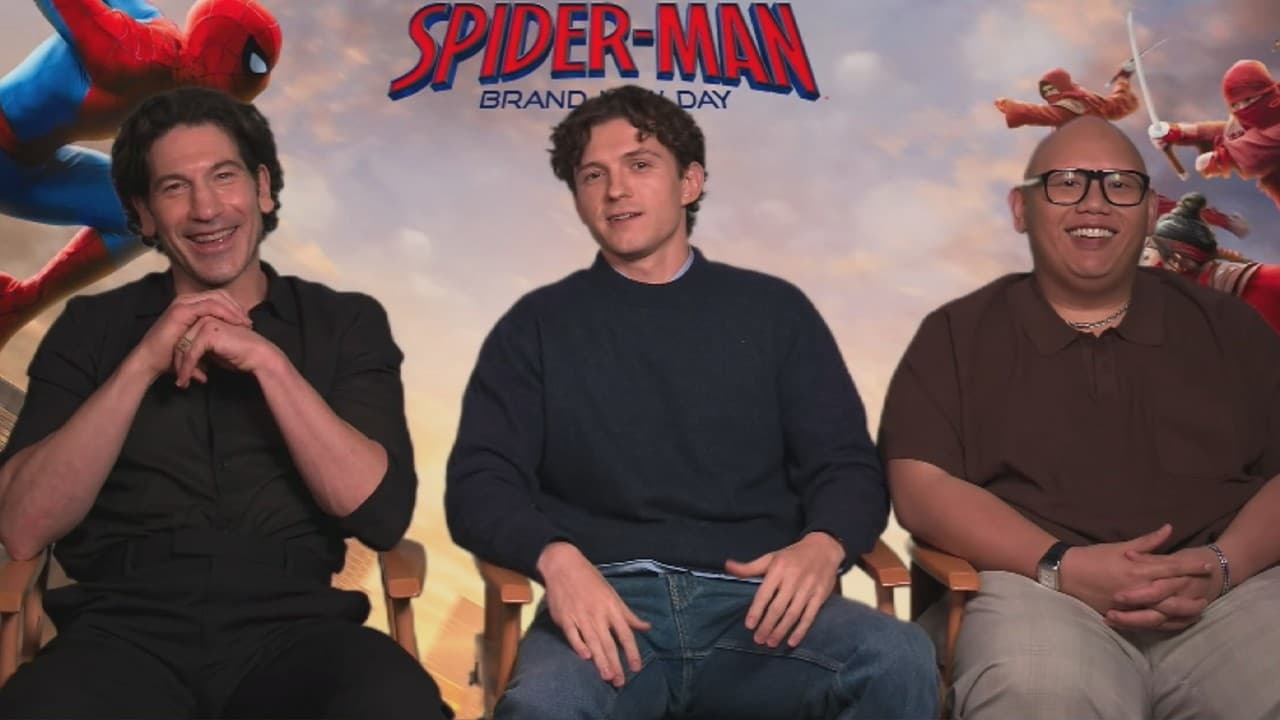
Tom Holland walked into the Extra interview in blue. Blue for Spider-Man, he explained, because he is simultaneously deep inside the Odyssey press cycle and cannot afford to mix up the mental filing cabinets. Two blockbusters. Two studios. Two characters who could not be more different. One summer.
Jon Bernthal sat beside him and said very little he didn't mean. That is, if you've watched Bernthal work. On screen, in a room, across a press circuit. Entirely on brand. Where Holland deflects with charm, Bernthal deflects with weight. The two men have been doing this long enough that the rhythm between them is almost choreographed, the older actor's stillness counterbalancing the younger one's kinetic energy.
What the Extra sit-down told viewers this week looked like a feel-good bit of talent promotion. What it actually documented was the public face of a mentorship relationship that started when Holland was, by his own admission, still a child. And that has now produced two of the most commercially loaded films arriving in a single calendar season. That is not sentiment. That is career architecture, and it is worth examining closely.
How Holland and Bernthal's friendship began during Spider-Man casting
Tom Holland and Jon Bernthal first bonded during the period surrounding Holland's Spider-Man audition process, when Holland was a teenager and Bernthal was already an established dramatic actor. Holland has described Bernthal as a figure he genuinely looked up to from that early stage.
Holland told the interviewer plainly: when they met, he was a child. That is not false modesty from a 29-year-old. He was, in fact, a teenager from Kingston-upon-Thames who had done Billy Elliot on stage and a single feature film when Marvel began testing him for a role that would define the next decade of the studio's output. Bernthal was already in a different professional category. A trained actor with roots in the Stella Adler tradition, a full run on The Walking Dead behind him, and a reputation in the industry for the kind of ferocious commitment that makes directors trust him with anything.
The gap between them at that point was not just years. It was experience, method, and the sheer weight of hours logged on difficult sets. That Bernthal treated the younger man as a peer worth investing in rather than a franchise asset to be tolerated says something real about how the relationship formed. Holland has spoken across multiple press cycles about the influence. This week was not the first time. But the specificity landed differently here. He mentioned traveling to Ohio to watch Bernthal perform in a stage play, the kind of gesture that has nothing to do with career maintenance and everything to do with genuine admiration.
The family-values throughline Holland offered. Both men coming from similar family units, as he put it. Sounds like the usual talent-interview softener until you consider the evidence. Bernthal is known in Hollywood for being fiercely present as a father and husband, almost ostentatiously so in an industry that rewards the opposite. Holland has spent the last several years building a on purpose home-centered public image alongside Zendaya. The parallel is real. It is also, for both men, commercially useful, even if it didn't start that way.
What back-to-back Odyssey and Spider-Man productions actually cost the performers
Filming two major studio productions back-to-back in the same year means performing at peak physical and mental intensity across consecutive months with almost no recovery window. Both Holland and Bernthal flagged the physical toll directly. Bernthal noted his back, Holland cited bruises and knocks from stunt work.
Bernthal's joke about his back landed as a laugh line. It was also data. Back-to-back major productions at this scale. Both described as enormous in size and scope. Means there is no off-ramp between the physical demands of one character and the next. Bernthal spent time on the Odyssey set and then stepped directly onto the Spider-Man set as Frank Castle. Holland did the same in reverse order, or in parallel. The logistics alone are staggering.
Holland spoke with some care about what it took to make the practical stunt work believable. The unit on this Spider-Man film, he said, had a real desire to do things practically, which is a creative choice that sounds admirable in a press setting and costs genuine physical currency on the day. Bruises are not metaphors. A stunt team can be world-class and performers still absorb the impact of what world-class looks like from the inside.
The simultaneous press tours are their own tax. Holland wore blue as a mnemonic device. That is funny and also slightly alarming. The man is so deep inside two distinct promotional machines that he needs a visual cue to remember which franchise he is currently representing. For context, most major stars consider a single film's press tour an endurance test. Holland and Bernthal are doing two at once. The studios are getting extraordinary value from two performers whose professionalism is keeping the plates spinning.
"Chemistry cannot be cast from a breakdown. It is either there or it isn't, and when it is, it took time to build."
Why the Punisher's shift from TV-MA to the Marvel Cinematic Universe is a tonal…
Jon Bernthal's Punisher originated in Netflix's TV-MA environment, where Frank Castle's violence and psychological damage could be depicted without franchise constraints.
Bernthal was candid about the anxiety that surrounded the transfer. He used the word concern. His word. About how Frank Castle would move from the world that built him into the considerably brighter visual and moral register of a Spider-Man film. That concern was not unfounded. The Netflix Punisher worked precisely because it was allowed to be brutal. The character's damage was the point — see Gwyneth Paltrow Had No Idea. That Was the Point.. Strip the damage out and you have a man in a skull shirt with unclear motivations.
The solution, as Bernthal described it, was collaborative and specific. Colton Hill. A Green Beret who consulted on the original Netflix series for both tactical realism and psychological accuracy. Was brought back in. The fact that Marvel welcomed Hill into the production rather than asking Bernthal to simply perform a lighter version of the character suggests the studio understood what they were purchasing. They wanted Bernthal's version of Frank Castle, not a franchise-smoothed approximation.
This matters beyond the fan-service dimension. Marvel has spent years grappling with the question of how to reintegrate its Netflix-era characters. Daredevil, Jessica Jones, Luke Cage. Into a shared universe that is now, after Avengers: Endgame, operating at a different altitude entirely. The Punisher is the hardest case because the character's entire appeal is built around moral ambiguity and graphic violence. What Bernthal described this week suggests Marvel found a workable answer, at least for this film. Director Destin Daniel Cretton and Tom Holland, he said, were the ones who made it feel safe to bring Frank Castle across intact. That is a real creative achievement if the film bears it out.
The strategic logic of Holland and Zendaya promoting two films together
Tom Holland and Zendaya are simultaneously promoting Spider-Man: Brand New Day and The Odyssey, appearing together on a shared press circuit that gives both studios additional coverage while compressing their combined promotional commitments into a single global tour window.
Holland described it as a dream. The business reality is more calculated than that, though the dream is also real. Both things can be true at once. Two studios are getting a premium press asset in a relationship that the public is deeply invested in, and they are getting it at a moment when the combined cultural footprint of Spider-Man and The Odyssey is large enough to dominate the entertainment conversation across most of a summer.
Zendaya's path into The Odyssey is worth a beat here. Holland told the interviewer that he was the one who told her about the Athena role. That he surfaced the opportunity, she pursued it, and now they are both on the same press trail, which is an unusual piece of real-world plot. As we noted in our earlier reporting on the Odyssey press tour, the couple has become adept at using public appearances to say something without quite saying it, controlling the information flow around their relationship with a precision that PR teams charge significant money to execute.
From a pure business angle, the dual-promotion model is efficient in ways that don't appear in the marketing budget. Every joint appearance generates two sets of coverage, two sets of social amplification, and a narrative warmth that neither film could buy independently. The studios, Holland said pointedly, deserve gratitude for allowing them to do this together. That is a gracious framing. It is also a reminder that the studios made a calculation and the calculation is paying off.
What Ned Leeds's arc across the Spider-Man trilogy reveals about franchise character…
Jacob Batalon's Ned Leeds has grown from comic-relief best friend to a character with genuine dramatic weight across three Spider-Man films, and that evolution reflects Marvel's broader bet that ensemble loyalty from audiences is worth nurturing over many years rather than cycling through supporting players.
Batalon spoke about privilege and gratitude in the interview, and those words land differently when you consider what the trilogy actually asked of him. In the first film, Ned was essentially Peter Parker's delighted audience. The friend who discovers the secret and becomes a kind of proxy for the viewer's excitement. By the third film, No Way Home, the character was carrying genuine emotional stakes in one of the most technically complex MCU entries ever made. That is a significant arc.
The actor's observation that his back hurts now where it didn't when they started is, again, a laugh line with data inside it. The physical demands on a franchise performer across a decade of production compound in ways that are invisible to the audience. Batalon has been doing this since 2017. The version of him sitting in that Extra interview is not the same person who walked onto his first Marvel set, and that gap. Between the nervous newcomer and the seasoned ensemble member. Is exactly what franchise storytelling is designed to create and then cash in on.
Marvel's investment in continuity of supporting cast is not sentiment. It is audience-retention strategy. Each returning face is a signal to the viewer that this world is stable and worth caring about. The emotional response people have to seeing Batalon or Bernthal in a new Spider-Man film is a direct return on a decade of careful casting decisions. You cannot manufacture that response from scratch. You can only earn it, slowly, across multiple films.
How mentorship functions as a career asset in the Marvel talent ecosystem
Within major franchise productions, experienced actors who mentor younger co-stars create an on-set dynamic that benefits the production. More grounded performances, faster emotional calibration, reduced friction. While also building loyalty networks that make future collaboration easier and less expensive to arrange.
The mentorship Holland described is not the kind that happens in a formal sense. Bernthal did not sit the teenager down and deliver wisdom. What Holland described was presence. Being around someone whose work ethic and values you respect, and letting that calibrate your own. He watched Bernthal on stage in Ohio. That is a choice a young actor makes when they take someone's craft seriously, not when they are networking.
The return on that investment, from a purely transactional view, is sitting in the Extra interview this week: two men who trust each other completely, who can do difficult work back-to-back without the friction that eats time and money on big productions, and who generate genuine warmth in promotional settings that audiences can actually feel. Chemistry cannot be cast from a breakdown. It is either there or it isn't, and when it is, it took time to build.
There is a broader pattern here worth naming. The careers profiled across our film wealth coverage repeatedly show that the performers who build durable, multi-decade trajectories are not always the most talented in a narrow technical sense. They are often the ones who invest in relationships. With directors, with co-stars, with the crews who make them look good. As seriously as they invest in the roles themselves. Holland at 29 already has a relationship portfolio that most actors spend entire careers trying to assemble.
Bernthal, for his part, gets something real from this too. The Spider-Man platform is the largest single-film audience he has ever played to. His version of Frank Castle in a PG-13 context, if it works tonally, opens a fanbase that the Netflix Punisher never reached. The mentorship flows in both directions, even if the public framing only runs one way.
What Sadie Sink's secret role signals about Marvel's information strategy
Marvel's decision to keep Sadie Sink's character details entirely under wraps through the promotional period. With cast members offering flat refusals when asked. Reflects the studio's consistent use of narrative secrecy as a marketing tool that drives opening-weekend speculation and repeat viewership.
Holland's response was immediate and total: absolutely not. Not a tease, not a knowing smile that leaks something through the denial. The door closed. Bernthal's expression in the frame confirmed the same. Whatever Sink is doing in this film, the people who know are not going to be the ones who say.
Marvel has refined this into a precise instrument over many films. The studio understood early that withheld information generates coverage as reliably as released information. Sometimes more so. Every article written about what Sadie Sink might be doing in this film is a marketing impression the studio did not have to buy. The mystery, as Holland put it, makes it special. He said that with a smile, but he also meant it as a statement of strategy.
Sink herself is an interesting casting signal regardless of what the role turns out to be. She arrived on a large cultural platform through Stranger Things and has since been careful about feature-film choices. Speak No Evil, The Whale. That pull toward dramatic credibility rather than franchise obligation. Her presence in a Spider-Man film, whatever form it takes, is not a default move. It is a intentional choice that somebody, presumably Marvel, worked to make happen.
Where Holland's career stands as he approaches 30 with two tentpoles arriving at once
Tom Holland enters the back half of his twenties as one of the few performers in Hollywood with an established franchise identity, a credible dramatic track record, and a personal relationship that has become a cultural phenomenon in its own right. A combination that gives him unusual use heading into contract and…
The blue outfit is a small thing. What it represents is not. Holland is so busy at this moment in his life that he needs external reminders to keep his two professional identities sorted. That is a specific kind of problem. The kind that most actors in Hollywood would happily accept. Two major studios want him as a lead at the same time. His partner is on a parallel track with comparable heat. The press tour they are doing together is generating the kind of coverage that used to require a significant public-relations operation and now arrives organically because the relationship is real.
The question, at this career juncture, is what comes after. The Spider-Man contract will eventually reach a negotiating point. The Odyssey opens a lane toward prestige drama that Uncharted, for all its box-office performance, did not fully unlock. Holland has been thoughtful about this publicly. He took a mental-health break from social media several years ago, he has spoken carefully about the pressure of franchise life, and the image he and Zendaya have built together is one of groundedness rather than spectacle. That is a specific brand position, and it holds value across whatever comes next.
For a full picture of how the financial architecture of a career like Holland's actually works. The franchise fees, the back-end participation, the endorsement layer. The Neon Hollywood Atlas tracks the wealth profiles of the performers reshaping what it means to be a movie star in 2026. Holland's own profile reflects a fortune that is still largely tied to his franchise identity rather than the diversified portfolio model that older stars have built. That will change. The mentorship from Bernthal, the dramatic credibility being built through Odyssey, and the goodwill that comes from being genuinely liked on a press tour. All of it is laying the groundwork. At 29, with two summers' worth of films in his name, he is not at the peak. He is at the base of the next climb.