Tom Hardy, Helen Mirren, and the Machinery Behind MobLand's 'Drama'
A veteran actor says nothing about set-tension rumors for months. His co-star speaks. He calls it "sad." That sequence is not a crisis, it is a masterclass in reputation management, and Paramount+ is the quiet winner.
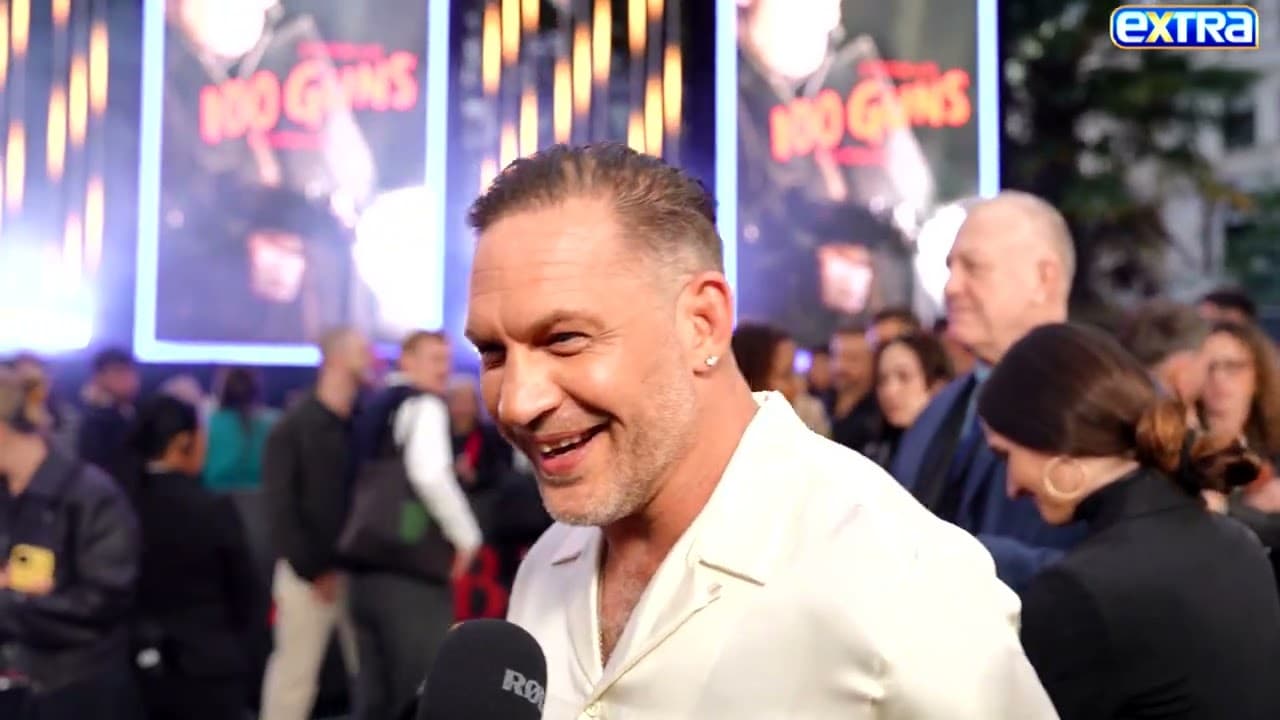
Tom Hardy stood at the Leicester Square premiere of MobLand Season 2 this week and declined, again, to say anything much about the rumors. He had made that choice months ago. Since production wrapped, tabloids had circled a story of on-set tension. Hardy went quiet. Helen Mirren did not.
Mirren called him 'absolutely remarkable.' She talked about differing actor methods, about love, about respect on set. Hardy, told Extra TV at the Leicester Square event, received all of it with a single line: 'She's my friend.' That was the full rebuttal. No counter-narrative. No publicist statement. No sit-down interview explaining what really happened. Just silence, then a warm acknowledgment, then back to talking about the show.
The restraint is intentional. And when you map it against where Hardy sits in his career right now, a streaming hit confirmed for a third season before the second has even aired, the strategy reveals something instructive about how A-list talent navigates the gap between tabloid friction and franchise value.
What the MobLand on-set drama rumors actually claimed
Reports circulated that tensions existed between Tom Hardy and other cast or crew during MobLand production. No specific incident was confirmed on the record, and neither Hardy nor Mirren has substantiated any named conflict.
The rumors arrived, as they often do, without a named source and without a specific incident. Tabloid dispatches suggested friction on set. They gestured at the familiar vocabulary of difficult talent, clashing methods, creative disagreements, an atmosphere gone sour. None of it was pinned to a date, a scene, or a witness willing to attach their name.
That vagueness is worth holding onto. The absence of a concrete allegation is precisely what made Hardy's silence viable as a strategy. There was no incident to rebut. There was a mood. And moods, left unfed, tend to dissipate.
Mirren moved first among the principals. She spoke publicly about different acting methods, a diplomatic framing that both acknowledged some version of difference existed and immediately defused it by recasting that difference as a feature, not a fault. Hardy, speaking to Entertainment Tonight, described the whole episode as 'sad.' Not damaging, not false, just sad. It was a precise word. It named a feeling without escalating a fight.
Why Hardy's silence was the only rational move
Hardy chose not to respond to the rumors because any public denial would have extended the story's news cycle and given it a legitimacy it had not yet earned. Silence starved the narrative of oxygen.
Hardy put it plainly in his Entertainment Tonight sit-down. If you say something, it becomes a story. If it was never really a story in the first place, speaking turns nothing into something. That is not spin, it is how media cycles actually function.
The counter-move, the one celebrities reliably get wrong, is the defensive statement. It signals the rumor landed. It invites follow-up questions. It reframes a vague whisper as a confirmed point of conflict that now requires a response. Hardy has been in this industry long enough to know that mechanism cold.
He also had structural protection. MobLand was already a hit. Season 3 had been announced. He was standing at a major premiere. The business context made tabloid friction feel small beside the visible evidence of professional success. Silence is a much safer bet when the scoreboard is already in your favor.
There is a generational dimension here too. Hardy mentioned it himself, the idea that methodological differences between actors can be 'so misinterpreted' across generations. It was a gentle flag that the story may have been born of a failure to read professional shorthand correctly. He declined to elaborate. Smart.
"Silence is a much safer bet when the scoreboard is already in your favor."
Helen Mirren's defense, what it cost her and what it bought
Helen Mirren publicly vouching for Tom Hardy cost her nothing professionally and bought the show considerable goodwill. A Dame and Oscar winner calling a co-star 'absolutely remarkable' is not a neutral act, it is a character reference from the most credible source available.
Dame Helen Mirren does not need MobLand. She is not dependent on a streaming crime drama for her next award, her next role, or her legacy. That independence is exactly what makes her public support so valuable. She had no obvious incentive to speak unless she meant it.
Hardy acknowledged the asymmetry. 'She needed it,' he said at Leicester Square, a self-deprecating read that also named the dynamic accurately. Mirren offered a gift. He accepted it with grace and zero additional drama. The result was a story that pivoted from 'tension on set' to 'warm co-stars defend each other.' Paramount+ did not have to lift a finger.
Mirren's framing, different methods, deep mutual respect, a cast that functions like a family, also served the show's broader brand. MobLand is positioning itself as prestige crime television. Prestige television runs on the mythology of serious actors doing serious work. A narrative about creative difference handled maturely feeds that mythology far better than any press release could.
Hardy's own assessment of Mirren on set tracked with the public framing. He talked about watching her 'let the devil out', about the pleasure of seeing a heavyweight actress embrace a genuinely wicked character. That is promotional language, yes, but it is also clearly felt. The two are, by every available indication, genuinely close.
Harry Clarke, how Hardy builds a character designed to outlast drama
Tom Hardy describes his MobLand character Harry Clarke as written entirely on the page, with Hardy's role being to inhabit rather than invent, a intentional deflection that redirects credit to the writing while also protecting Hardy from being blamed if the character misfires.
At Leicester Square, Hardy was direct about his process. Harry is on the page. Hardy fills in the gaps by standing there and trying not to bump into the furniture. It is a performance of modesty that contains a real methodology. He is describing instinctive rather than academic acting, reading a script for feeling rather than structure, then trusting the writing.
He credited showrunner Jez Butterworth by name. Butterworth's writing, Hardy said, is coordinated and organized. The guys know what they want. This is not mere politeness. It is a intentional positioning: Hardy as instrument, Butterworth as architect. That framing insulates Hardy from the narrative risks that come with being seen as a difficult genius rewriting scenes to serve himself.
The character of Harry also does something structurally clever. Hardy plays him against gangster type, someone you could invite into your house, he said, a man whose violence sits beneath a surface of ordinary warmth. That tension is what makes audiences feel strange sympathy for a murderer. It is also what makes Harry compelling across multiple seasons, because the gap between the surface and the reality never fully closes.
Harry's marriage, to Jan, played with pragmatic intelligence, adds a second register entirely. Hardy described the relationship as built on honesty of a very specific kind: Jan doesn't want the details, Harry tells her what she needs to know, and both tiptoe around what he called 'the huge god-sized hole' between them. That architecture sustains long-form drama. It is a relationship that cannot resolve. It can only deepen.
MobLand's three-season deal and what it signals for Paramount+
MobLand has been confirmed for a third season before Season 2 has aired, which signals that Paramount+ views the show as a franchise anchor rather than a one-cycle experiment. Early renewal at scale is a streaming platform's clearest declaration of confidence.
Streaming platforms renew shows for a third season before the second airs only when the internal data is unambiguous. Viewing hours, subscriber retention, and international licensing numbers tell a story well before critics do. Paramount+ has seen that story and liked it enough to commit.
For Hardy, this is significant in a specific way. His film career has been built on franchise adjacency, the Batman universe, the Mad Max reboot, the Venom films. Television was always the space where he could exercise more sustained creative control. MobLand offers that, plus the stability of a guaranteed run. Three seasons is enough to build something with consequence.
Mirren's presence is not decorative. She is the prestige anchor that elevates the entire property on award-season shortlists and in international licensing conversations. Streaming platforms pay for names that travel. Her name travels everywhere. Combining her with Hardy, two British actors with distinct but complementary registers, gives MobLand a cast profile that punches above a typical crime drama. Our broader tracking of film wealth profiles shows how consistently this kind of prestige casting inflates a show's perceived value in distribution deals.
Season 3 is already outlined. Hardy said so at the ET sit-down, catching himself mid-sentence and pulling back with a laugh. The outline exists. That means the writers' room has been working. The machine is running. Whatever 'drama' the tabloids catalogued has not slowed it by a single frame.
Kit Harington and the ensemble dynamic Hardy describes
Tom Hardy describes the MobLand ensemble as a cast that has worked together long enough to move between intense dramatic scenes and ordinary conversation without difficulty, a sign of a professionally settled production rather than a fractured one.
Hardy has worked with Kit Harington, who plays the character in relationship with Hardy's Harry, for over a year by the time of these interviews. That tenure matters on a drama this emotionally demanding. When actors know each other well enough to say 'what about this?' rather than hold a formal position, the material gets looser and better.
The on-set rhythm Hardy described is recognizable to anyone who has spent time around long-form television. You play a violent scene. You cut. Someone asks what was for lunch. The ability to exit the material cleanly, without either performing distress or performing toughness, is a mark of professional health. Hardy returned to this point deliberately. The cast gets on. The writing is brilliant. Work is fun. Each statement is a small act of counter-programming against the tension narrative.
Paddy Considine got a specific mention in the Extra sit-down. Hardy described going to him when he has a 'wobble about work', a puzzle to think through. That kind of collegial trust does not exist on a set defined by mistrust. It is possible to read too much into casual praise, but Hardy's specificity here has the texture of something real.
What Gina's storyline reveals about MobLand's long game
The character of Gina, Harry and Jan's daughter, becoming a mirror of her father's choices expands MobLand from a gangster procedural into a generational family drama, a structural move that gives the show room to run well beyond typical crime-drama fatigue.
Hardy talked at length about Gina at the ET sit-down. Children do as you do and not as you say. The line lands because it names the exact mechanism: Harry cannot protect his daughter from becoming him by telling her not to. She watches. She imitates. The 'pipe dream of the illusion of family', Hardy's phrase, starts to fracture as the fledgling leaves the nest.
This is the structural move that separates long-running prestige drama from crime shows that burn bright and collapse. The Sopranos, Succession, The Wire, each found a way to fold the consequences of the protagonist's choices into the bodies of the people around him. MobLand is reaching for that register. Gina is not a subplot. She is the show's long-term engine.
For Hardy, it also expands the emotional palette available to him. Harry is not just protecting his family from outside threat, he is the threat his family needs protecting from. That is a dramatically richer position than straight crime drama allows. Three seasons, properly written, could map the full arc of that damage. The film wealth profiles we track rarely show sustained streaming success without exactly this kind of structural ambition underneath the casting.
What the 'sad' comment tells us about Hardy's media posture in 2026
Hardy's description of the rumors as 'sad' rather than 'false' or 'unfair' reveals a media strategy built on emotional deflection rather than factual rebuttal, a more sophisticated posture that closes down follow-up questions while projecting maturity.
The word 'sad' does specific work. It is not 'untrue', which invites a verification argument. It is not 'unfair', which implies a victim. It is sad. It names a feeling. It closes the door on the story by refusing to stand inside it and fight.
Hardy has been a tabloid subject for most of his adult life. He knows how the machinery works. A denial becomes a headline: 'Hardy denies...' A counter-story becomes a he-said-she-said that runs for another week. 'Sad' is a rhetorical full stop. It expresses disappointment without assigning blame, and it signals to any journalist in the room that there is nothing more to dig for here.
His broader media posture at this stage of his career is consistent with what we see from talent getting through franchise stability, an intentional reduction in exposure, a narrowing of what gets said publicly, and a redirection of attention toward the work. Hardy mentioned that stopping work is itself decompression. He trains. He does not 'do anything.' It is a studied plainness. The image it projects is of someone who has metabolized fame and finds it simply less interesting than the job.
That image, correctly maintained, is one of the most durable in the entertainment industry. It is the opposite of the difficult-star narrative the tabloids briefly tried to build. Hardy let Mirren speak, said the single true thing, she is his friend, and returned to talking about Harry Clarke. The story, by the time of these two premiere-week interviews, was already over.
Who wins and loses when a streaming drama weathers its own PR moment
Paramount+ is the structural winner when MobLand's drama rumors collapse without escalation, the show emerges with a coherent cast narrative, a prestige brand intact, and a third-season order that positions it as a genuine streaming franchise.
Platforms do not survive on individual hits. They survive on libraries. A show that generates clean goodwill across three seasons is exponentially more valuable than one that burns bright and craters in year two. The business logic behind MobLand's early Season 3 renewal is inseparable from the PR logic behind Hardy and Mirren's managed response to the rumors — see Selena Gomez Built a Billion-Dollar Brand. Music Is Now the Side Project..
Hardy wins too. He has a franchise character at a moment when franchise characters are the most reliably bankable assets in the industry. Harry Clarke, played against gangster type, designed to generate audience sympathy across multiple seasons, is exactly the kind of role that sustains a career between films. Our latest reporting consistently shows that streaming anchors negotiate from a position of strength when their platform has publicly committed to multiple seasons before a single episode of the current run has aired.
Mirren wins by association. She chose a role that let her 'let the devil out,' as Hardy put it. The public defense of her co-star adds a layer of loyalty and institutional seriousness to a performance already being watched closely. If MobLand runs three seasons and remains prestige property, her character May will be part of that legacy.
The losers are whoever filed the original tension story, because the story has now been neutralized twice, on camera, by both principals, without a single fact being added to it. That is a remarkably clean outcome for a production that could easily have spent its entire premiere week in defensive crouch. Instead, Hardy stood in Leicester Square talking about breathing in between jobs. That, in the end, is the whole strategy.