Tangled Live-Action's First Look Reveals a Disney Franchise Betting on Unknown Quantities
Fan-captured footage from Spain introduces Teagan Croft and Milo Manheim as Rapunzel and Flynn Rider. And the casting choices say everything about how Disney approaches its most beloved IP in the post-remake era.
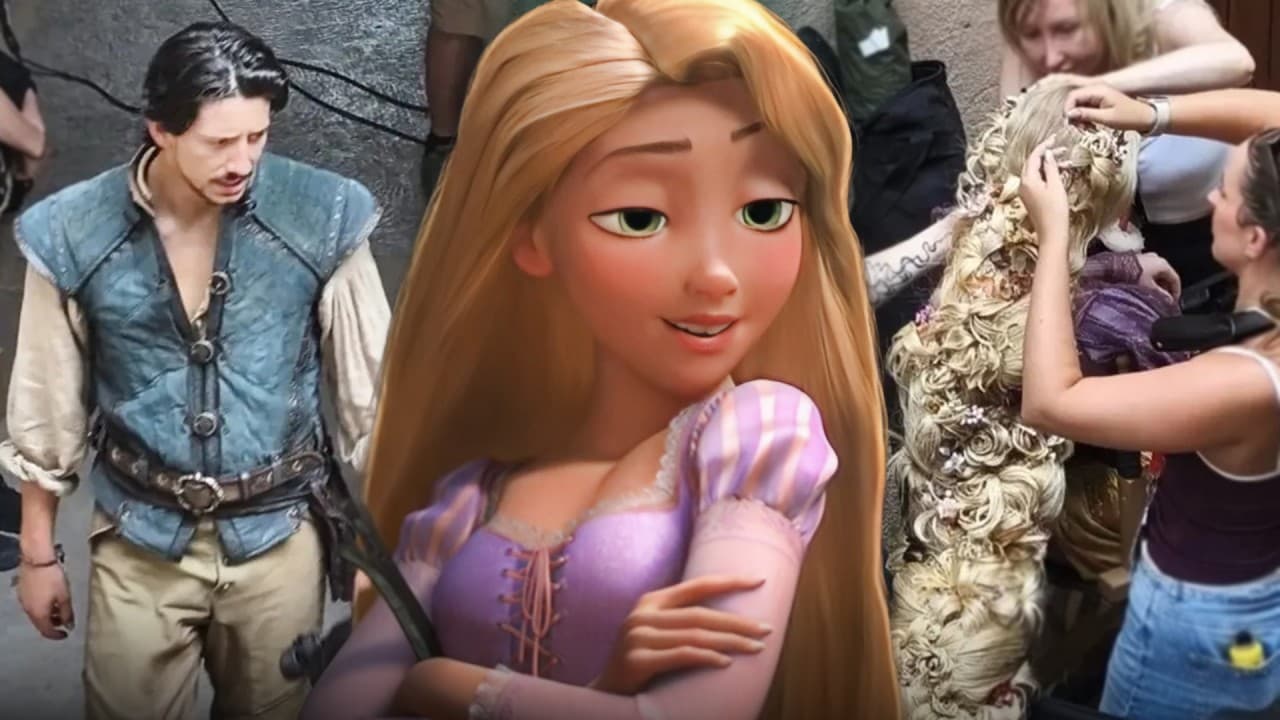
The footage arrived the way things always arrive now. Not from a studio marketing department, not from a carefully timed press release, but from a fan with a phone standing somewhere outside a Spanish location shoot. In it, Milo Manheim walks a set in a denim vest and khakis, giving the camera what his co-star Teagan Croft cannot yet provide: the smirk, the swagger, the studied casualness of a man who knows exactly how good-looking he is. Flynn Rider, in the flesh, more or less.
What makes the clip remarkable is not the fidelity to the animated source. Though solitaire ring, vest, and all, the costume department has done its homework. But the weight that a single fan-captured moment now carries in the machinery of franchise announcement. Disney did not release this. Disney did not control it. And yet it functions as the most effective piece of Tangled marketing to date, because it arrived with the oxygen of something discovered rather than delivered.
That is the environment into which Croft and Manheim have stepped: a live-action Disney remake landscape where the appetite for content is bottomless, the scrutiny is instantaneous, and the margin for error is priced into the casting long before a frame is shot. Who these two actors are, what they bring, and how Disney calibrated this particular bet is the real story underneath the hair extensions and the Spanish sunshine.
Who is Milo Manheim, the actor playing Flynn Rider
Milo Manheim is a 25-year-old Disney-channel actor best known for the Zombies franchise, making the Tangled live-action his highest-profile dramatic and theatrical leading role to date.
Manheim grew up inside the Disney ecosystem. A fact that reads, depending on your vantage point, as either the ideal preparation for a role like this or a ceiling he needs to visibly break through. The Zombies films made him a recognizable commodity within the studio's streaming and tween network, but they did not make him a movie star in the traditional sense. They made him a reliable performer of a very specific Disney register: warm, physically expressive, easy in front of a camera.
What the fan footage and Manheim's own comments. told Entertainment Tonight that 'everybody loves Flynn' and that he is doing his best to satisfy expectations. Reveal is a young actor who understands the weight of the IP he is carrying. That self-awareness is itself a skill. Flynn Rider is not a straightforward hero. He is a charming opportunist with a conscience, a character whose comedy and emotional arc depend on precise comic timing and the willingness to play genuinely unlikable before the pivot to likable. Getting that ratio wrong is how remakes become punchlines.
Manheim's public framing of his approach. That he can 'only be true to myself and embody the spirit of the cartoon'. Is both honest and strategically sound. It gives him permission to interpret rather than imitate, which is the only sustainable path through a role that an entire generation has already cast in their imagination. The question is whether his range is wide enough to satisfy viewers who want the familiar and critics who will want something new. That answer only arrives when the film does.
The career mechanics here are worth examining. Landing the male lead of a live-action Disney feature is the kind of role that resets a trajectory. It either confirms that a performer belongs at this level or exposes why they do not. For Manheim, it is arguably the first real test of whether he is a Disney Channel alumnus or a Disney leading man. Those are different things, and the industry treats them differently.
Who is Teagan Croft, Disney's new Rapunzel
Teagan Croft is an Australian actress who rose to prominence playing Rachel/Raven in DC's Titans series on Max, making her live-action Tangled a significant genre pivot from dark superhero drama to Disney musical fantasy.
The Rapunzel casting is the more surprising of the two. Croft built her reputation in the Titans universe. A notably grim, mature-audience take on the DC Teen Titans property that is about as far from the golden towers and singing lanterns of Tangled as television gets. She spent years playing a character defined by repressed emotion, psychological darkness, and the threat of demonic power. Now she is being asked to embody Disney's most luminously optimistic princess.
That pivot is either a liability or a masterstroke of range demonstration, and which it turns out to be depends almost entirely on what Croft does with the musical components. Rapunzel in the 2010 animated film is carried significantly by her voice. Not just in the literal sense of the songs, but in the emotional openness of every line reading. The character's wonder is her engine. It is a mode of performance that requires total commitment without self-consciousness, which is a completely different instrument than the controlled, inward work Croft has done on Titans.
What the production footage does show is that the physical transformation has been executed seriously. The army of hair stylists Croft reportedly worked with is not a trivial detail. Rapunzel's hair is, in a very literal sense, the plot of the film. Getting it wrong would be the first thing every review mentioned. Getting it right buys Croft the visual authority the role demands before she says a word.
Disney's logic in casting her becomes legible when you consider what the studio is actually buying. Croft is not a risk in the way that a total unknown would be. She has proven she can carry a series as a lead, sustain a long shoot, and hold audience attention across multiple seasons of a demanding dramatic property. She is, in other words, a known quantity of a specific kind: disciplined, capable, tested. Whether she can also be joyful is the open variable, and that open variable is what makes this casting interesting rather than safe.
"Kathryn Hahn is the signal sent early and loudly: when leads are unproven, prestige in the villain slot buys goodwill that extends to everyone else on screen."
Why Disney shot Tangled on location in Spain
While Disney has not formally confirmed the full production details, fan footage places the Tangled live-action shoot in Spain, consistent with the studio's recent pattern of using European locations to provide practical texture for animated-to-live-action adaptations.
The choice of Spain as a production base is worth pausing on. Disney's animated Tangled is set in a vaguely Northern European kingdom. The architecture is Germanic, the landscape is forested cliffs and rivers. Spain offers something different: warm light, Mediterranean stonework, a visual palette that reads as fairy-tale without requiring the kind of enormous set construction that a pure stage shoot would demand.
There is also a financial logic running underneath the aesthetic one. European production incentives have reshaped where major studio tentpoles are made. The UK, Spain, and several Central European countries offer rebates and co-production structures that can meaningfully reduce the cost of a large-scale fantasy film. For a project of Tangled's likely budget. And live-action Disney remakes have historically ranged from modestly expensive to eye-wateringly so. Those incentives represent real money against the production cost line.
The fan-capture dimension is worth naming plainly: shooting on location in an accessible environment is always a double-edged proposition. The studio loses control of when the public first sees the film. It gains, in exchange, the authenticity that a controlled backlot environment cannot fully provide, and. Perhaps more usefully. The organic social energy of footage that feels discovered. The Manheim clip traveled because it felt like a secret. That is worth more, in the current attention economy, than any number of officially released first-look images.
Kathryn Hahn as Mother Gothel: why this casting matters most
Kathryn Hahn's casting as Mother Gothel in the Tangled live-action is the production's highest-use creative decision, because Mother Gothel's complexity. Manipulative, theatrical, and genuinely menacing. Demands an actress capable of playing comedy and horror simultaneously.
Of everything the Entertainment Tonight report surfaces, the Kathryn Hahn confirmation is the element that should most excite anyone paying attention to this project as a piece of craft rather than a piece of IP. Mother Gothel is, in the architecture of the original film, the best villain Disney produced in that generation of features. She is not a monster. She is a narcissist who has constructed an entire emotional ecosystem designed to make her victim feel loved and dependent simultaneously. That is a sophisticated piece of psychological writing, and it requires an actress who can play warmth and menace in the same breath.
Hahn has spent the last several years demonstrating, across WandaVision and various film roles, that she is precisely that kind of performer. She can be hilarious. She can be terrifying. She can be both at once. Her confirmation of the casting. In a on purpose cheeky social media video that played on the absurdity of the announcement before leaning into the inevitability of it. Showed an actress who has already done the character work, who already knows what she is going to do with the role.
For Disney, Hahn's involvement does something the leads alone cannot fully accomplish: it provides a critical credibility anchor. When a studio is asking audiences to invest in two relatively unproven film leads, placing a fully formed and critically respected performer at the center of the story's conflict is a structural guarantee. Audiences who are uncertain about Croft and Manheim will be certain about Hahn. That certainty creates goodwill that extends, by proximity, to everyone else on screen.
The business dimension here maps neatly onto what we have seen Disney do with its most successful recent remakes. The casting of a high-prestige supporting or antagonist performer. Someone whose involvement signals that the production is serious. Has become as important to the marketing of these films as the leads themselves. Hahn is that signal, sent early and loudly.
Mandy Moore's graceful handover and what it signals about the remake era
Mandy Moore, the voice of Rapunzel in the 2010 animated Tangled, publicly expressed enthusiasm for the live-action adaptation and indicated openness to playing Rapunzel's biological mother in the remake, representing a model of IP transition that benefits both the franchise and the original performer's legacy.
Mandy Moore's posture toward the live-action Tangled. Captured in a May conversation with ET and revisited in this week's coverage. Is a case study in how original talent can get through the remake era without either clinging to ownership they no longer hold or performing a graciousness that reads as hollow. Her line about trusting that Croft will be 'fantastic' and that she 'can't wait to see the live-action' is exactly the right note: it is generous without being self-effacing, enthusiastic without being desperate.
More interesting is the exchange about Moore potentially playing Rapunzel's biological mother. The Queen, who in the animated film appears only briefly but whose role in any expanded live-action version could be substantially larger. Moore's answer, 'I would love to,' delivered with apparent sincerity, is a smart piece of positioning. It signals availability without lobbying. It keeps her adjacent to the franchise without making her seem unwilling to let it go.
This dynamic. Original voice actor expressing enthusiasm for involvement in a live-action version. Has become its own genre of celebrity navigation in the current Hollywood moment. The interesting thing about Moore's version of it is its emotional authenticity. She has spoken publicly over the years about the significance of the Tangled project to her career, arriving as it did at a moment when her music career was in transition. The film matters to her in a way that goes beyond contractual nostalgia.
For the studio, Moore's enthusiasm is free marketing from a source with deep credibility among the exact audience segment most invested in whether the live-action version honors the original. That credibility cannot be bought. It can only be earned, over years, by the original production having meant something to the people who loved it.
How live-action Disney remakes have performed commercially and critically
Disney's live-action remake slate has produced both billion-dollar hits like The Lion King (2019) and critical disappointments, establishing a pattern where box-office performance and audience reception frequently diverge from critical consensus.
The commercial record of Disney's live-action adaptations is complicated enough that no single narrative fully fits it. The Lion King made over $1.6 billion worldwide in 2019 on the back of nostalgia, technical spectacle, and a voice cast that read like a cultural event. Cinderella, Beauty and the Beast, and Aladdin all cleared significant box-office thresholds. And yet each of those films also generated a running critical conversation about whether the exercise of replication. However technically accomplished. Is artistically defensible in the first place.
Tangled occupies a specific position in the Disney animated canon that creates both opportunity and risk. The 2010 film was the studio's return to the classical musical fantasy form after a period of uncertainty about whether that form still had commercial life — see The Reverse Megxit: What Meghan's Return to Acting Reveals About the Sussex Business Model. It succeeded, enormously, and in doing so it became the template for Frozen, Moana, and the subsequent wave of Disney animated features that dominated the 2010s. Adapting it into live-action means adapting a film that was itself, in some structural sense, a revival. Which raises questions about what a revival of a revival actually adds.
The answer Disney appears to be betting on is spectacle and casting. A real Spanish landscape, a real woman with an extraordinary length of hair, real actors doing what animated characters cannot: age, sweat, stumble over lines in a way that reads as human. Whether that argument is sufficient to justify the project creatively is a separate question from whether it will perform commercially. Based on the broader slate, the commercial case writes itself. The creative case is still being made, one fan-captured clip at a time.
For context on how the film industry calibrates these bets, it helps to look at what happened with the live-action Little Mermaid in 2023. A film that performed adequately but not spectacularly, and that generated a debate about whether the casting conversation had consumed more oxygen than the film itself could repay. Tangled's early rollout suggests Disney has internalized that lesson: lead with performance, lead with craft, let the characters do the work.
What this first look means for Croft and Manheim's career trajectories
A live-action Disney lead role functions as a career-defining test for both Teagan Croft and Milo Manheim. Success could elevate them to a tier of bankable young talent; a high-profile stumble would be significantly harder to recover from than a quiet miss on a smaller production.
The stakes asymmetry of a project like this is worth naming clearly. For Manheim, the Tangled role is the most prominent thing he has been attached to, full stop. If it works, it is the film that redefined what he was capable of. If it does not, it is the film that established the ceiling of the Disney Channel pipeline. Competent, appealing, but not quite sufficient for this level of franchise. That is a hard ceiling to emerge from, as the careers of several Disney Channel graduates who attempted similar pivots demonstrate.
Croft's situation is slightly different because her baseline is set in a different place. Titans established her as a performer of real dramatic substance in a way that Manheim's Zombies work, however charming, does not quite match. A stumble in Tangled would not erase Titans from her CV. But a genuine success. A Rapunzel who becomes the film's emotional anchor. Would announce her as one of the most versatile young actresses working, someone capable of carrying franchise work across multiple tonal registers.
The comparison that structures both careers going forward is, unavoidably, the one set by the last generation of Disney live-action leads. Emma Watson's post-Beauty and the Beast trajectory, the various paths taken by the casts of Cinderella, Aladdin, and The Little Mermaid. These are the data points that the industry uses to evaluate what a live-action Disney lead role actually does to a career over five to ten years. The honest answer is: it depends almost entirely on what the performer does next, and how quickly. The window that a successful high-profile lead role opens is real, but it does not stay open indefinitely.
This is, ultimately, why the fan footage from Spain generated the kind of attention it did. It is not just a first look at a costume. It is the opening bid in a negotiation between two young actors and an audience that has not yet decided whether it wants to accept them. That negotiation will run for however long it takes the film to reach theaters. And every frame between now and then is part of the argument. The latest reporting on both performers' subsequent projects will tell us a great deal about how the studio itself is reading those odds.
The economics of Disney's IP recycling machine in 2026
Disney's live-action remake program is, at its core, a capital-efficient IP monetization strategy that converts fully amortized creative assets into new theatrical and streaming revenue cycles, with Tangled representing a title whose original animated success makes it among the lowest-risk candidates in the remaining remake…
Strip away the nostalgia and the casting discourse, and Disney's live-action remake program is a remarkably legible piece of corporate strategy. The studio holds a library of animated titles whose cultural penetration. Measured in the number of people who know the characters, the songs, the emotional beats. Represents decades of marketing spend that has already been made. Adapting those titles into live-action does not require building a new audience. It requires converting an existing one.
Tangled is, by that logic, close to ideal remake material. The 2010 film found a large audience that has now aged into the demographic most likely to bring children to theaters. The songs. Alan Menken's work on that score is genuinely excellent. Are embedded in a generation's memory in the way that only a handful of studio soundtracks achieve. The IP has not been overexposed in the way that, say, the Marvel or Star Wars properties have been. It arrives relatively fresh, which is a meaningful commercial advantage.
The casting of Hahn, in particular, reflects the business logic of prestige-signaling as a marketing investment. A name that carries critical credibility costs more up front and returns that cost in reviews, awards conversation, and the kind of word-of-mouth that sustains a film beyond its opening weekend. The comparison point is how studios have used prestige supporting casting in franchise contexts before. Think of the role a single performance can play in elevating the perceived quality of an entire production. That math works in Disney's favor here.
For anyone tracking the broader economics of the entertainment business. And the Atlas provides a useful map of who holds wealth and influence in this industry at any given moment. Disney's remake pipeline is one of the most durable revenue mechanisms in American media. It does not require Disney to take large creative risks. It requires the studio to execute familiar material at a sufficiently high level that audiences feel the value proposition is met. Tangled, with this cast and this creative team, appears to be threading that needle. At least in the early going. The proof, as always, is in the picture.
What the fan-capture moment reveals about the new publicity landscape
The viral fan-captured footage of Milo Manheim in costume on the Tangled set illustrates how location shoots have become uncontrolled marketing events, where organic audience discovery now generates more credible early buzz than any official studio first-look campaign.
There is a structural irony in the fact that the most effective piece of Tangled marketing produced so far was not produced by Disney at all. A fan with a phone, standing near a location shoot in Spain, captured Manheim in costume and released it into an environment already primed to receive it. The clip traveled. It generated coverage. It arrived, critically, before the studio was ready to control the conversation. And paradoxically, that timing made it more valuable than a controlled release would have been — see The Interview the FCC Tried to Kill, and Why That Made It More Powerful.
This is the fundamental tension that location shooting creates in 2026. The practical and financial advantages of shooting on real locations are well established. But real locations are permeable. They sit inside public space. And public space is now equipped with cameras connected to global distribution networks at essentially zero cost. Every major production that steps outside a controlled studio environment accepts this as a condition of doing business, and the smart ones have begun to think about how to use it rather than resist it.
The Tangled team's posture. If we can infer it from the shape of what has emerged so far. Appears to be a comfortable one. Manheim has been publicly enthusiastic and accessible in his comments. The footage that has surfaced is flattering. The production appears to understand that the first-look moment, in the current environment, belongs to whoever captures it first, and has either accepted that or is sophisticated enough to have shaped the conditions under which it occurred.
The broader implication for how studios manage IP reveals extends well beyond this single production. The conversation around authenticity in celebrity and franchise marketing has been building for years. And as pieces like our analysis of Tom Holland's Odyssey joke and how public figures manage the line between genuine revelation and calculated disclosure demonstrate, the most effective moments of press often feel unscripted precisely because the infrastructure supporting them is invisible. The Tangled fan footage is that dynamic operating at the franchise level: the appearance of accident, delivering the substance of announcement.