Sam Neill Is Gone, and the Media Machine Barely Paused to Notice
A week that delivered a Jurassic Park legend's sudden death, a senator's proof-of-life controversy, and the cruelty economy of celebrity grief reveals exactly how the attention business prices human loss in 2026.
The news came out of Australia late on a Sunday night. Or early Monday morning, depending on which time zone was doing the grieving. And by breakfast on the American East Coast it was already competing for airspace with a conspiracy theory about a geriatric chair. That is the precise and merciless arithmetic of the current attention economy: Sam Neill, 78 years old, Jurassic Park, The Hunt for Red October, Peaky Blinders, gone suddenly and unexpectedly after his family had announced just months earlier that he was cancer-free. The shock of that particular reversal. The hopeful medical update followed so quickly by the worst kind of news. Barely had room to breathe.
On the same morning, the TMZ Podcast was working through a full docket of political mortality and manufactured controversy. Mitch McConnell's team had released a weekend press release and a proof-of-life photograph. Lindsey Graham had died of a torn aorta linked to heart disease. Margaret Cho had posted a TikTok that her own audience described as dancing on a grave. By the time the hosts got to Sam Neill, the conversation was already freighted with the week's cumulative weight. And yet Neill's death landed as what it was: a genuine, uncomplicated loss, unmarked by political fracture or viral outrage.
What this particular Monday morning reveals is not new, exactly, but it is clarifying. The media apparatus that surrounds death, illness, and public disappearance in 2026 operates on a tiered system of engagement. Politicians generate suspicion. Comedians generate backlash. Actors. Real ones, the kind who spent decades building a body of work rather than a personal brand. Generate something closer to grief. The difference in those responses tells you almost everything about how fame is manufactured, consumed, and mourned right now.
Why Sam Neill's death hit differently than the rest of the week's news
Sam Neill's death registered as unambiguous grief because his career was built on decades of craft rather than controversy. He was a character actor of the highest order, not a political figure or a brand, which left no room for the cynicism that colored every other story this week.
There is a category of actor whose fame is structural rather than personal. They are not the star of the franchise; they are the reason the franchise feels like something real. Sam Neill spent forty years working in that register. Alan Grant in Jurassic Park is the obvious touchstone. The film is now over thirty years old and the character still functions as a kind of cultural north star for a certain generation of filmgoers. But the range behind it is the more instructive thing. The Piano. The Hunt for Red October. Event Horizon. Peaky Blinders, in its later iterations. An actor who can move credibly between a Steven Spielberg blockbuster and a Jane Campion art film is not a movie star in the conventional sense. He is something rarer: a craftsman with range.
His family's Instagram announcement described the death as sudden and unexpected, offering no specific cause, and noting that more information would follow. The detail that struck hardest for anyone who had been following his health is that Neill had publicly declared himself cancer-free earlier in 2026. The whiplash of that sequence. The good news, then this. Is part of why the reaction online felt different from the noise surrounding the week's other deaths. There was no political valence to reach for. No one had a take. The space where hot-takes usually live was briefly, mercifully, empty.
For the film industry, Neill's death closes a particular chapter in the history of blockbuster filmmaking. He was part of the original cast that made the Jurassic Park universe matter. Not as a franchise mechanism but as a piece of popular cinema with genuine emotional stakes. You can trace a direct line from his performance in 1993 to the multi-billion dollar IP machine that has run ever since — see Selena Gomez Built a Billion-Dollar Brand. Music Is Now the Side Project.. The irony is that the later entries in that franchise, the Chris Pratt era, never quite captured what the original had, and what the original had was largely a function of the actors who made you believe in the dinosaurs before the CGI did its work. Neill was central to that contract.
What the McConnell proof-of-life controversy actually exposes
The McConnell photograph controversy exposes a structural problem in political communication: in an era of convincing AI-generated imagery, no static image can serve as proof of anything, which means public trust in official statements has effectively collapsed regardless of whether those statements are truthful.
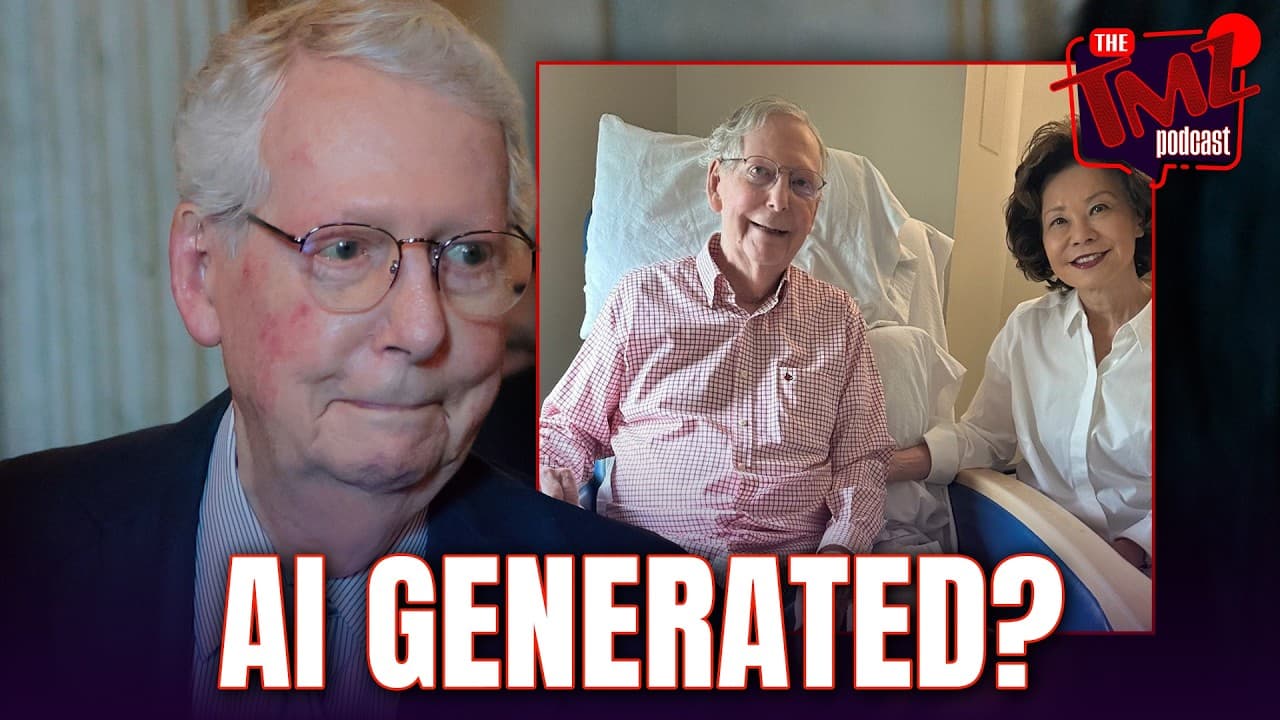
The McConnell team's weekend press release was thorough by the standards of political health communication. A serious fall. No broken bones. No heart attack, no stroke, no tumors, no hemorrhages. A brief loss of consciousness, hospitalization, a subsequent bout of pneumonia. It is the kind of statement that, fifteen years ago, would have settled the question. Instead, it opened a new front. The accompanying photograph. McConnell seated in what his critics insisted on calling a hospital bed (it was, as the TMZ hosts laboriously established, a geriatric chair, built for patients with limited mobility, not an ICU gurney). Became the primary object of forensic scrutiny before the afternoon was out.
The AI-manipulation theory centered on the corner of a Washington Post newspaper visible in the frame. The paper's date and a visible headline were apparently intended to timestamp the image, to prove it was current. Conspiracy-minded observers zoomed into the newsprint and declared the text illegible or distorted. Evidence, in their reading, of generative AI artifacts. The more prosaic explanation is that a photograph taken on an older smartphone, next to a window, of small-print text will produce exactly that kind of compression noise. But the more prosaic explanation is no longer winning these arguments, because we have entered a period in which the tools that could theoretically be used to fake an image have made every image suspect, real or not.
This is the bind that public figures. Especially older ones whose staffs may not be running sophisticated digital communications operations. Now find themselves in. A photograph proves nothing to a skeptical audience. A video can be dismissed as old footage or AI synthesis. A live appearance on Capitol Hill requires a level of physical fitness that the patient may not yet have. There is, at present, no format of proof that the committed skeptic cannot dismiss, which means the information war around political health disclosures is functionally unwinnable for the people making them. Our earlier analysis of the silence around McConnell traced how this vacuum of communication created the conditions for the conspiracy in the first place. The photograph didn't close that vacuum. It just changed its shape.
Jimmy Kimmel's parody response. His own face photoshopped onto a hospital-bed figure, captioned as a health update. Is worth noting not for its humor but for what it reveals about the celebrity-political media overlap — see Hayden Panettiere Is Gone at 36: What Her Life Reveals About the Cost of Child Stardom. When a late-night host can turn a sitting senator's medical crisis into a late-night bit within forty-eight hours, the boundary between political journalism and entertainment commentary has not blurred. It has dissolved entirely. That may be appropriate given the entertainment-industrial complex that now surrounds Washington, or it may be a symptom of something more corrosive. Probably both.
"The window between event and narrative is closing. What used to take days now takes hours, and the shortcuts favor outrage over grief every time."
Lindsey Graham's death and the speed of political grief in 2026
Lindsey Graham's death from a torn aorta linked to heart disease arrived with emergency-response images already circulating online, compressing the space between breaking news and public mourning to near zero. A rhythm that leaves almost no room for the private grief of people who actually knew him.
The images of Graham being transported from his residence, apparently already on a breathing tube, were circulating before most of his colleagues had released formal statements. That sequence. Image first, statement second, official confirmation third. Is now the standard architecture of a breaking death story, and it is worth pausing on how recently it became standard. The photograph of a public figure's final medical emergency, taken by someone with a phone and posted before the family has had a chance to make calls, represents a genuine rupture in the way societies have historically managed the transition between a life and its public accounting.
Graham was 70. A fact that generated genuine surprise in a Washington environment where age itself has become a kind of political credential. The week before his death, he had apparently been seen ascending Capitol steps without difficulty. A TMZ correspondent who had interviewed him recently noted that he had been good-humored and physically present in a way that made the news feel sudden in a different register than it might have otherwise. The bubble-wand encounter that the hosts referenced. A piece of light, humanizing video journalism. Now reads retroactively as something closer to a farewell.
The political consequences of Graham's departure are beyond this publication's lane, but the media consequences are not. His death, arriving simultaneously with the McConnell health story and the Neill obituary, created a kind of editorial pile-up in which three significant stories competed for the same Monday morning attention. In that competition, the most politically charged story (McConnell) generated the most traffic. The most tragic (Neill) generated the most genuine emotional response. And Graham's death. Which arguably had the largest structural consequences of the three. Occupied an uncomfortable middle space, too recent for retrospective, too complex for easy sentiment.
What Margaret Cho's TikTok reveals about the cruelty economy of celebrity commentary
Margaret Cho's immediate mockery of Lindsey Graham on TikTok. Posted before the news had finished breaking. Illustrates how social platforms now incentivize speed over judgment, rewarding the fastest take rather than the most considered one, with comedians particularly exposed to the backlash that follows.
The line itself. 'from the closet to the coffin, real seamless'. Is the kind of joke that might, under different circumstances and with more distance, find a specific audience. Comedy about political hypocrisy has a long and legitimate history. The problem was the timing: the post went up essentially as the news was breaking, before Graham's family had been able to process what had happened, before the basic facts of his death had been confirmed. The cruelty read not as satire but as opportunism.
The interesting analytical question is not whether the joke was in bad taste. It clearly was, and the online response confirmed as much. But why a comedian with Cho's experience made the calculation that speed mattered more than calibration. The answer is probably the same one that explains most bad takes in 2026: social platforms reward the first voice in the conversation, and the first voice in the conversation does not always have time to consider what it is actually saying. The incentive structure is built for reflexes, not reflection.
The TMZ hosts' response. Which amounted to a fairly direct rejection of the 'comedy card' as a blanket defense. Is worth noting because it comes from a media organization not traditionally known for restraint. When the outlet that built its brand on aggressive celebrity coverage says a take has gone too far, that is a meaningful calibration point. The framing they landed on was simple and probably correct: you do not have to fake grief for someone whose politics you oppose, but you do not have to post anything at all. The absence of a post is not a moral failure. The presence of a bad one is.
Cho's situation also illustrates a broader professional risk that comedians face in the social media era. The live set allows for context, for audience chemistry, for the comedian to read the room and adjust. TikTok does not. A joke that lands differently than intended cannot be walked back with body language or a follow-up line. It simply exists, stripped of everything that might have made it legible as comedy, available to be screenshotted and redistributed by people who were never its intended audience. The platform does not care about intent. It cares about engagement, and outrage generates more of that than almost anything else.
How the AI-image skepticism problem changes political crisis communication
AI-image skepticism has made it nearly impossible for political offices to issue photographic proof-of-life statements with any confidence that a significant portion of the public will accept them, effectively breaking the traditional communication tool kit for managing a politician's health crisis.
The mechanics of the McConnell photo skepticism are worth understanding in some detail, because they represent a template that will be applied to every future political health disclosure. The argument runs: AI image generators sometimes produce illegible or blurry text when asked to render printed material, because they interpolate rather than reproduce. Therefore, any photograph containing printed text that appears slightly blurry. Which is to say, almost any photograph of printed text taken with a phone camera at distance. Can be held up as potential evidence of AI generation. The standard of proof required to rebut the claim is effectively infinite, because any rebuttal can itself be dismissed as part of the fabrication.
What this means practically is that political communications offices need to think differently about health disclosures. The static image is no longer a viable tool. A controlled video, filmed in a format that makes metadata verification possible, with a clearly current and verifiable timestamp, might do more work. But as the TMZ hosts correctly noted, even that can be dismissed as old footage or deep-faked. The only format that retains some resistance to the skepticism loop is a live appearance, either in public or via an unedited streaming feed. And a live appearance is precisely what a patient in recovery may not be able to manage.
This is not a problem unique to McConnell, and it will not end when his situation resolves. Any senior politician who is hospitalized for more than a few days will now face this structural deficit: the tools available to reassure the public are the same tools that the public no longer trusts. The information environment has developed faster than the communication strategies designed to operate within it, and there is no obvious fix.
The career and legacy of Sam Neill beyond Jurassic Park
Sam Neill's career spanned more than four decades across Hollywood blockbusters, European art cinema, and prestige television. A range that places him among the most versatile leading men of his generation, not simply as the star of a dinosaur franchise but as a serious actor who understood how to inhabit every register of…
The Jurassic Park association is inevitable and not entirely unfair. The film is genuinely one of the most consequential pieces of popular cinema of the last half-century, and Neill's performance as Dr. Alan Grant is the emotional engine that makes the spectacle meaningful. But reducing him to that single role misses the architecture of a forty-year career that ran from Omen III in 1981 through John Carpenter's In the Mouth of Madness, through the chamber-drama intensity of The Piano opposite Holly Hunter and Harvey Keitel, through late-career television work that included Peaky Blinders and a run of projects that demonstrated he had no interest in coasting on franchise nostalgia.
For readers who track the film industry's economics closely, Neill represents a career model that is genuinely rare: the character actor who crossed over into tentpole stardom without losing the craft work that made him interesting. Most actors who anchor a franchise of Jurassic Park's scale end up defined by it in ways that constrain subsequent choices. Neill managed to avoid that gravitational pull, partly through intentional selection of projects and partly through the kind of charisma that directors across genres find useful. Specific, grounded, never indicating.
He had been public about a cancer diagnosis in 2023, which had given his fanbase an extended period of anticipatory grief, followed by the relief of the cancer-free announcement earlier this year. The sudden reversal of that narrative. The unexpected death after the good news. Is part of why the Monday morning response felt so disorienting. The public had, in a sense, already processed the possibility of losing him and had concluded that the threat had passed. It had not passed. That particular whiplash belongs to a very specific category of loss, and the entertainment industry has not yet developed a language adequate to it.
What this week's death cluster reveals about how media prices loss
When multiple high-profile deaths occur simultaneously, media coverage reveals an unspoken hierarchy: political figures generate controversy and traffic, entertainers generate genuine mourning, and the structural consequences of loss. Who fills the seat, who inherits the role. Get crowded out by the emotional and partisan…
The competition between these three stories on the same Monday morning is itself analytically useful. McConnell generated the most heat but the least resolution. A proof-of-life photograph that proved nothing to the people who needed convincing. Graham's death generated the most structural consequence but the least media oxygen, squeezed between a conspiracy story and an obituary for a beloved actor. Neill generated the cleanest grief but the shortest news cycle, because there was no controversy to sustain engagement once the initial shock had passed. That sequencing is not accidental. It reflects the incentive architecture of platforms and publishers in 2026.
The business of celebrity and political coverage. And the line between those two categories has never been more porous, as our latest reporting consistently documents. Runs on conflict. Graham's death is sad. McConnell's photograph is suspicious. Cho's joke is offensive. Neill's passing is simply a loss, and simple losses are the hardest to monetize in an attention economy that requires a next move, a counter-narrative, a reason to keep scrolling. The result is that the most uncomplicated human moment of the week. The death of a great actor who had told his audience he was going to be okay. Gets the least sustained coverage.
This is not a new observation. But the speed at which the cycle moved this week. From breaking death to conspiracy to backlash to obituary, all before noon on a Monday. Suggests the compression is accelerating. The window between event and narrative is closing. What used to take days now takes hours, and the shortcuts that come with that speed are not neutral: they favor outrage over grief, suspicion over acceptance, the hot take over the considered retrospective. The people who suffer most from that compression are not the media outlets that benefit from the traffic. They are the families who are still making phone calls when the first TikTok is already live.
The age and fitness question that Washington can no longer avoid
The simultaneous hospitalization of Mitch McConnell and the sudden death of Lindsey Graham. Both in their seventies. Has reignited the structural debate about whether the United States Senate's age profile represents a governance risk that existing institutional norms are not equipped to manage.
The comment that got the most traction in the TMZ discussion. Borrowed from a viewer who suggested senators should serve eight years, like a president. Captures a frustration that runs well beyond partisan lines. The current Senate includes a remarkable concentration of very old men and women whose capacity to serve is, by the standard of any other professional environment, a legitimate question. McConnell himself has had multiple public health episodes over the past several years. His continued presence in a leadership-adjacent role has been a subject of genuine policy concern, distinct from political opposition to his positions.
The instinct of the TMZ hosts. That a sitting senator who is still hospitalized should probably resign. Is not a hot take. It is a fairly mainstream position that institutional norms make difficult to voice in political media without accusations of partisanship. The entertainment-media axis, which operates outside the protocols of the political press, can say it plainly. Whether that plainness constitutes good journalism or just good ratings is a separate question, but the underlying point is hard to dismiss. Governance requires presence. Presence requires health. Health is not guaranteed, and the current system has almost no mechanism for managing its absence gracefully.
The deeper issue. One that the news cycle will not stay on long enough to address. Is that the concentration of very old politicians in very powerful positions is not an accident. It is the product of seniority systems, donor relationships, and the structural advantages that incumbency confers. Reforming those systems requires the kind of sustained political will that is hard to generate when the news cycle is already moving on to the next photograph, the next conspiracy, the next TikTok. The deaths and hospitalizations will keep coming. The structural response, if there is to be one, will have to come from somewhere other than a Monday morning podcast.