Zendaya, Tom Holland, and the Quiet Power of Sharing the Frame
Their Entertainment Tonight sit-down for Christopher Nolan's The Odyssey looked like a soft press junket moment. Read the architecture underneath and it reveals a great deal about how Hollywood's most scrutinized couple is managing the next phase of both their careers.
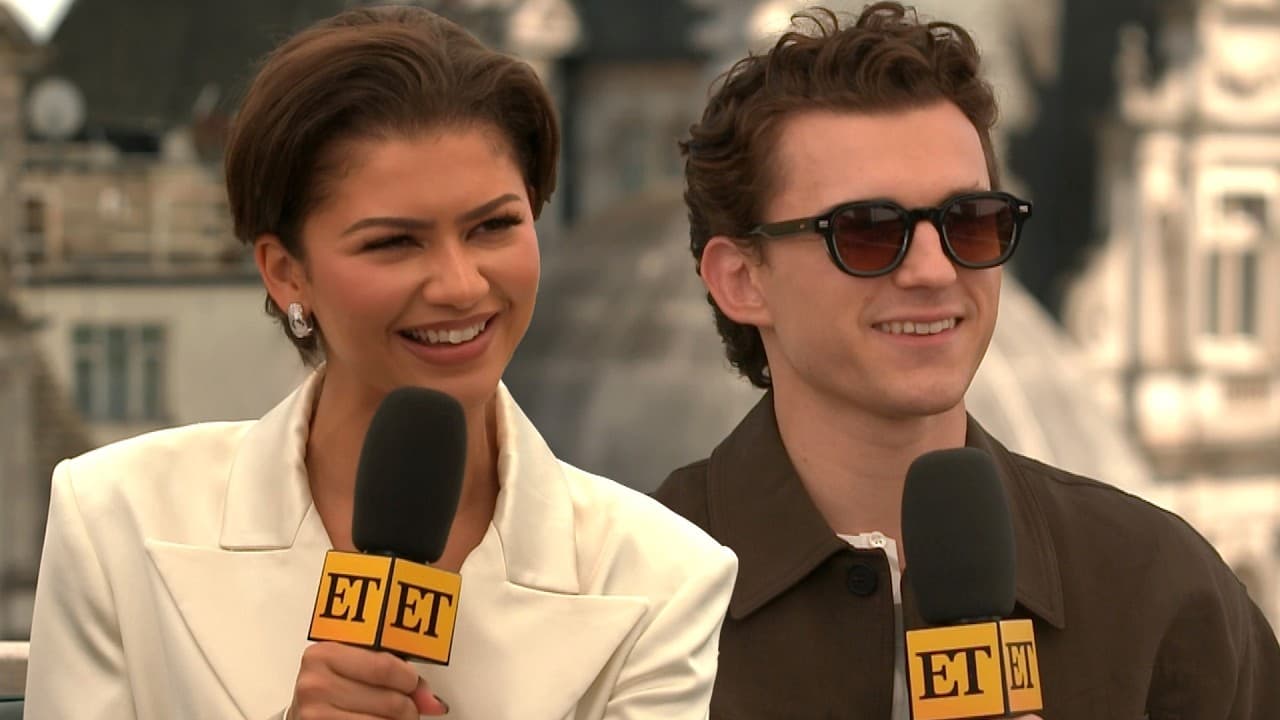
The detail that landed hardest in Zendaya's conversation with Entertainment Tonight this week wasn't anything about Greek mythology. It was this: when Tom Holland came home from a meeting with Christopher Nolan and had news to share, Nolan's team had already called ahead to ask if he could be the one to tell her. The director brokered the reveal. That's not a charming anecdote about a couple in love. That's a data point about how much creative capital both of them carry inside the same production, and how carefully the machine around them is being managed.
The Odyssey, Nolan's long-gestating adaptation of Homer's epic, is one of the most anticipated theatrical events in recent memory. It shoots across real locations. Iceland, unnamed landscapes that Zendaya described as looking like postcards and paintings. Under a director whose on-set philosophy Holland summarized as no faffing, no wasted days, just the work. Into that world, Zendaya was brought not as a supporting cameo but as a presence significant enough that her first day on set was, by Holland's account, the hardest first day of any actor in the film. He wouldn't say more. He didn't have to. The implication is enough.
What the Entertainment Tonight interview actually documents, beneath its warmth and careful spoiler avoidance, is two A-list careers arriving at the same inflection point simultaneously. And the strategic choices, both personal and professional, that come with getting through that territory as a unit. The question isn't whether The Odyssey will be a hit. Nolan's commercial record makes that a near-certainty. The question is what a Nolan credit does for each of them individually, and whether sharing a marquee strengthens or complicates what they are each building on their own.
What Zendaya's role in The Odyssey actually signals about her career trajectory
Zendaya's casting in The Odyssey. With a first day described by Tom Holland as the toughest of any actor in the film. Signals a intentional pivot toward prestige-scale, auteur-driven work that sits alongside rather than inside franchise infrastructure.
The arc of Zendaya's last five years is not subtle. Euphoria gave her a platform. Dune made her a global box-office presence. Challengers, produced outside the studio system, proved she could carry a film on tension alone, no superhero suit required. Each move has been a calculated step away from the kind of teen-skewing, IP-dependent work that defines many careers at her level. And a step toward the kind of roles that earn respect in rooms where Oscars are discussed.
A Nolan film is a different category of statement. His projects don't just perform; they become cultural reference points. Being inside one. Meaningfully inside one, not as decoration. Changes the conversation around an actor in a way that even a strong Dune sequel cannot. The fact that her first day was described as the film's most demanding sequence, one Holland watched being filmed and called unlike anything he'd seen before, suggests she wasn't brought in for name value. She was brought in because Nolan wanted something specific from her.
That specificity matters enormously. Directors of Nolan's caliber are not known for casting against instinct. If he designed a scene around Zendaya's particular abilities. The quality of stillness she carries, the way she can register interior weight without telegraphing it. Then what appears on screen will function as a kind of director's endorsement — see The December Reckoning: How Luigi Mangione Turned a Guilty Plea Into a Platform. That's a credential with a very long shelf life.
Her place in the film wealth landscape is already secure. What The Odyssey offers is something more durable: the association with work that will be studied and re-watched for decades. That's a different kind of asset than a box-office gross.
How Tom Holland's Nolan collaboration reframes his post-Spider-Man identity
Tom Holland's role in The Odyssey is his most significant step beyond the Spider-Man franchise, putting him inside a prestige production where his performance. Not the IP around him. Carries the weight.
Holland's challenge has always been the same one facing any actor whose defining role is a Marvel property: how do you exist outside the suit without the audience always waiting for you to put it back on? Cherry, in 2021, was an early attempt. A Russo brothers film, which kept him within a familiar creative family. Uncharted was franchise-adjacent, built on IP, comfortable. The Odyssey is different. This is Nolan, and Nolan's films don't function as vehicles for movie stars in the traditional sense. They function as films in which movie stars are asked to disappear into the work.
What Holland described in the Entertainment Tonight sit-down. The nightly debrief sessions with Zendaya, the focus on doing rather than performing, the grief he felt when his wrap came. Reads like someone who found, for the first time at this scale, a project that demanded he forget the audience exists. That is not a small thing for an actor whose entire Marvel tenure required constant awareness of fan expectation. Every choice Holland made as Spider-Man was filtered through the knowledge of what the character meant to millions of people. Nolan strips all of that out.
The detail about receiving a 'perfect' from Nolan. A mark Holland described as something the whole cast was quietly competing for. Is interesting not just as a color note but as a window into what this set was like. It was a meritocracy of craft. Holland wanted one. He did what he had to do to get it. That is the language of an actor who is hungry in a way that franchise work, which guarantees outcomes before the cameras roll, rarely produces.
His candor that the hardest part of the shoot was when it ended. 'Is that it?' he said, visibly unwilling to let go. Is the kind of thing that, when it reads as genuine rather than performed, shifts how an industry thinks about a performer. People who don't want to leave a set like that are usually people who did something they're proud of.
"A Nolan credit doesn't just open doors. It changes the architecture of the conversations happening behind them."
Why sharing a production is a strategic gamble for high-profile couples
When a high-profile couple appears in the same major film, the professional upside. Shared preparation, mutual support on set. Is real, but so is the reputational risk that their individual work gets filtered through the lens of their relationship rather than evaluated on its own terms.
Hollywood has a long and complicated history with couples who work together. Sometimes the pairing produces the best work of both careers. More often, at least in the court of public opinion, one performance gets absorbed into the other, and the resulting coverage collapses two distinct artistic contributions into a single celebrity narrative: the romance, not the work.
Zendaya and Holland are acutely aware of this dynamic. They have spent years managing the gap between their public relationship and their professional lives with unusual discipline. The fact that they arrived at The Odyssey through separate channels. Holland cast first, Zendaya offered the role subsequently. Matters more than it might seem. It establishes, at least in the record, that Nolan wanted each of them independently. The overlap is circumstantial. The casting was not a package deal.
That distinction will not stop gossip columns from writing it as one. But it gives both of them, and the film's marketing apparatus, a defensible frame. They are two actors who happen to share a life, who happened to be cast in the same film by the same director, who happened to find that working together deepened rather than distracted from the experience. Each clause of that sentence carries equal weight. Omit any one of them and the story becomes something different.
What's visible in the Entertainment Tonight interview. told Entertainment Tonight with the kind of careful warmth both of them have refined over years of press. Is a couple modeling a specific kind of public posture. They are intimate without being indulgent. They praise each other without deferring to each other. They make clear they are a unit while insisting, without needing to say it directly, that they are also two separate professionals doing two separate jobs. That is a harder balance to strike than it looks.
What Christopher Nolan's directing style means for actors who come through his sets
Actors who work with Christopher Nolan consistently describe a set culture built on confidence and precision. His approach to directing tends to produce career-defining performances because he shoots practically, moves quickly, and treats every actor as capable of greatness.
Both Holland and Zendaya were specific, even under the constraint of spoiler avoidance, about what Nolan's presence on set felt like. Holland used the phrase 'gracious' more than once. He described a director who fills you with confidence, who gives actors a sense that they belong on his set. Zendaya talked about a magic that, even for someone who had a peek behind the curtain, was never lost. These are not the kinds of comments actors give about directors they are simply contractually obliged to promote.
Nolan's method. Practical locations, real environments, limited reliance on digital augmentation. Creates a specific kind of pressure that turns out to be enormously useful for actors. When the dolphin in the water is a real dolphin, when the mountain you're standing on is a real mountain, when Iceland is actually Iceland and it is actually freezing, the performance doesn't require imagination. The world provides the stimulus. The actor simply has to respond to what's actually there.
Zendaya's comment about Iceland. Trying very hard not to shake between takes, steadying her body the moment she heard action. Is a small detail that illuminates the whole approach. The cold wasn't a problem to be solved in post. It was the condition of the scene. That kind of filmmaking asks something different of actors, and the performances it extracts tend to carry a particular kind of physical truth that audiences register even when they can't name what they're responding to.
For careers at the level Zendaya and Holland now occupy, having a Nolan film on the résumé doesn't just open doors. It changes the architecture of the conversations happening behind those doors. Directors who might have thought of them primarily as franchise assets begin to think of them as something else. That is a slow shift, not a sudden one. The Odyssey accelerates it.
Matt Damon's role and what his casting reveals about The Odyssey's commercial ambitions
Matt Damon's casting in The Odyssey. Combined with his physical transformation and, by Holland's account, extraordinary stamina and focus across a long shoot. Signals that the film is built around a traditional prestige anchor performance, not ensemble spectacle.
Holland's praise for Matt Damon was specific in a way that the praise for a film's marketing beats rarely is. He didn't invoke Good Will Hunting as a shorthand for general greatness. He used it to explain what he meant by 'incredible actor status,' a quality he distinguished explicitly from movie-star status. The framing was intentional. Damon is both things, Holland was saying, but the thing that mattered on set was the former.
The stamina observation is worth sitting with. Holland joined the shoot toward the end of a long production. Damon had been going through it, as Holland put it, for months by that point. And what Holland found. In an actor who had already been doing it that long, across locations that by all accounts were physically demanding. Was focus, commitment, and, notably, kindness. That last word keeps appearing when actors describe the best sets they've worked on. Sets led by kind anchors tend to produce better work from everyone.
The Odyssey's commercial ambitions are obvious. IMAX, global locations, Nolan's name, a cast of this weight. The infrastructure around the film is designed for scale. But the casting of Damon as the presumed Odysseus, with a performance that Holland described as insane from one actor to another, suggests the film isn't betting on spectacle alone. It's betting on a central performance powerful enough to make a thousands-of-years-old story feel urgent. That's the harder and more interesting bet.
The IMAX theatrical argument and what Nolan's films mean for the exhibition business
Christopher Nolan's films have become the clearest proof point for IMAX's business case. His productions routinely demonstrate that audiences will pay a premium for theatrical experiences that cannot be replicated on a home screen.
Both Zendaya and Holland made the theatrical pitch explicitly, and they did so without sounding like they were reading from a studio brief. The reason is simple: they believe it. Zendaya described The Odyssey in IMAX as 'the closest thing to being there'. A line that would read as marketing copy in a press release but landed differently here, coming from someone who was actually there and is trying to articulate the gap between those two experiences.
Holland's framing was more emotional. He invoked the movie that changes your life when you see it as a kid, then asked the audience to imagine having that experience on an IMAX screen. It's a specific kind of pitch. Not 'this film is big,' but 'this film could be formative for you'. And it is the pitch that Nolan's theatrical releases have been making for years. Interstellar. Dunkirk. Oppenheimer. Each one positioned not just as a film to see but as an experience to have.
The exhibition business is watching The Odyssey with particular intensity. For our latest reporting on where the theatrical economy is heading, the stakes here extend well beyond any single film's gross. Nolan has become the industry's most reliable argument that theatrical is not dying. It is differentiating. Movies that can only fully exist in a theater are not competing with streaming. They are operating in a separate category. The Odyssey, if it delivers what the cast's descriptions suggest, becomes the next piece of evidence in that argument.
The business case for IMAX specifically depends on tent-poles that justify the premium. A Nolan film set across Iceland and other extreme locations, shot practically, designed for the largest possible frame. That is not a film that shrinks gracefully to a television screen. The immersion is part of the content. Lose the format and you lose something real.
How the couple's press strategy for The Odyssey differs from their usual media management
Zendaya and Tom Holland's joint press for The Odyssey marks a shift from their usual practice of keeping professional appearances largely separate. Appearing together in this context signals a intentional choice to let the film, rather than their relationship, be the reason for the shared frame.
This is a couple that has, with notable consistency, refused to let their relationship become the primary story. Red carpets together, yes. But separate press tours, separate awards conversations, separate industry positioning. The decision to sit together for an Entertainment Tonight exclusive. To answer questions about what it was like to compare notes, to joke about whether competing for Nolan's 'perfect' creates tension at home. Is a departure. And departures of this kind are rarely accidental.
The logic is visible. The Odyssey is a film where their shared experience is genuinely part of the story. They can speak to each other's performances in ways that other cast members cannot. They can articulate the texture of the production from two vantage points, two different call sheets, two different emotional journeys through the same material. That is useful content for a studio trying to build anticipation around a film whose plot details remain tightly guarded.
But the strategy cuts both ways. The more they are seen together in the context of this film, the more the film risks becoming, in coverage terms, a celebrity couple story with a Greek mythology backdrop. The spoiler discipline both of them maintained throughout the interview. Holland explicitly refusing to describe Zendaya's opening scene, Zendaya deflecting questions about her favorite moments with careful generality. Is partly professional loyalty to Nolan's vision. It is also, clearly, a way of keeping the conversation from collapsing into tabloid territory.
They are performing competence as a couple. Not romance. Not domesticity. Competence. Two professionals who happen to love each other, talking seriously about serious work. That is a harder image to sustain than it looks, and the fact that it holds throughout the interview is its own kind of achievement.
What The Odyssey means for both careers beyond the opening weekend box office
Regardless of its opening weekend gross, The Odyssey positions both Zendaya and Tom Holland for the kind of long-cycle career capital. Awards consideration, auteur access, critical repositioning. That a franchise film cannot provide.
Box office is the loudest number, but it is rarely the most important one for an actor's career over a ten- or twenty-year arc. What matters more is whether a film changes the conversation about what you are capable of. For both Zendaya and Holland, the Spider-Man and Dune franchises have already demonstrated commercial draw at the highest level. What remained unproven. Or at least less proven. Was whether either of them could inhabit the kind of film that critics and awards bodies take seriously as art.
Nolan's track record with his actors is instructive. Cillian Murphy spent years as a respected working actor before Oppenheimer turned him into an Oscar winner. The film didn't create his talent; it provided a context in which that talent could register at full volume. That is the opportunity The Odyssey represents for both Zendaya and Holland. Not a reinvention, but an amplification. A setting in which what they are already capable of finally has room to land.
The financial architecture of their careers, tracked across our full coverage of film talent, will be shaped by the back-end deals, the increased use in future negotiations, and the caliber of projects that become available after a film like this performs. Directors who don't take meetings with franchise leads will take meetings with Nolan collaborators. That is a real and material shift. It doesn't show up in a first-weekend gross, but it shows up in the offers that arrive six months later.
What the Entertainment Tonight interview ultimately documents is two people who know exactly what they've been part of. They are not selling a film. They are testifying about an experience. There is a difference, and audiences. And industry readers. Can feel it. That kind of authenticity is, in its own way, the most effective marketing a film can have. And for Zendaya and Holland, it is also the most effective career communication. They are telling anyone paying attention: we belong in rooms like this. We did the work. We want more.