The Silence Around Mitch McConnell Is Its Own Kind of Statement
When a senator is stretchered out of his home unconscious and his office still won't name a diagnosis, the information void becomes the political story. And a case study in how power protects itself at any cost.
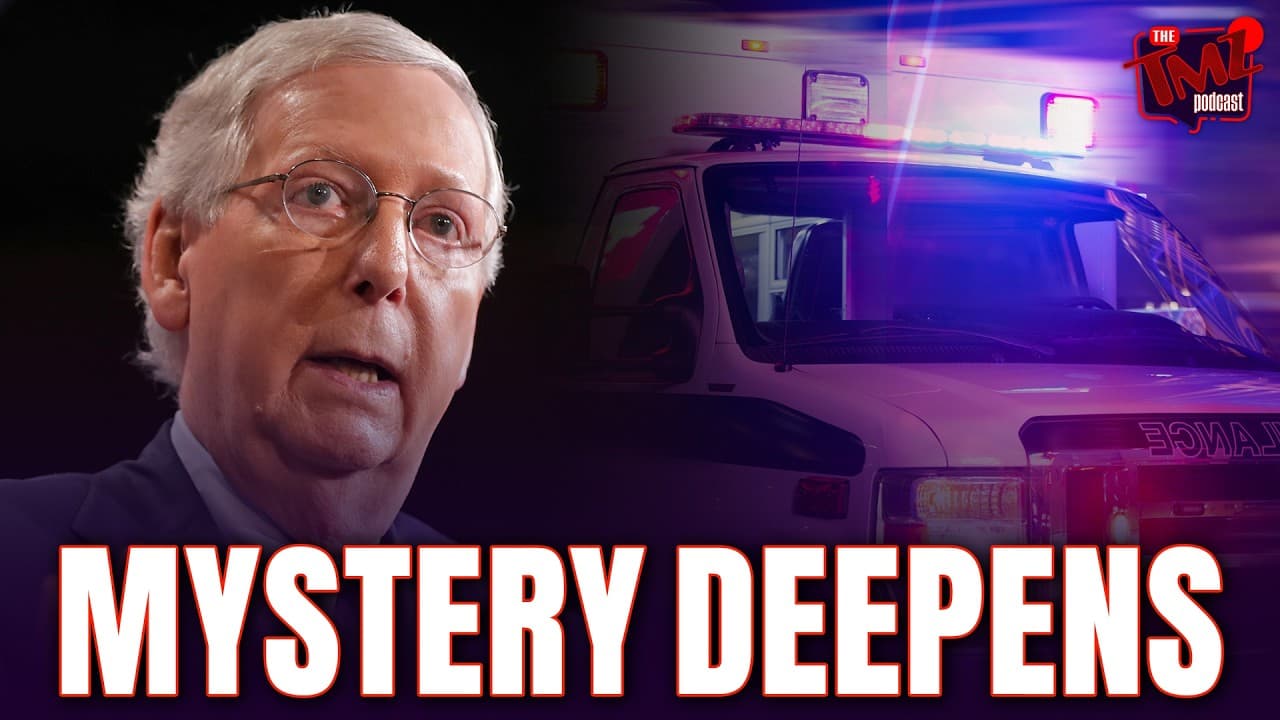
The ambulance call was logged for an unconscious person. The video. Shaky, shot from a distance. Caught what appeared to be Mitch McConnell's feet as paramedics stretchered him out of his Washington, D.C. Home. That was, for days, the most concrete thing the public knew about the medical condition of one of the most consequential political figures of the last three decades.
What followed was a masterclass in strategic ambiguity. His office confirmed he was hospitalized and receiving excellent care. It offered nothing more. No diagnosis, no prognosis, no timeline. Into that void rushed the full machinery of modern rumor: politicians claiming twenty- and thirty-minute phone conversations that, as the team at TMZ's podcast observed this week, would have collectively consumed fifteen hours of a single day if tallied together. Marjorie Taylor Greene accused his wife of being a communist spy. Twitter accounts with 'sources' declared him on life support. His own representatives quietly contradicted the most dire claims without, crucially, offering anything verifiable in their place.
This is not simply a health story. It is a story about how political power operates when it is most vulnerable. Who controls the narrative, who benefits from the fog, and why the institution of the U.S. Senate has built almost no formal mechanisms to force transparency from its own members. McConnell's hospitalization is a news event. The silence around it is the system working exactly as designed.
What we actually know about McConnell's hospitalization
Emergency services responded to McConnell's Washington, D.C. Home for an unconscious person, and video footage showed him being stretchered into an ambulance. His office confirmed hospitalization and said he was receiving excellent care, but has not disclosed his diagnosis or the cause of the medical emergency.
The hard facts, as reported by the TMZ podcast this week, are thin. A call went out for an unconscious person at McConnell's residence. Paramedics arrived. He was loaded into an ambulance. A moment captured on video, though only his lower body was visible in the footage TMZ obtained. He was transported to a hospital, where, according to his office, he is under medical care.
That is the sum of confirmed information. His office has not named a condition. It has not described what triggered the emergency. It has not offered a timeline for recovery or a return to Senate duties. 'Excellent care' and 'doing okay' are phrases that communicate exactly as much as their authors intend. Which is to say, nothing medically specific and nothing politically committal.
The irony is that the machinery his team is using to manage this story is the same machinery McConnell spent decades mastering on the legislative floor: say the minimum required, hold the line, let the other side exhaust itself speculating. It is a tactician's response to a medical crisis, and it is working in the sense that no single, damaging fact has leaked. It is failing in the sense that the absence of facts has been filled by something far less controllable.
Why the politician phone-call parade backfired as a PR strategy
Multiple politicians publicly claimed they had spoken with McConnell by phone for 20 to 30 minutes, but the claims compounded implausibly and several were quietly walked back with admissions like 'I did most of the talking.' The strategy meant to reassure the public instead deepened suspicion.
There is a recognizable political playbook for moments like this: deploy friendly validators. Send out allies to say they spoke with the patient, he sounded sharp, he was cracking jokes. It is the same move executed whenever a president returns from a physical or a CEO takes medical leave. The goal is to make the story about reassurance rather than inquiry.
The problem, as the TMZ hosts noted with genuine bewilderment, is arithmetic. If you add up the claimed call durations from every politician who stepped forward to announce a conversation with McConnell, the total approaches something approaching a full working day. The calls cannot all be true in the form described. And when CNN commentator Scott Jennings disclosed he had spoken to McConnell for roughly twenty minutes. And then added the qualifier that he had done most of the talking. The reassurance operation began to undermine itself.
A validator who admits the subject was mostly silent is not a validator at all. He is a witness. And what he is witnessing, in that admission, is a man who may have been present on a phone call without being the sharp, engaged senator the public was meant to imagine. The walk-back did not kill the story. It gave the story its legs.
"The silence around his condition is not incidental to the power struggle that follows. It is central to it."
McConnell's prior health episodes and what they established
McConnell has a documented history of serious public health episodes, including a visible freeze during a press conference that was widely interpreted as a stroke-like event. Each episode has followed the same pattern: minimal disclosure from his office, public concern, and a return to duty without medical explanation.
This is not the first time the question of McConnell's health has become national news. The press-conference freeze. When he simply stopped mid-sentence and stood motionless for an extended, alarming stretch before aides intervened. Was one of the most widely circulated political videos of recent years. His office attributed it to dehydration and a concussion sustained from an earlier fall. Whether that explanation was complete was never independently verified, because no independent verification was offered or required.
The pattern established then is the pattern in use now: acknowledge the incident, provide a benign-sounding explanation, return to duties as quickly as optics allow, never submit to a third-party medical accounting. For a private citizen, that is an entirely reasonable approach to one's own health information. For an elected official holding one of the most powerful legislative seats in the federal government, it is a different calculation. Though one that the existing rules do not force him to make differently.
What makes the current episode more acute is cumulative weight. Each prior incident did not reset public concern; it compounded it. By the time an unconscious-person call is logged at his home, the public is not evaluating this hospitalization in isolation. It is evaluating it against a file of episodes that his office has consistently declined to explain in full. The credibility deficit is not a product of this week's silence alone. It was built over years.
The Senate has no mandatory fitness-for-duty standard
Unlike the U.S. Presidency, which requires an annual physical examination whose results are typically disclosed publicly, the Senate has no rule requiring members to demonstrate physical or cognitive fitness for continued service.
The presidential physical is an institution. Whatever one thinks of the political theater around it. And there is substantial theater. The basic norm exists: the head of the executive branch submits to medical examination, and the results are shared with the public in some form. The press corps has standing to ask questions. The White House physician has standing to speak. It is imperfect transparency, but it is transparency of a kind.
The Senate has nothing equivalent. A senator's capacity to serve is formally evaluated by no one outside of elections. The body can vote to expel a member by a two-thirds majority, but that mechanism exists for misconduct, not incapacity, and has almost never been used. There is no medical board, no cognitive testing requirement, no mandatory disclosure threshold. A senator can appear on the floor unable to complete a sentence, and the institutional response is, more or less, to help them to their chair.
The TMZ hosts put the point plainly this week: if you hold an important government position, a baseline physical and cognitive standard seems like a reasonable minimum. The comparison to the presidential physical is apt. What is striking is that this observation. Obvious to casual observers of political news. Has not translated into any institutional pressure for reform. The Senate, as an institution, has no particular incentive to build mechanisms that would constrain its own members. And so it hasn't.
This is worth understanding as a structural feature, not an oversight. The self-governing norms of the Senate were written by senators. The idea that a member might be required to demonstrate fitness to an outside party runs directly against the body's sense of its own sovereignty. The result is a system that is precisely as transparent as its most powerful members choose to make it. Which, in McConnell's case, is not very.
Why ego and partisan math keep elderly legislators in office
Senators and justices routinely remain in office past the point of obvious physical decline because stepping down means ceding their seat to a governor's appointment or an opposition party, making retirement a partisan calculation as much as a personal one.
The most clarifying recent parallel is Ruth Bader Ginsburg. Whatever one thought of her jurisprudence, the decision to remain on the Supreme Court rather than retire during a Democratic administration. A decision she made while battling serious illness. Became, after her death, a defining regret for the coalition that most admired her. The seat she held flipped. The court shifted. The TMZ hosts made exactly this point this week, without flinching: even someone you revere can make an ego-driven decision that costs the cause they spent a lifetime building.
McConnell's calculus is analogous but simpler to read. He has been one of the most effective legislative tacticians in modern Senate history precisely because he understands the value of a single vote, a single seat, a single procedural lever. The notion that he would voluntarily surrender his seat. And with it, some fraction of Republican caucus control. Runs against everything his career demonstrates about how he assigns value to institutional power.
The people calling for his retirement are not wrong on the merits. A legislative body that cannot guarantee its members are cognitively capable of understanding the legislation they vote on has a legitimacy problem. But the pressure to retire is moral and reputational, not structural. And moral pressure, in McConnell's case, has historically been a lever with very limited range.
What is left, then, is the waiting. Waiting for a resignation that may not come voluntarily, waiting for a medical update his office has shown no inclination to provide, and waiting for the political realignment that follows whenever a seat of this consequence finally changes hands. The fog around his condition is not incidental to that process. It is central to it.
Could a video or photo statement even end the speculation?
A proof-of-life video or photo from McConnell would not necessarily end public speculation, because in the current media environment any image can be dismissed as AI-generated or recycled from an earlier date. The epistemic environment has made visual proof nearly unverifiable for a skeptical audience.
The TMZ podcast floated the most obvious solution this week: post a short video of McConnell looking at a camera, saying he's recovering. Even that, the hosts immediately acknowledged, would not close the loop. Someone would note the video lacks a date stamp. Someone else would call it AI. A third contingent would argue the footage was from 2023 and recycled.
The pre-digital solution. Hold up today's newspaper so the date is visible. Was raised half-jokingly, but the joke contains a real observation. We have arrived at a moment in which the very tools that could provide transparency are also the tools that have destroyed trust in visual evidence. A photo proves nothing to someone who does not want it to. A video proves nothing to someone primed to disbelieve it.
This is not primarily McConnell's problem to solve; it is a structural problem in how public trust in institutions operates right now. But it does mean that the communications strategy of 'say little and let it blow over' has, paradoxically, more runway than it might otherwise. If even a credible proof-of-life clip would be contested, the incentive to produce one shrinks. Silence, at least, cannot be fact-checked.
What it would actually take to settle public concern is probably not a video. It is a named physician, affiliated with a named institution, providing a named diagnosis and a named prognosis. The kind of specific, attributable medical accounting that would allow independent verification. That is also, not coincidentally, exactly what McConnell's office has not provided and shows no signs of providing.
Who actually benefits from the information vacuum
The primary short-term beneficiary of the information vacuum is McConnell's office, which retains control over the narrative and avoids any confirmation of the severity of his condition.
Control of information is control of the story. As long as McConnell's office releases nothing specific, it cannot be accused of releasing something false. The trade-off is the speculation. But speculation, from a crisis communications standpoint, is more manageable than a confirmed devastating diagnosis, because speculation can be denied and its sources discredited.
The media ecosystem benefits differently. TMZ, which broke the ambulance footage, built substantial audience around the story this week. Political commentary shows found days of material in the competing claims from politicians and the rumor cycles on social media. The information void is not just a political condition; it is an audience condition. Every day without a definitive answer is another day the story remains live and clickable. You can track the full media heat map around stories like this in our latest reporting.
The political opposition benefits last and most uncertainly. The inclination is to assume Democratic politicians gain from McConnell's health crisis, but the dynamics are more complicated. A McConnell who resigns or is incapacitated creates an appointment process that depends entirely on who governs his home state of Kentucky. That calculation is not straightforwardly advantageous to either party; it depends on a specific political configuration at a specific moment.
What is certain is that nobody with actual power. Not his office, not his Senate colleagues, not the institutional machinery around him. Has a strong incentive to force transparency. The Senate does not require it. His allies do not want it. His office controls it. And so the ambulance footage circulates, the phone-call claims accumulate and collapse, and the most powerful legislative body in the world continues to have no formal answer for what happens when one of its own members can no longer discharge the duties of the office.
What the McConnell episode reveals about how political fame ages
McConnell's situation illustrates a broader pattern in which political figures, like entertainment celebrities, accumulate institutional power that becomes nearly impossible to relinquish voluntarily. And where the surrounding apparatus prioritizes narrative control over public accountability, often until the moment of forced…
There is a version of this story that is purely political. And then there is the version that sits alongside every story this publication tracks about celebrity, image machinery, and the economics of sustained public power. Which is that the people at the top of any status hierarchy, whether that hierarchy is built on legislative influence or box-office revenue or streaming numbers, develop institutional ecosystems that are designed above all to preserve their position.
The communications operation around a hospitalized senator is not categorically different from the communications operation around a celebrity getting through a scandal or a decline. The variables are different. The media environment is different. But the core logic. Control the information, manage the optics, never concede more than you must. Is identical. You can see the same dynamics play out in the business profiles we track across the entertainment and tech worlds.
What makes the political version more consequential is that the stakes are not brand equity or streaming deals. They are votes on legislation that affects hundreds of millions of people. A celebrity who overstays their cultural moment costs their management fees and their label some revenue. A senator who overstays their physical capacity costs the republic something harder to price. The Ginsburg example is the sharpest: a seat held too long, for reasons that mixed genuine conviction with ego, changed the composition of the Supreme Court for a generation.
McConnell, whatever one thinks of his politics, is among the most skilled practitioners of institutional use in modern American life. The silence around his hospitalization is, in its way, a final demonstration of that skill. The understanding that in politics, as in so many other fields of concentrated power, what you don't say can protect you longer than anything you do.