Tom Holland Says Robert Pattinson Makes Him a Better Actor. That's Not a Compliment. It's a Career Statement.
In an ET exclusive for Christopher Nolan's The Odyssey, Holland's praise for Pattinson reveals something more interesting than mutual admiration: two post-superhero careers, forged in the same crucible, now reaching for the same ceiling.
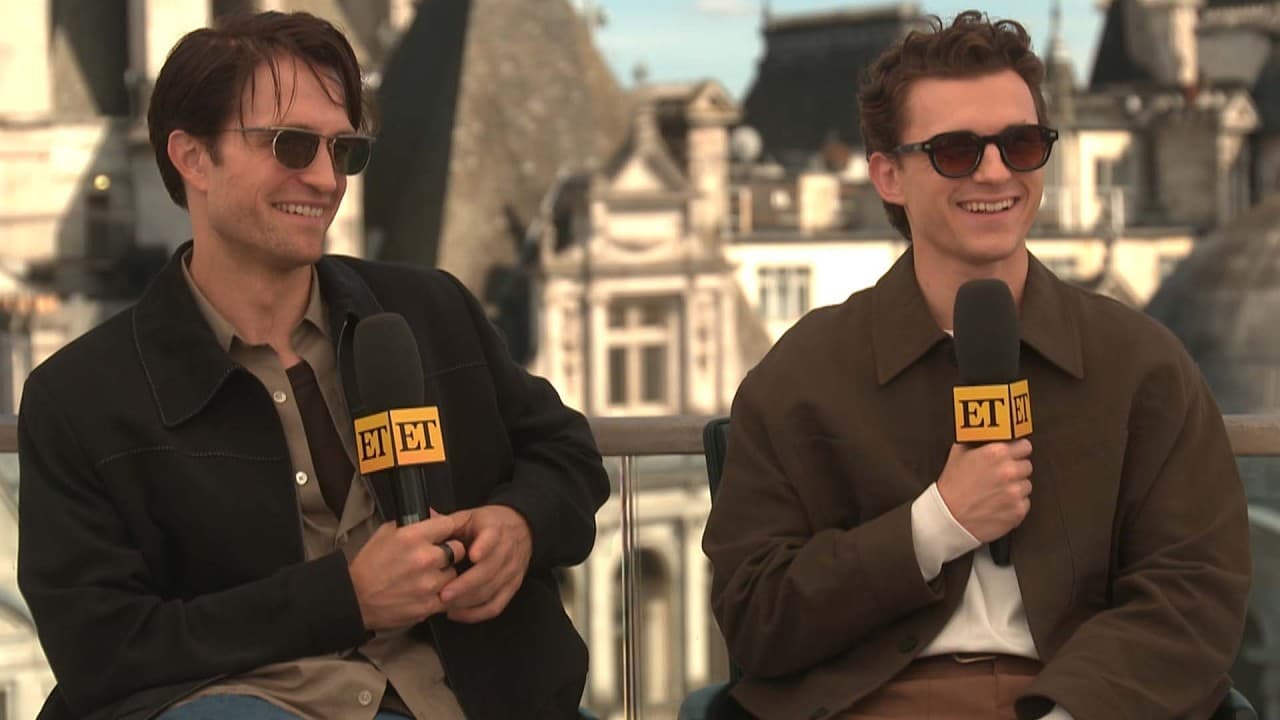
The sentence was short, almost throwaway, but it landed with the weight of a career thesis. Tom Holland, sitting across from Robert Pattinson in an Entertainment Tonight exclusive published this week, told the interviewer that every time he has worked with Pattinson, he has left a better actor. Not a more confident actor. Not a more famous one. A better one. That is a specific claim, and in the vocabulary of a 29-year-old who has spent the better part of a decade inside the Marvel machine, it is a startling one to make in public.
The context is Christopher Nolan's The Odyssey, the director's adaptation of Homer's epic that has assembled one of the more genuinely formidable casts in recent memory. Matt Damon at the top of the call sheet, Anne Hathaway, Holland, and Pattinson among the ensemble. The film shot across punishing locations: Sicilian islands, mountain hikes in sideways rain, twelve-hour days on ancient Greek boats in open water. Holland, told Entertainment Tonight this week, was intimidated walking onto set. By Nolan, by the crew's reputation, by the ambition of the project, by Hathaway's body of work. He said it plainly, without performing humility. That candor is itself a signal.
What the interview surfaces, beneath the warmth and the laughter about Matt Damon's visible abs through a loose T-shirt, is a portrait of two actors at a very particular inflection point. Both Holland and Pattinson emerged from blockbuster franchises that could have calcified them. Spider-Man and Twilight respectively. And both have spent years running hard in the opposite direction. The Odyssey is not a franchise pivot. It is a destination. Understanding why they are here together, and what each gets from the pairing, tells you more about the current economics of prestige film than any box-office report.
Why Tom Holland calling Pattinson a 'better actor' catalyst is a calculated public move
Holland's praise for Pattinson is a intentional act of career repositioning: by publicly crediting a peer known for fearless indie choices, Holland signals that his own ambitions now live in that same register, far from the Marvel safety net.
Actors praise their co-stars in press junkets the way politicians thank their donors. Reflexively, warmly, and without much cost. Holland's framing was different. He did not say Pattinson was generous or fun to work with, though he said those things too. He said Pattinson makes him better. The distinction matters because it implies a transfer of craft, a hierarchy of artistic influence that Holland is voluntarily placing himself on the lower rung of. For the actor who has played Spider-Man across at least six Marvel films, that is not a small concession.
Holland also named what specifically he admires: Pattinson's ability to make large, committed choices that never tip into caricature. That is a precise note. It speaks to the tension every actor in a big-budget film feels. The pressure to scale your performance to match the spectacle, which is precisely the trap that turns blockbuster work into self-parody. Pattinson, who has made a second career out of taking that risk in films like The Lighthouse, Good Time, and Mickey 17, has developed a recognizable answer to that problem. Holland is saying, aloud, that he is studying it.
The public praise also does work for The Odyssey's marketing machinery. Nolan films do not need manufactured buzz. They arrive pre-sold on the director's name alone. But an ensemble cast benefits from a visible chemistry narrative, and the Holland-Pattinson dynamic, two former franchise heroes who have both transcended their origin stories, is a ready-made one. Entertainment Tonight got the exclusive. The clip will circulate. The story writes itself, which is precisely why it was packaged this way.
Robert Pattinson's second-career blueprint and why it works as a template
Robert Pattinson rebuilt his career after Twilight by step by step choosing directors with singular visions. Cronenberg, the Safdies, Eggers, Reeves. A strategy that restored critical credibility without abandoning mainstream reach, and that now positions him as a prestige-film anchor.
Pattinson's post-Twilight decade is one of the more studied career rehabilitation arcs in contemporary Hollywood, and its mechanics reward close attention. The move was not to flee commercial cinema entirely. He took Batman, a franchise role of enormous scale. But to use the commercial platform as ballast while doing genuinely risky work on either side of it. Cosmopolis with David Cronenberg in 2012. Good Time with the Safdies in 2017. The Lighthouse with Robert Eggers in 2019. High Life with Claire Denis. Each film was a intentional statement of intent, and the cumulative effect was a critical reputation that now precedes him into every room.
What makes the template compelling as a model is that it required real exposure. These were not prestige-lite vanity projects with famous directors and conventional narratives. Good Time cost $6 million and asked Pattinson to sustain a film almost entirely on his own performance as a desperate, sweating Queens criminal. The Lighthouse asked him to work in black-and-white, in a claustrophobic two-hander, in a register that had no commercial safety net whatsoever. These were bets placed with creative capital, not career insurance policies.
Holland, watching this from the Marvel ecosystem, would have noticed the architecture clearly. The Odyssey, directed by a filmmaker of Nolan's stature, functions for Holland the way Batman v Superman's cultural weight functioned for Pattinson. As proof of seriousness at scale. But Holland is arriving at this point younger than Pattinson did, which is either an advantage or a pressure, depending on what he does next.
Pattinson's own role in The Odyssey adds another layer. He told Entertainment Tonight he never quite saw his character as the villain. Just as weak, a vain aristocrat undone by his own appetites. That reading is consistent with the approach he has taken across his best work: find the humanity in the grotesque, resist the easy legibility of good and evil. It is, as Holland observed, a method that scales without losing authenticity.
"To say someone makes you a better actor is not a compliment. It is a confession about where you think you currently stand."
What Christopher Nolan's set discipline reveals about how prestige films are actually made
Nolan runs a set where every person is in position at 7 a.m. And no one waits in a trailer. A production philosophy that compresses schedules, eliminates idle time, and creates a psychological intensity that actors either thrive in or find crushing.
The production details Holland and Pattinson shared are not incidental color. They describe a working methodology that has real consequences for the kind of performances a film captures. On a Nolan set, you do not wait to be called. You are ready, and you go. There is no gap between the makeup chair and the camera; you leave one and walk directly to the other. The day runs from seven in the morning to seven at night, and the whole time, in Holland's telling, you are on.
This is a intentional philosophy, not a logistical accident. Nolan has spoken elsewhere about his preference for practical effects and real locations precisely because they create conditions that cannot be faked in post-production. The same logic applies to performance: an actor who has been sitting in a trailer for two hours, scrolling a phone, warming up on demand, gives a different kind of attention to a scene than one who has been in the world of the film all day. The castle hike, the boat in open water, the sideways mountain rain. These are not merely atmospheric. They are conditioning.
Holland described finding that energy infectious, which is a generous reading. Pattinson's description was slightly different: he noted, with precision, that when you arrive on a Nolan set for the first time, it is a reality check. That phrase carries weight. It implies a gap between expectation and experience, a recalibration of what you thought the job would be. Both actors were careful to note that the film's real hardship fell on the crew working the disease sequences. A gracious and telling piece of deflection that shows a cast that has clearly been media-trained to frame the production's difficulty without overclaiming.
Matt Damon as number one on the call sheet and what top-billed leadership actually does
Matt Damon's presence as the lead of The Odyssey set a behavioral standard for the entire cast. His visible energy on the hardest shooting days, Holland said, would have made the film a at root different experience had it been absent.
The number-one position on a call sheet is not just a billing negotiation. It is a cultural signal that lands on set every day. The actor who is first on the sheet is, in the field, the person whose attitude sets the ambient temperature of the production. When that person is difficult, or disengaged, or visibly suffering, it grants permission for everyone below them to do the same. When they show up with what Holland described as a smile on their face on the toughest mountain hikes and in the coldest rains, it forecloses complaint as an option.
Holland's assessment of Damon was unambiguous: he called it a dream come true, and said the film would have been a very different experience without him — see Kamri Peterson's DWTS Moment Is Bigger Than a Dream Come True. That is the kind of language that, in a junket context, usually arrives pre-packaged and generic. But Holland applied it with specifics. The hikes, the rain, the hardest days. That suggest he is describing something he actually witnessed and felt rather than something a publicist cleared.
Damon at this stage of a career that includes Goodwill Hunting, the Bourne franchise, and multiple Soderbergh collaborations brings a particular kind of credibility to a set. He is not proving anything. That freedom from self-consciousness is itself a gift to a younger cast that is, by Holland's own admission, still working out how to belong in rooms of this size. The visible abs through the loose T-shirt were merely confirmation of dedication most of the cast probably already suspected.
For a closer look at how Holland navigates ensemble dynamics in high-profile productions, our earlier piece on Zendaya, Tom Holland, and the Quiet Power of Sharing the Frame traces how the two have consistently used co-billing to amplify rather than compete with each other.
Anne Hathaway as a lifeline: what Holland's intimidation reveals about prestige casting…
Holland's admission that he was intimidated by Hathaway's body of work. And that she became the wind in his sails. Reveals the unspoken mentorship dynamics that run beneath prestige ensemble casts, where the most experienced actors carry the emotional infrastructure of the production.
The admission was unexpected, and the more interesting for it. Holland has spent years in front of cameras, has survived the scrutiny of the Marvel promotional cycle, has done enough press to have long since developed a comfortable public persona. And yet he described walking onto this set feeling genuinely intimidated, and he named Hathaway specifically as the reason he found his footing.
The dynamic he described. Watching someone at the top of their game doing the best work of their career, while remaining gracious and helpful to a younger colleague. Is a specific and recognizable experience for anyone who has worked in an industry with steep hierarchies. What he was witnessing in Hathaway was the combination of mastery and generosity that is, in the field, the rarest thing in a competitive creative field. Many actors achieve the mastery. Fewer pair it with the openness to bring others up alongside them.
It also says something about the architecture of Nolan's casting choices. The Odyssey is not a film built around one star and a supporting cast of functional performers. It is assembled as a genuine ensemble of actors who each bring independent credibility. And who are, in turn, responsible to each other in the way that implies. Hathaway's willingness to be a wind in Holland's sails is not just generous. It is a professional understanding of how a film of this scale gets made: together, or not at all.
For broader context on how Holland's profile fits within the economics of film wealth and career trajectory, the pattern of young franchise actors using Nolan productions as legitimizing platforms has a short but consistent history.
The stunt philosophy difference between Holland and Pattinson and what it signals about…
Pattinson said he finds it significantly easier and more enjoyable to be the person getting hit rather than doing the hitting in stunt work. A preference that maps directly onto the kind of reactive, yielding characters he is drawn to play, and that explains his casting in The Odyssey's more passive villain role.
The exchange about swords and stunts was framed as a practical conversation, but it contained a genuine piece of actor's philosophy. Pattinson explained that when you are the one doing the hitting, you must concentrate on precision. On not hurting your scene partner, on landing correctly. Which restricts your freedom. When you are absorbing impact, responding to someone else's energy, you can throw yourself around with looseness. You can be more free.
That preference maps with unusual precision onto the kind of characters Pattinson consistently gravitates toward: reactive men, men acted upon by circumstances or by their own weakness, men whose dramatic function is to receive the world rather than impose themselves on it. Even his reading of The Odyssey's antagonist. Not quite a villain, just weak, a vain aristocrat who cannot control himself. Is framed in those terms. The character is defined by what he cannot resist, not by what he chooses.
Holland, whose superhero work has required enormous physical precision and control. The web-slinging choreography of Spider-Man demands that someone always be the one doing the hitting. Offered this contrast in a spirit of collegial curiosity rather than disagreement. But the gap in approach is real, and it likely contributes to exactly what Holland described: working with Pattinson introduces a looseness, an unpredictability, into the scene that demands a different quality of response. You cannot plan around someone whose physical grammar is built on surrender.
Our latest reporting on The Odyssey's production continues to track the film's release strategy as Nolan's post-Oppenheimer follow-up assumes its position as the year's most anticipated prestige event.
The post-superhero career problem and how The Odyssey solves it for both actors
Both Holland and Pattinson carry the commercial taint of franchise blockbusters. Spider-Man and Twilight respectively. And The Odyssey offers each of them the same thing: a Nolan credit that functions as a critical reset, associating their names permanently with the most respected director working in mainstream cinema.
There is a structural problem that attaches to any actor who becomes culturally synonymous with a franchise character. The problem is not fame. Fame is useful. The problem is imaginative limitation: audiences and, more dangerously, casting directors begin to see the character when they see the face. The cure is not obscurity. The cure is a project so unambiguously serious, so definitively outside the franchise grammar, that it recodes the association. A Nolan film is one of the few tools still capable of doing that work in one move.
Pattinson understood this earlier and acted on it more aggressively, perhaps because the Twilight association was more claustrophobic than the Spider-Man one. The vampire franchise carried a cultural condescension that Marvel, for all its critical reception problems, does not. But Holland has also been methodical: Cherry, the Russo brothers' heroin-addiction drama, was an early signal of intent. Uncharted was a commercial placeholder. The Odyssey is the consolidating move.
What both actors gain from the film is durable. A Nolan credit does not expire. It does not depend on the film's box office, though Nolan films generally perform well enough to make that a non-issue. It attaches to a director whose name, in the current critical culture, functions as a quality guarantee. A shorthand that travels across decades and territories. Holland and Pattinson will carry The Odyssey on their CVs long after whatever comes next, and casting directors in every genre will read that credit as evidence of something real.
The deeper play, for both of them, is in what the experience actually teaches. Not just the credential it confers. Holland's account of leaving every Pattinson collaboration as a better actor, of finding Nolan's relentless pace infectious, of watching Hathaway work at the top of her game, describes an education, not just a transaction. The Odyssey is not a film they are selling. It is a film that is, apparently, remaking them. That is not nothing. In the long arithmetic of a career, it may be everything.
You can track the full arc of Hollywood's prestige wealth mechanics across our film wealth profiles and the broader Atlas of net worths we follow, where the careers of both actors sit within a larger pattern of franchise graduates converting cultural capital into lasting industry standing.
What the Favignana moment reveals about ensemble hierarchy and location fatigue
Pattinson's arrival at the Sicilian island of Favignana. Greeted by a cast returning from the sea utterly silent and depleted. Captures in miniature how location-shoot exhaustion creates an accidental social stratification that the most self-aware cast members recognize and respect.
The anecdote was told as comedy, and it landed that way. Pattinson arrived at the island hotel alone, found it empty, then watched the rest of the cast come in from the boat. Silent, spent, moving with the particular quiet of people who have earned their exhaustion. He found himself a quarter of the way through the film and already certain he had drawn the easier assignment.
What the moment actually describes is the invisible social architecture that forms on long location shoots. The actors who shared the hardest physical conditions. The twelve-hour boat days, the open-water shoots, the weather improvisation. Accumulate a shared experience that functions like a private currency. You cannot buy your way into that room with good intentions or star power. You earn it by being there. Pattinson, arriving from elsewhere, understood that he was on the outside of something real, and he had the self-awareness to say so without resentment.
Holland made a similar observation about the disease crew, the unit that shot the sequences he and Pattinson were largely spared from. And both actors were intentional in their insistence that what those colleagues went through was the real hardship of making the film. This is a cast that has clearly discussed the hierarchy of difficulty among themselves and arrived at a shared account of it. That kind of collective honesty, on a film with stakes this high and egos this large, is rarer than it sounds.