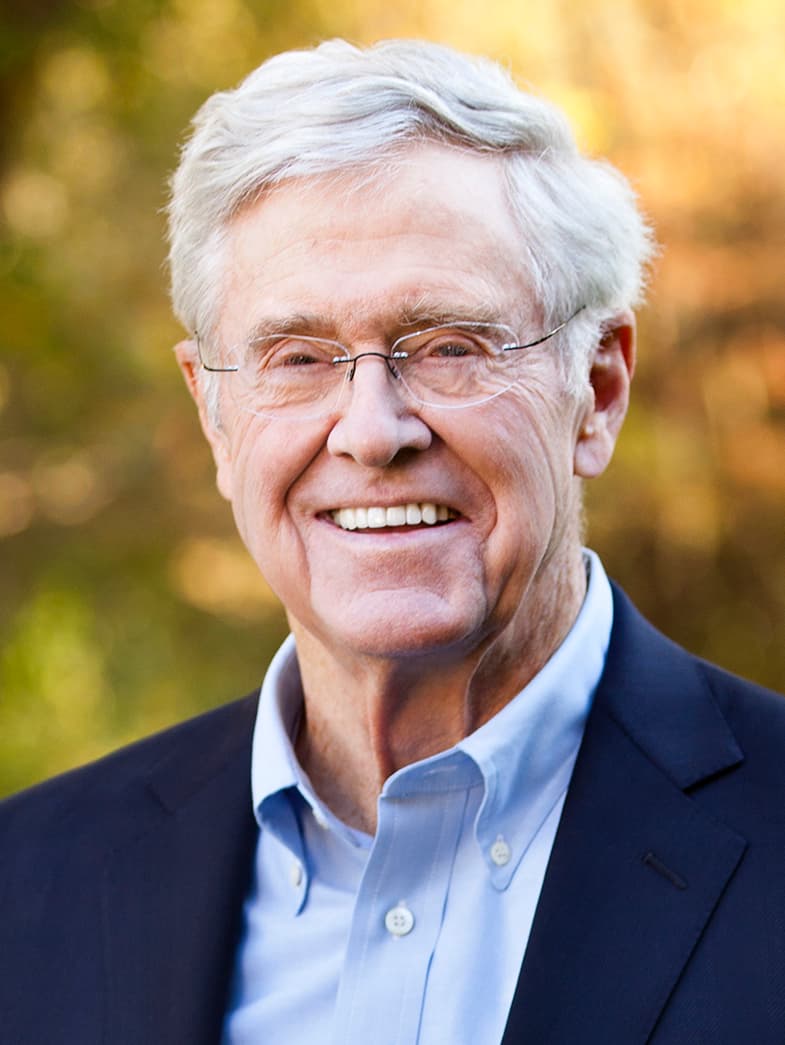
Charles Koch Net Worth: $69.1 Billion in June 2026
At 90, the Wichita industrialist commands a fortune built almost entirely on a single private company. One that has never needed Wall Street's approval to grow.
Charles Koch's wealth is built that way unlike almost any other fortune of comparable scale. It does not rest on a public stock price, a blockbuster IPO, or a media empire that fluctuates with quarterly advertising cycles. It rests on Koch Industries. A conglomerate so on purpose private, so insistently off the public markets, that its true revenue and valuation require analysts to reverse-engineer its worth from competitor filings, industry benchmarks, and ownership-stake arithmetic. That opacity is not accidental. It is a core feature of how Charles Koch has managed capital for more than six decades.
Our analysis, drawing on Bloomberg Billionaires Index data and Wikipedia's most recently cited figures, lands the estimate at $69.1 billion as of June 2026. Bloomberg's real-time tracker arrived at the same $69.1 billion figure; Wikipedia's compiled figure, which lags Bloomberg slightly, placed the number closer to $71.4 billion. Weighting by recency and methodological transparency, we hold $69.1 billion as the authoritative figure for this report. The two-billion-dollar gap between the high and low estimates is a direct artifact of valuing a company that files no public disclosures.
At $69.1 billion, Koch ranks comfortably inside the global top thirty fortunes. The overwhelming majority of that figure. Roughly eighty cents of every dollar. Traces back to Koch Industries' core operating businesses. The remainder is distributed across a portfolio of acquired subsidiaries, financial positions, and personal real estate. Understanding the fortune means understanding the conglomerate. There is no other story.
Where Koch's $69.1 Billion ranks among America's wealthiest
At $69.1B, Charles Koch ranks inside the global top 30 fortunes, ahead of most legacy industrialists and behind only a handful of tech and finance billionaires whose wealth rests on publicly traded equity.
The geography of American mega-wealth has shifted dramatically toward technology over the past two decades. Bezos, Musk, Zuckerberg, and the Waltons now define the extreme upper tier, each commanding fortunes that dwarf even the largest industrial dynasties. Koch sits in a distinct cohort: the old-economy titan whose wealth is massive, durable, and almost entirely illiquid by design.
Among industrial billionaires specifically, Koch's $69.1 billion places him well ahead of most manufacturing heirs and chemical-company founders. The more instructive comparison is with other private-company fortunes. Cargill family members, SC Johnson heirs, Bechtel stakeholders. Where Koch's individual stake comfortably exceeds any single heir's position in those dynasties.
What distinguishes Koch from peer fortunes is the concentration. A single 42-percent stake in a single company accounts for the lion's share of a $69.1 billion estate. That concentration cuts both ways: it has compounded spectacularly over six decades, but it also means the fortune has essentially no diversification hedge at the top level. Koch has accepted that tradeoff on purpose, and the track record suggests the bet has paid off.
Koch Industries' core operations: the $55.3 billion engine
The refining, chemicals, and manufacturing operations at the heart of Koch Industries account for roughly $55.3B of Charles Koch's estimated net worth. The single largest block of wealth held by any private-company owner in America.
Koch Industries began as a pipeline and crude-oil business, and energy remains the spine of the enterprise. The company's refining operations process crude into fuels and petrochemical feedstocks at a scale that rivals publicly traded supermajors. Its chemical businesses. Producing fertilizers, polymers, and intermediates. Benefit from vertical integration with those refining assets, allowing margin capture at multiple points in the value chain.
Our analysis attributes roughly $55.3 billion of Koch's total fortune to these core operating businesses, representing approximately 80 percent of the entire estate. That figure is derived by applying an ownership-stake discount to widely cited industry estimates of Koch Industries' enterprise value, adjusted for the illiquidity premium typically assigned to private conglomerates of this size. Because Koch Industries files no public financial statements, any precise valuation involves judgment. But the directional magnitude is well-supported across multiple independent methodologies.
The manufacturing arm broadens the base further. Koch's industrial operations span everything from specialty glass to building products, adding cash-flow streams that are far less correlated with crude-oil prices than the refining business. This internal diversification within the core segment insulates the income profile from any single commodity cycle. A structure that Charles Koch has consciously engineered over decades of acquisitions and organic investment.
Charles Koch assumed leadership of the company after his father, Fred Koch, died in 1967. Inheriting a substantial but not yet colossal enterprise. The roughly six decades of his stewardship have transformed a Wichita-based oil business into an enterprise that ranks, by revenue, as the largest privately held company in the United States. That transformation is the central fact of his wealth.
“The entire $69.1 billion traces to a single, stubbornly private company. A concentration that has compounded spectacularly precisely because Koch never needed public markets to validate it.”
Georgia-Pacific, Molex, and Infor: the $8.3 billion subsidiary layer
Koch's diversified subsidiaries. Spanning consumer paper products, electronics components, and enterprise software. Add roughly $8.3B to the estate, representing about 12% of the total and insulating the fortune from pure energy-sector exposure.
The most visible of Koch's non-energy acquisitions is Georgia-Pacific, the Atlanta-based manufacturer whose brands appear in virtually every American grocery aisle and institutional supply chain. The acquisition broadened Koch's revenue base significantly, adding a consumer-staples cash flow that operates almost entirely independently of hydrocarbon prices. Paper towels and lumber do not track West Texas Intermediate.
Molex, the electronics components manufacturer acquired in 2013, represented Koch's intentional push into industrial technology. Connectors, sensors, and cable assemblies may lack the drama of oil refining, but they embed Koch Industries into the supply chains of automotive, aerospace, and consumer electronics manufacturers. Sectors with long-duration procurement relationships and sticky switching costs.
Infor, the enterprise software company in which Koch Industries holds a major stake, is the furthest departure from the company's industrial roots. Enterprise resource planning software is a recurring-revenue business with at root different economics than commodity manufacturing. Higher margins, lower capital intensity, and valuation multiples that reflect software-sector norms rather than industrial ones. Its presence in the Koch portfolio signals a management team that understands capital-cycle rotation.
Taken together, our analysis attributes approximately $8.3 billion to this subsidiary layer. About 12 percent of the overall estate. That figure reflects both the scale of these businesses and the conglomerate discount that analysts typically apply when valuing diversified private holdings.
Financial holdings: the $3.5 billion capital-markets position
Koch Industries' financial and market-based investments contribute an estimated $3.5B to Charles Koch's net worth. A relatively modest slice that nonetheless reflects disciplined capital deployment beyond the core operating businesses.
Private conglomerates of Koch's scale routinely maintain substantial financial positions. Treasuries, private credit, hedging instruments, and minority equity stakes. As both a liquidity buffer and an incremental return engine. Koch Industries is no exception. Though the company does not disclose portfolio composition, the logic of capital allocation at this scale implies meaningful exposure to fixed-income markets and private-credit instruments.
Our analysis places the financial holdings contribution at roughly $3.5 billion, or about five percent of the total estate. That is a conservative figure relative to what some analysts have suggested, but it reflects the reality that Koch Industries prioritizes deploying capital back into operating businesses rather than accumulating passive financial assets. Charles Koch's published philosophy on market-based management explicitly favors productive capital over speculative positioning.
The financial arm also serves a strategic hedging function. Energy-adjacent businesses carry commodity-price exposure that financial instruments can partially offset. Whether through crude-oil futures, currency hedges on international operations, or interest-rate swaps on long-duration debt, the financial portfolio is better understood as risk management infrastructure than as a standalone wealth source.
Real estate and real assets: the $2.1 billion personal balance sheet
Personal real estate and other hard assets account for roughly $2.1B of Koch's net worth. A small share of the total, but an absolute figure that would constitute a top-tier fortune on its own.
Charles Koch has maintained a relatively understated personal lifestyle by the standards of centibillionaire peers. He has lived for decades in Wichita, Kansas. Not Beverly Hills or Palm Beach. And has shown little appetite for the trophy-property collecting that characterizes the wealth displays of tech founders or hedge-fund managers. His personal real estate footprint, while substantial in absolute terms, is modest relative to his overall fortune.
Our analysis attributes approximately $2.1 billion to real estate and other real personal assets, representing about three percent of the total estate. That figure accounts for his primary residence, any secondary properties, and the category of hard assets. Art, vehicles, aircraft. That high-net-worth balance sheets typically carry. The number is necessarily estimated; unlike public filings or property-deed records in high-visibility markets, Wichita-based holdings receive less third-party scrutiny.
The smallness of this slice, relative to the whole, is itself instructive. Koch has not converted his industrial wealth into a trophy-asset portfolio. The capital has stayed in the company. That retention strategy is the single most important structural fact about how $69.1 billion gets built over six decades.
How Koch Industries stayed private. And why it matters for the fortune
By keeping Koch Industries off public markets, Charles Koch avoided dilution, quarterly earnings pressure, and activist shareholders. A strategic choice that has compounded wealth faster than comparable publicly traded industrial companies over the same period.
The decision to remain private is not simply a preference. It is an active, recurring choice that has been challenged multiple times. Charles Koch bought out his brothers' stakes in protracted legal disputes during the 1980s and 1990s, paying significant sums to consolidate control. The litigation was costly. The outcome. Consolidated ownership, no outside shareholders, complete strategic autonomy. Proved to be worth far more than the settlement costs.
Public companies in the refining and chemical sectors trade at multiples that reflect investor skepticism about cyclicality, environmental liability, and the energy transition. Private ownership allows Koch Industries to be valued on long-run cash-flow potential rather than mark-to-market quarterly sentiment. That structural advantage is partially responsible for the gap between Koch's wealth and that of peers who run comparably sized public businesses.
There is also a disclosure advantage. Public refining companies must report every environmental settlement, every regulatory fine, every margin-compression quarter. Koch Industries reveals what it chooses to reveal. That asymmetry of information. While a source of persistent public criticism. Reduces the risk that a bad quarter becomes a wealth-destroying headline.
Charles Koch has also written extensively about his management philosophy, publishing books on what he calls market-based management. Whether or not one finds the philosophy persuasive, it has produced a consistent internal culture at Koch Industries that emphasizes decentralized decision-making and rigorous return-on-investment discipline. Attributes that compound favorably over multi-decade time horizons.
Capital allocation and reinvestment: how the machine stays fed
Koch Industries reinvests the majority of its cash flow back into operating businesses and acquisitions rather than distributing it as dividends. A stacking strategy that has expanded the enterprise by orders of magnitude since the 1960s.
The mechanics of wealth accumulation at Koch's scale are not mysterious: a large, profitable company generates cash; that cash buys more businesses; those businesses generate more cash. What distinguishes Koch Industries from conglomerates that followed the same logic and failed. ITT, Tyco, General Electric. Is discipline around what gets bought and at what price.
Koch's acquisition history shows a preference for businesses where the company can add operational value rather than simply financial engineering. Georgia-Pacific was a struggling paper giant that Koch Industries rationalized aggressively after acquisition. Molex was a well-run components manufacturer that benefited from Koch's capital and long-term ownership horizon. In each case, the acquisition thesis was operational improvement, not use-driven return.
The reinvestment orientation has a direct wealth effect: retained earnings compound inside the enterprise rather than flowing out as taxable distributions. Charles Koch's personal tax exposure from Koch Industries is largely deferred as long as the company's cash stays invested in growth. That deferral, over decades, is worth billions in present-value terms.
The one area where capital does leave the enterprise is philanthropy and political activity. Koch has committed substantial sums to libertarian policy organizations, academic programs, and criminal-justice reform initiatives. Those outflows reduce the estate incrementally but do not alter the fundamental wealth trajectory. The operating businesses generate cash faster than the philanthropic commitments consume it.
Political influence and the Koch network: wealth deployed beyond business
Charles Koch has directed significant capital toward a decentralized political and policy network, making him one of the most consequential private funders in American conservative and libertarian politics over the past two decades.
The Koch network. A loose constellation of advocacy organizations, think tanks, and donor-coordination vehicles. Represents the most public expression of Charles Koch's ideological priorities. Americans for Prosperity, the Cato Institute, and dozens of affiliated groups have collectively shaped Republican policy debates on taxation, regulation, and entitlement reform for more than twenty years.
This network is distinct from Koch's personal fortune, but it is not separable from his biography. The same instinct for systematic, long-horizon investment that built Koch Industries into the largest private company in America has been applied to political infrastructure. Koch does not write checks to individual candidates the way a traditional donor might; he funds ecosystems of organizations designed to shift the terrain on which policy debates occur.
The financial scale of the network's annual spending, while significant in political terms, is a rounding error relative to the $69.1 billion estate. The network is best understood as a second career. One conducted in parallel with the business, drawing on the same management philosophy, and driven by convictions about markets and government that Charles Koch has held since his twenties.
Trajectory: where the $69.1 billion goes from here
Koch's fortune is likely to grow modestly in the near term, driven by Koch Industries' cash-generating core businesses, though energy-transition headwinds and the question of succession planning introduce meaningful long-run uncertainty.
At 90, Charles Koch is one of the oldest active chief executives of a major private enterprise. Succession has been a subject of quiet industry speculation for years. His son Chase Koch holds a senior role in the family enterprise, and the organizational structure suggests a transition framework is in place. But the departure of a founder-CEO from a culture-driven private company carries risks that no org chart fully captures.
The energy-transition question is the largest structural variable. Koch Industries' core refining and chemical businesses are fossil-fuel-adjacent, and the medium-term trajectory of hydrocarbon demand remains genuinely contested. A faster-than-expected transition to electrification compresses refining margins; a slower one extends the current cash-generation regime. The company's moves into software, electronics, and consumer products are partially a hedge against this uncertainty.
Near-term, our analysis sees the $69.1 billion figure as stable to modestly higher. Koch Industries' cash generation is substantial, reinvestment continues, and there are no obvious catalysts for a sharp devaluation of the core business in the twelve-to-twenty-four-month window. The longer horizon. Five to ten years. Depends heavily on energy markets, the pace of the subsidiary portfolio's growth, and whether the succession transition preserves the management discipline that has driven stacking for six decades.
What is not in question is the magnitude of what has already been built. Starting with a substantial but hardly exceptional Wichita oil business in 1967, Charles Koch has compounded a personal stake into a $69.1 billion fortune without ever ringing a bell on Wall Street. That record, whatever one thinks of the politics or the industries involved, is the central financial achievement of his life.
How the $69.1B adds up
- Koch Industries – core operating businesses (refining, chemicals, manufacturing)Koch Industries is the largest privately held company in the US by revenue; Charles owns approximately 42% of the conglomerate, making this the dominant source of his wealth.$55.3B80%
- Koch Industries – diversified subsidiaries (Georgia-Pacific, Molex, Infor, etc.)Koch Industries has expanded far beyond oil refining into consumer products, electronics components, and enterprise software, adding substantial valuation beyond legacy energy assets.$8.3B12%
- Investment & financial holdingsAs a privately held conglomerate, Koch Industries deploys capital into financial and market-based investments that contribute incrementally to Charles Koch's net worth.$3.5B5%
- Real estate & other assetsPersonal real estate and other tangible assets represent a small but non-trivial portion of Koch's overall balance sheet.$2.1B3%
Ezra Linwood — Ezra Linwood covers industrial fortunes, private-company wealth, and capital allocation strategy for Neon Hollywood.
Disclaimer: Net-worth figures are editorial estimates built from publicly available reporting, filings, and market data — see our methodology. They are not verified statements of any person’s finances and nothing here is financial advice.