Newlyweds, Co-Stars, Competitors: What the Odyssey Premiere Reveals About Tom Holland and Zendaya's Shared Career Machine
A London afterparty, a $250 million Christopher Nolan epic, and a throwaway line about "perfects" in rehearsal. Together they expose the most interesting power dynamic in Hollywood right now.
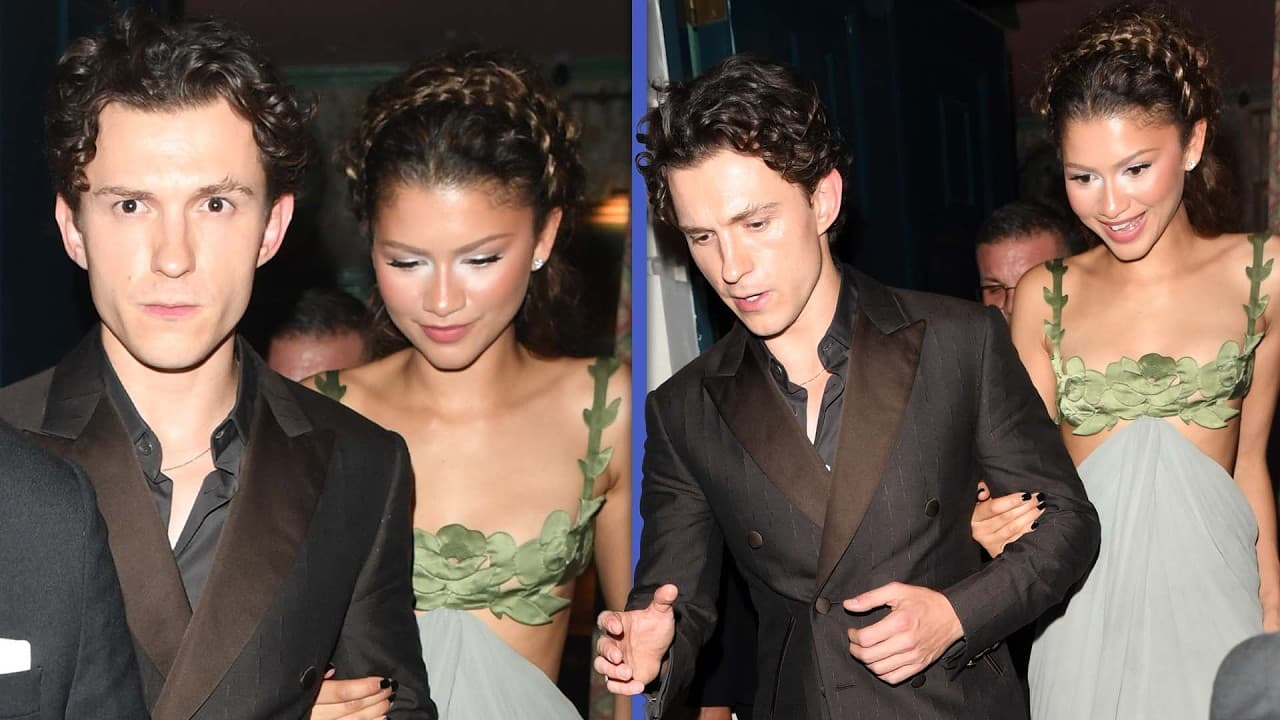
Tom Holland is laughing as he tells it. The story of how his wife got a perfect from Christopher Nolan before he did. The laugh is genuine. The edge underneath it is also genuine. That tension, held lightly in public, is exactly the thing that makes Holland and Zendaya the most strategically fascinating couple in the film business right now.
The occasion was the UK premiere afterparty for The Odyssey, a nearly three-hour, $250 million adaptation that opens July 17th. Holland plays Telemachus, Odysseus's son. Zendaya plays Athena. She arrived in a second Valentino look. Her first was already making the rounds. And the two of them worked the room arm in arm, the word 'newlyweds' trailing them everywhere like a fragrance. In a sit-down with Entertainment Tonight that week in London, director Christopher Nolan confirmed, with evident pride, that Zendaya had done something 'perfect' on set. Holland confirmed that he then 'did everything he could' to match it.
What looks like a charming anecdote is actually a window into something more structural: two of the most bankable stars of their generation have built a life that doubles as a vertically integrated creative partnership, stress-tested it inside one of the most demanding productions in recent memory, and are now releasing the result into a summer box-office season that badly needs a win. The business case for their union. Romantic and professional at once. Has never been clearer.
Christopher Nolan cast Tom Holland first. What that sequencing tells us
Christopher Nolan cast Tom Holland as Telemachus before Zendaya was attached to The Odyssey, with Holland later breaking the news of her casting to her directly. That sequencing matters: it positions Holland as the gravitational center of the project, not merely as Zendaya's spouse riding her heat.
The casting order is not a trivial detail. Since Dune made Zendaya a genuine global film star. An achievement examined in depth in our Nolan Effect piece. There has been a persistent industry read that her profile now eclipses Holland's outside the Spider-Man franchise. Nolan anchoring the film to Holland first is a quiet but legible counter-argument. It says: this director, who does not cast for marketing purposes, saw Holland as the load-bearing wall.
Holland described the moment he got to tell Zendaya about her own casting as one of the best surprises he had delivered. That framing. He was the messenger, the one already inside the project. Is the kind of psychological foothold that matters enormously to actors getting through a shared career. He was not the plus-one. He was the one who had already earned the room.
Nolan's track record of turning already-established stars into newly serious ones is well documented. He did it with Matthew McConaughey in Interstellar, with Cillian Murphy across multiple films culminating in Oppenheimer. The question Holland is implicitly auditioning for here is whether he can make that same leap. From franchise cornerstone to prestige auteur's collaborator. The Odyssey is the first real evidence.
The 'perfect take' dynamic and what it says about competing spouses on set
Zendaya received a 'perfect' designation from director Christopher Nolan on set of The Odyssey before Tom Holland did, sparking what Holland described as friendly but real competitive motivation.
Nolan told Entertainment Tonight plainly that Zendaya did something perfect because she did something perfect. No hedging, no diplomatic softening for the cameras. He also acknowledged that Holland and co-star Matt, hearing that assessment, 'took it a little personal.' This is a director who is not known for public warmth or promotional fluff. When he volunteers that kind of detail, it lands differently than a studio publicist would.
Holland's response was textbook controlled competitiveness. He got his hug from Nolan. He was specific about that, flagging it as meaningful. And then he openly admitted to recalibrating his effort once he understood the benchmark existed. That is not the answer of a man coasting on his fiancée's (now wife's) reputation. It is the answer of a serious actor who is tracking his own standing in real time.
Zendaya's account of the same moment was characteristically deflecting: she was 'just excited to be there,' she didn't want to be the weak link. That is a familiar posture for her in press. The self-deprecating shrug that sits on top of extraordinary technical preparation. People who have watched her work across Euphoria, Dune, and Challengers understand that the shrug is not the whole story — see Jordyn Woods and Karl-Anthony Towns Got Married. And the Guest List Told the Whole Story. The 'perfect' wasn't luck.
What the exchange reveals at the business level is that this couple does not operate on an enforced hierarchy of talent. They are genuinely competing for excellence within the same production, which is the kind of creative environment that tends to produce exceptional work. And exceptional press. Every journalist covering this film now has a narrative engine: who delivers the better performance, the actor cast first or the one who got there second and immediately raised the bar?
"They are genuinely competing for excellence within the same production. And that tension is the best promotional engine the film could have asked for."
Anne Hathaway as Tom Holland's anchor. The supporting cast strategy Nolan deployed
Anne Hathaway plays Telemachus's mother in The Odyssey and became what Tom Holland described as 'the wind in his sails' throughout the shoot, forming a close friendship that gave Holland an emotional grounding separate from his relationship with Zendaya on the same set.
Holland's description of Hathaway evolved in real time during the interview. He reached for 'anchor,' caught himself because the connotation was wrong (pulling down, not holding steady), and landed on 'the wind in his sails.' The correction was unrehearsed and revealing. He was searching for a word that captured support without dependency, energy without rescue. That is a specific kind of professional relationship: the senior colleague who makes you better without making you smaller.
Hathaway's own career trajectory makes her an interesting mirror for what Holland is attempting. She spent years as a massively commercially successful actress. Princess Diaries, The Devil Wears Prada. Before Les Misérables and The Dark Knight Rises repositioned her as someone whose range the industry had underestimated. The critical recalibration took time and took difficult, exposed work. Holland is at a built that way similar inflection point.
For Nolan, the supporting cast architecture here is intentional. Surround a younger lead with actors who carry their own gravitational fields. Hathaway's awards credibility, Zendaya's cultural weight. And the audience reads the central performance as elevated by proximity. It is one of the quieter craft decisions great directors make that never appears in production notes.
The $250 million budget and what it demands from its stars commercially
The Odyssey carries a reported production budget of $250 million, making it one of the most expensive films of 2026 and placing significant box-office pressure on its two most recognizable faces. Tom Holland and Zendaya. To deliver opening-weekend numbers that justify the scale.
A $250 million production budget, before prints and advertising, typically requires somewhere north of $600 million in global theatrical revenue to reach break-even for the studio. That is a very specific kind of commercial problem, and it lands squarely on the promotional shoulders of the cast. Nolan's name travels far on its own. His last original film cleared $950 million worldwide. But his epics have also had the benefit of built-in cultural urgency. A Homer adaptation does not arrive with the same pre-sold audience as a biopic about a historical event the entire world has been re-litigating for decades.
This is where the Holland-Zendaya coupling becomes a genuine commercial asset rather than merely a tabloid one. Their combined fan bases span different demographics with different moviegoing habits. Holland's Spider-Man audience skews younger and franchise-loyal. Zendaya's post-Dune, post-Challengers audience skews toward arthouse-curious viewers who will travel for prestige spectacle. Together they cover more of the opening-weekend map than either would alone.
The premiere strategy reflects this clearly. The London event was a genuine dual activation. Both stars present, both in distinct headline-generating looks, both giving quotes that will run in entertainment coverage across multiple markets and languages. The 'newlywed co-stars competing for the director's approval' story writes itself, travels globally, and costs nothing beyond the infrastructure already built around the film's release. That is not an accident. That is a publicity operation that knows exactly what it has.
What 'newlywed' does to a celebrity brand. The timing of going public as married
Entering a major film's promotional cycle as newlyweds gives Tom Holland and Zendaya a fresh news hook that extends press coverage beyond the film's own story, amplifying both their individual profiles and the production's visibility at a commercially critical moment.
Celebrity marriage, when it lands during a press cycle, operates as a force multiplier. The film becomes the occasion; the relationship becomes the story that travels wider. Outlets that would not otherwise lead with a period epic now have a reason to run the image: arm-in-arm on the red carpet, the 'newlywed' label doing the work of a caption. You can track this pattern across recent precedent. the wedding analysis around Taylor Swift and Travis Kelce showed how a relationship milestone can rewrite two separate brand narratives simultaneously.
For Holland specifically, the framing is useful because it softens the transition from beloved franchise star to serious dramatic actor. 'Newlywed' is warm. It is accessible. It gives audiences an emotional entry point into a film that might otherwise feel like homework. Three hours, ancient Greek source material, a demanding director. The human story functions as a doorway.
For Zendaya, the calculus is slightly different. She has spent the years since Euphoria carefully building an image of intentional, almost austere artistic seriousness. Roles chosen for risk, not comfort, fashion choices that read as curatorial rather than aspirational. 'Newlywed' could, in the wrong context, domesticate that image in ways she might not want. The Valentino goddess look at the afterparty. A second red carpet outfit anchored to her character Athena — see Quinta Brunson's Red-Carpet Ambush Reveals How Abbott Elementary Stays Culturally Alive. Was clearly the corrective. She was signaling: the film comes first, the iconography is still mine.
Zendaya's Valentino afterparty look as calculated character extension
Zendaya wore a Valentino look at The Odyssey's UK premiere afterparty that on purpose echoed her character Athena, using the red carpet as a continuation of the film's visual world rather than a separation from it. A strategy that reinforces her artistic identity while generating standalone fashion coverage.
The decision to echo your on-screen character at a premiere is not new, but Zendaya and her stylist Law Roach (or whoever is dressing her in this cycle) execute it at a level that generates its own press ecosystem. The look does not need to be explained; the reference is legible enough that entertainment and fashion media both pick it up, running it under film coverage and style coverage simultaneously. That is double-exposure from a single wardrobe decision.
Athena as a character reference is also doing specific image work. The goddess of wisdom, strategy, and craft. Not beauty for its own sake, not romantic attachment, but excellence and precision. Wearing that into an afterparty where you are also being photographed as a newlywed is a balancing act. The fashion says: I am the character. The body language with Holland says: I am also in love. Both things are true and both things are commercially useful.
Zendaya's fashion choices have long operated as a parallel text to her career moves. For readers tracking her full arc across our film wealth profiles, the through-line is consistent: every major professional pivot has been accompanied by a visual vocabulary shift that primes the audience before the work arrives. The Odyssey cycle appears to be no different.
How this film fits Tom Holland's post-Spider-Man identity construction
The Odyssey represents Tom Holland's most significant step toward a post-franchise identity, pairing him with a director whose films confer prestige on their leads and placing him in a classical dramatic role that asks for emotional range his Marvel work was never designed to test.
Holland has been publicly thoughtful about the weight of the Spider-Man years. The way a franchise that made him a star also, by its nature, constrained the range of what audiences believed him capable of. Telemachus is a specific kind of corrective: a young man waiting for a father who has not come home, getting through loyalty and grief and the long uncertainty of absence. That is not a role you play with quips and physical comedy. It requires stillness.
The competition with Zendaya for Nolan's approval. Framed lightly at the premiere but clearly real. Is actually the right kind of pressure for this moment in his career. He is not the biggest star on the call sheet. He is not the most recently garlanded with critical praise. He is the one who got cast first, who has to justify that faith over nearly three hours of screen time, surrounded by actors who are all doing serious work. That is an environment that either reveals a performer's limits or expands them.
The business logic of The Odyssey for Holland is straightforward: a successful run here. Critically and commercially. Substantially widens the table of projects available to him post-Marvel. It is the same move that McConaughey made with Nolan, that Murphy made across multiple Nolan collaborations. The director is not just a filmmaker for these actors. He is a credential.
You can follow the financial contours of what that kind of career pivot means for long-term earning power across our full Atlas of tracked net worths. The pattern of franchise stars who successfully crossed into prestige work shows a consistent pattern of both fee escalation and longevity that franchise-only careers rarely match.