Quinta Brunson's Red-Carpet Ambush Reveals How Abbott Elementary Stays Culturally Alive
A comic confrontation with SNL's Marcello Hernández on the Emmys carpet was spontaneous. What it accomplished for Brunson's brand was anything but.
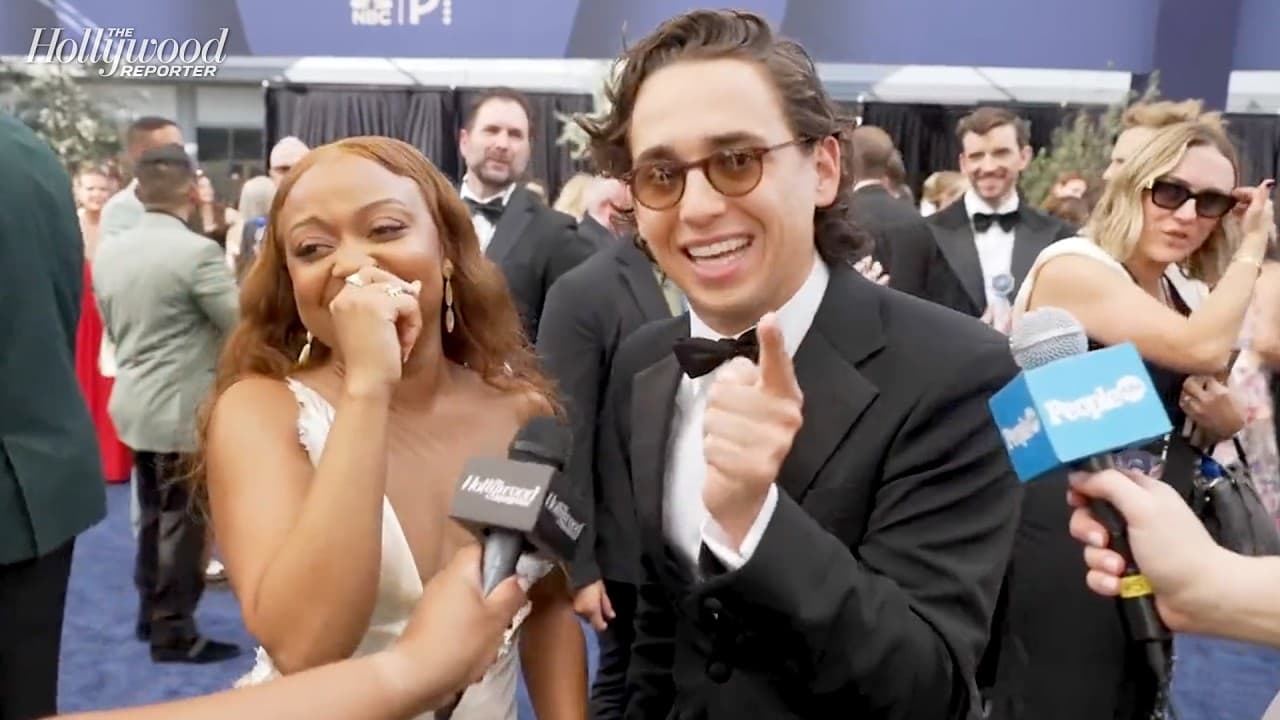
The beef, if you could call it that, began with a text message. Quinta Brunson says she sent it. Marcello Hernández says it barely counted. His mother, summoned mid-argument on a Hollywood Reporter red-carpet segment, sided with Brunson. The crowd loved every second.
The moment aired on the eve of the 2026 Emmy Awards, and it looked like an accident. It was not an accident. Brunson arrived at the carpet as the lead of a network comedy entering its sixth season, a show that, by any actuarial table of television longevity, should be fading into comfortable irrelevance. Instead, Abbott Elementary keeps showing up. It keeps getting nominated. And its creator keeps finding ways to make the whole enterprise feel urgent and alive even when the cameras are supposed to be pointed at someone else.
That is the skill the carpet segment actually demonstrated. Not charm, though there was plenty, but the strategic use of chaos. Brunson turned a routine press-line stop into a casting conversation, a bit of public accountability theater, and a love letter to her show, all at once. Hernández walked away with his own moment. The Reporter's segment went wider than most. Nobody lost. That is not luck. That is craft.
What actually happened on the Emmys red carpet
During a Hollywood Reporter red-carpet interview at the 2026 Emmy Awards, Quinta Brunson spotted SNL cast member Marcello Hernández and pulled him into a live, unscripted confrontation about a guest-casting invitation she says she extended and he declined.
The setup was simple enough. Brunson was mid-answer, talking about Abbott Elementary's sixth season, about what it means to keep a network comedy in Emmy contention, when Hernández appeared nearby. She broke off and waved him over. What followed, captured by the Hollywood Reporter and published the night before the ceremony, was several minutes of overlapping accusation, genuine laughter, and a phone-mom cameo that landed harder than most scripted bits on television that week.
The underlying dispute was this: Brunson wanted Hernández on Abbott Elementary. She texted him. He says she gave him a panic attack waiting for confirmation and that the invitation never solidified into an actual booking. She says she texted him warmly and he declined. The transcript of that text, read aloud on the carpet, amounts to something between an apology and a pitch meeting. Hernández's mother, reached by phone in the middle of the exchange, immediately took Brunson's side. Hernández looked at the camera and accepted his defeat with the particular grace of a man who knows he is losing in a way that is good for his career.
The segment ended in declarations of mutual affection. The resolution mattered less than the texture of the argument itself, two performers, both operating near the top of their respective comedy lanes, finding a frequency together that neither could have scripted in advance. Or at least, that is how it read. The ambiguity is part of the value.
Why Abbott Elementary's sixth-season position is more precarious than it looks
Abbott Elementary enters its sixth season as a critical favorite, but network comedies at that stage historically face sharply declining cultural urgency, making Emmy visibility and press-moment engineering more important than ever to sustaining the show's identity.
Brunson said something precise on that carpet, and it deserves unpacking. She said that being a network comedy that is 'not forgotten' never gets old. That framing is not modesty. It is an accurate description of the structural position her show occupies.
Network comedy, as a category, has been on life support for the better part of a decade. Cable stripped away the audience. Streaming stripped away the urgency. When Abbott Elementary arrived in 2021 and cracked the Emmy conversation, it felt like a genuine anomaly, a multi-camera-adjacent workplace show on ABC that critics actually argued about. The show won. It kept winning. But by season six, the conversation around any long-running series tends to calcify. Critics who championed the early seasons move on. The discourse migrates to whatever is newest.
Brunson's carpet move addressed that calcification directly. By making news, even cheerful, comedic news, she kept Abbott Elementary in the same conversation as the prestige cable and streaming entrants that dominate Emmy night coverage. She did not need a hot take or a controversy. She needed thirty seconds of footage that would travel. She got several minutes.
"Declining a text message costs nothing. Declining on camera, with your own mother as a witness, is a different calculus entirely."
What the Marcello Hernández casting push reveals about Brunson's talent strategy
Brunson's on-air pursuit of Hernández signals that Abbott Elementary is actively recruiting from the SNL pipeline, a strategy that would import cultural heat and broaden the show's reach into audiences who follow sketch-comedy talent.
The casting conversation embedded in that carpet confrontation was not incidental. Brunson has built Abbott Elementary on a very specific kind of performer, people with deep roots in comedy, strong on improv and reaction, capable of inhabiting the earnest world of a Philadelphia public school without letting the jokes overwhelm the warmth. Hernández fits that template precisely.
His rise on Saturday Night Live has been steep. He became one of the more talked-about featured players in recent seasons, with a quality that is genuinely rare, he can be absurd without losing the audience's trust. That is exactly what Abbott Elementary's guest-performer slots require. When Brunson says she wants him, she is not being polite. She is identifying someone whose energy would extend the show's creative range.
The public nature of the ask matters strategically. By staging the conversation in front of cameras, Brunson removed the private 'no' from the table. Hernández can decline a text message without consequence. Declining on camera, with his own mother as a witness, is a different calculus. It is a form of social pressure that is also, notably, an enormous compliment. The message to any other performer watching: Quinta Brunson will advocate for you loudly, and she will be charming about it, and her audience will root for you to say yes.
How Brunson engineers press moments that look unplanned
Quinta Brunson has a consistent pattern of turning promotional appearances into genuine news by weaponizing spontaneity, using real relationships and unscripted tension to generate coverage that scripted interviews cannot replicate.
The craft here is worth examining. Most celebrity red-carpet appearances produce a clean thirty seconds of content: the dress is discussed, the project is mentioned, the smile is consistent. The footage gets one cycle and disappears. Brunson's carpet stops tend to produce something more durable, a clip, a screenshot, a moment that becomes a reference point.
Part of this is a function of Abbott Elementary itself. The show is built on the premise that ordinary moments can be filmed to reveal something true about people. Brunson carries that sensibility into her promotional life. She does not perform charm at the camera. She performs it at the person next to her. The camera is a secondary beneficiary. That subtle reorientation is visible in the Hernández exchange, she never breaks to address the interviewer. The confrontation happens in its own plane, and the press-line context becomes the frame rather than the subject.
The risk in this approach is real. Unscripted moments can go wrong. An argument that reads as playful in the room can read as uncomfortable on screen. Brunson has the comedic instincts to feel the temperature of a moment and adjust. That is not a learnable skill in the ordinary sense. It is the core of her value as a performer and, increasingly, as a brand.
What the 'history' remark tells us about Brunson's Emmy positioning
When the interviewer noted that Brunson could make Emmy history, her deflection, 'I didn't know that', was a practiced piece of awards-season image management, projecting humility while keeping the possibility of a historic win in the air.
There was a single exchange in the segment that passed quickly and deserves a slower read. The interviewer told Brunson she could make history that evening. Brunson paused, said she hadn't known that, and pivoted immediately to gratitude and presence. The pivot was smooth. It was also intentional.
Awards-season image management is its own discipline, and Brunson has been practicing it since Abbott Elementary first entered the Emmy conversation. The rules are unwritten but consistent across the industry: do not appear to want the award too visibly, because visible wanting creates a rooting-against dynamic. Express surprise at your own eligibility. Anchor everything in the ensemble and the work. Brunson ran that playbook with precision on the carpet.
The 'history' framing, left vague, not elaborated, does meaningful work on its own. It signals to viewers and voters that something significant is at stake without Brunson having to make the case herself. The interviewer planted the flag. Brunson waved at it from a careful distance. Among the latest reporting on Emmy strategy, this pattern shows up repeatedly: the stars who win tend to be the ones who look least like they've been thinking about winning.
Marcello Hernández's career gains from a moment he technically lost
By appearing on the Emmys carpet in a comedic conflict with Brunson, and losing the argument gracefully, Hernández positioned himself as a desirable collaborator while reaching an audience well beyond SNL's core viewership.
It is worth accounting for what Hernández took from this exchange, because the distribution of value was not as one-sided as the joke structure implied. He was the butt of the bit. His mother betrayed him. He laughed at his own expense. On paper, he lost.
In the field, he won significant exposure. The Hollywood Reporter's carpet content reaches an industry audience that does not necessarily track SNL cast members by name. Brunson vouching for him, publicly, urgently, in front of an awards-show press line, is a form of credentialing that money cannot buy and agents can only approximate. She told the camera that she loves him and wants him on her show. For a performer building toward a post-SNL chapter, that is valuable positioning.
His instinct in the moment was also correct. He did not deflect the attention back to her. He matched her energy, escalated slightly, brought in his mother, and then accepted the reconciliation with warmth. That sequence required reading the room at speed. The people who book film and television roles, the ones who will matter when SNL is in his past, were watching. Some of them laughed. That is how careers get built at the margins of big nights. Our coverage of performers getting through exactly these transitions is catalogued across the Atlas for anyone tracking the business of fame at that level.
Why the mother cameo worked better than any scripted punchline
The unplanned appearance of Hernández's mother on a phone call during the exchange provided authentic emotional texture that no writer's room could manufacture, turning a press-line clip into something with genuine emotional stakes.
Television writers talk about the 'earned' moment, the beat that lands hard because the audience has been set up to receive it. The mother cameo earned nothing in the conventional sense. It arrived without setup. It had no arc. The laugh it produced was enormous anyway.
The reason is simple. Real affection reads differently on camera than performed affection. When Hernández's mother called him out for complaining about Brunson's alleged panic-attack-inducing delay, and then said the resulting content was funny, she was delivering a verdict that no scripted character could have delivered with the same authority. The audience knew immediately that this woman had no reason to perform for the camera. She was just a mother who thought her son was being a little dramatic and said so.
Brunson's response to the mother, warm, delighted, slightly victorious, was exactly right. She did not oversell it. She let the moment breathe. The ability to receive an unexpected gift and not crush it with commentary is among the rarer skills in live performance. It is also, not coincidentally, one of the things that makes Abbott Elementary work as a show. The writing room knows when to stop writing and let the performers be human. Brunson applies the same instinct to her own public appearances. The comparison is not coincidental. It is the signature.
What this moment signals about the business of long-running network TV
Abbott Elementary's continued Emmy presence in season six reflects a broader truth about network television economics: cultural relevance must be actively maintained through press strategy and star-power cultivation because ratings alone no longer sustain a show's identity.
Step back from the charm of the moment and the business logic underneath it becomes clear. Network television has shed its cultural authority steadily for fifteen years. The shows that survive, that stay in the Emmy conversation, that attract prestige talent, that generate press that has nothing to do with their episode count, do so through active effort. The era of a network comedy coasting on ratings has passed.
Brunson's presence on that carpet, six seasons in, doing something memorable enough to become a story rather than a byline, is the contemporary equivalent of a showrunner placing a strategic billboard on Sunset. It says: we are here, we are worth your attention, the best performers should want to be associated with us. It says that to audiences and to the industry simultaneously.
The parallel is worth noting for any analysis of what survives in the current television landscape. Shows that generate genuine press moments, not manufactured controversies, but real ones, moments that require actual human relationships and spontaneous chemistry, hold their position in the culture even as their ratings normalize. Abbott Elementary has been doing this since its debut. Brunson has been the primary engine of it. The Hernández exchange was not an exception to that pattern. It was the pattern, running cleanly. For deeper context on the entertainment business mechanics driving these decisions, the film category and business profiles here track the structural forces that make moments like this matter far beyond the carpet.
The long game: what Brunson's public persona is building toward
Across six seasons of Abbott Elementary and a series of high-profile public appearances, Brunson has constructed a persona that combines creative authority with genuine likability, the rarest combination in the industry, and the one with the longest commercial shelf life.
The piece that is hardest to manufacture in this business is likability that does not feel like a strategy. Audiences are good at detecting when a celebrity is performing accessibility. They are also very good at detecting when the warmth is real. Brunson reads as real. That is partly innate. It is also the product of consistent choices, in interviews, in public appearances, in the way she talks about her collaborators versus the way she talks about herself.
She speaks about Abbott Elementary as a collective. She uses 'we' freely. When she says she is happy not to be forgotten, she means the show, the cast, the crew, the whole enterprise. That posture builds loyalty inside the industry at a rate that individual stardom rarely achieves. The performers who want to be on her show are responding to something specific: the sense that she will treat them well, advocate for them, and put them in a context that reflects well on everyone involved.
The carpet confrontation with Hernández demonstrated all of this in compressed form. It showed creative pursuit, she wants good performers and will say so publicly. It showed warmth, the argument was funny because it was clearly built on real affection. It showed humility, she let his mother's phone verdict stand without trying to top it. And it showed the kind of comic instinct that has made Abbott Elementary the standard-bearer for a category of television that most people had written off. Six seasons in, the show is still making the case for itself. So is its creator. On the evidence of that carpet, neither is close to done. For context on how this kind of sustained cultural relevance shapes what we track in our Atlas, Brunson's career trajectory is becoming one of the more instructive data points in the modern network era, right alongside the late-night chess moves covered in our piece on Stephen Colbert backing his Emmy rival.