Ed Sheeran Lost His Opening Acts. The Venues Won.
Macklemore's firing from the Mathematics Tour, and the rapid exodus of every remaining support act, reveals who actually controls what artists can say on American stadium stages, and how much that control costs.
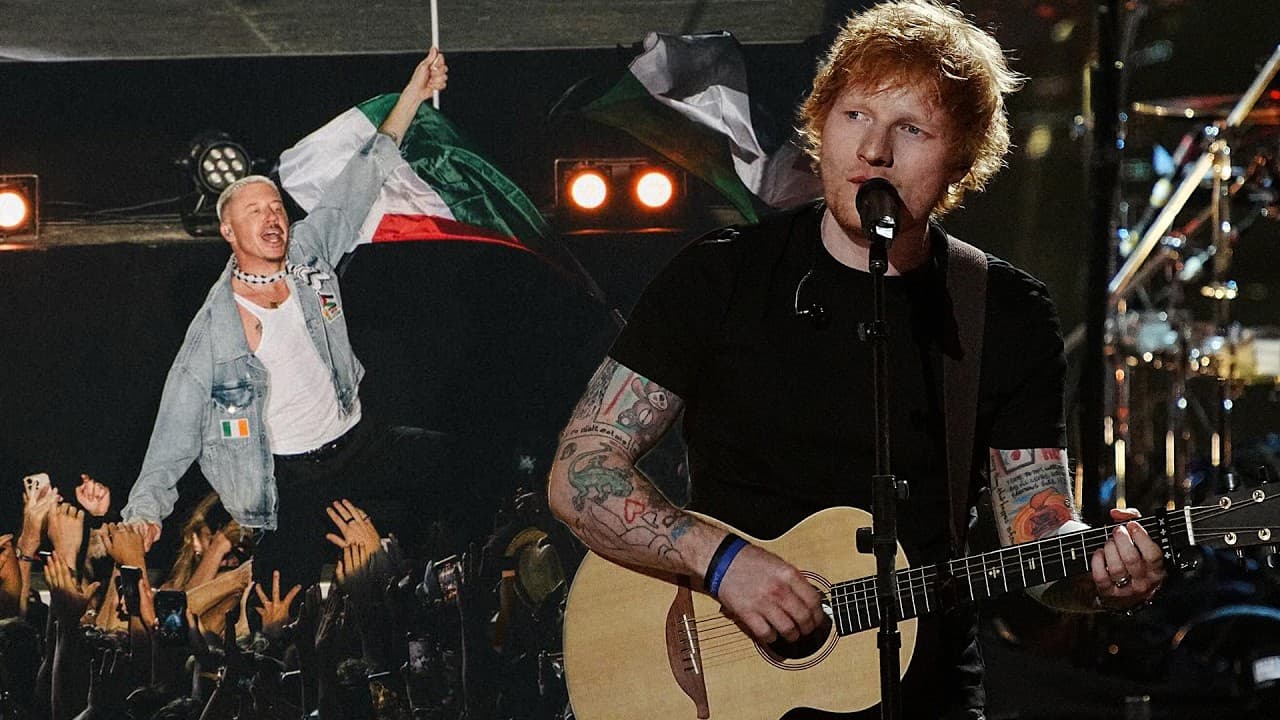
The moment that ended Macklemore's run on Ed Sheeran's Mathematics Tour lasted roughly two minutes. Standing before a packed MetLife Stadium over Labor Day weekend, Macklemore said "Free Palestine", twice, on purpose, and framed it as the reason he had wanted the tour slot in the first place. The crowd cheered. Then the statement crossed the desk of Robert Kraft, billionaire owner of the New England Patriots and, more relevantly here, of Gillette Stadium outside Boston, where Sheeran was scheduled to play two dates at the end of September.
What followed was not a cancellation. It was a negotiation, one that Sheeran lost. Kraft, according to Macklemore's own account and subsequently corroborated by Sheeran himself, rallied other stadium owners and presented the tour's promoters with an ultimatum: remove Macklemore or lose the venues. Sheeran says he spent the better part of a week in talks trying to find a middle path. There was none on offer. The promoters made the call. Macklemore was out.
Within days, every remaining support act on the tour, Finneas, Aaron Rowe, Benson Boone, and Lukas Graham, announced they were withdrawing in solidarity. Ed Sheeran, one of the world's highest-grossing live acts, was suddenly headlining a tour with no opening acts and a public-relations crisis that his carefully maintained apolitical brand was not designed to handle. What this episode actually reveals is not about Gaza politics. It is about the architecture of power in the American stadium business, and the precise limits of what even the biggest touring artists can promise the people who open for them.
What Macklemore actually said, and why it triggered a venue response
At MetLife Stadium on Labor Day weekend 2026, Macklemore used a two-minute opening-act monologue to call for Palestinian freedom and frame the tour slot as a intentional platform for that message.
Macklemore has spent the better part of eight years making his position on Israel's actions in Gaza a central plank of his public identity. This was not a spontaneous outburst at MetLife. It was, by his own account told Entertainment Tonight, exactly the reason he wanted to be on the tour: a chance to stand in American stadiums and say something he believed needed saying at volume. The Grammy winner knew what he was doing and said so clearly.
What he may not have fully modeled was the ownership chain above those stadiums. Gillette Stadium is not a neutral public venue. It is Robert Kraft's asset, and Kraft has been a visible and financially significant advocate for pro-Israel causes for years. The collision between Macklemore's message and Kraft's interests was not incidental. It was structural.
The firestorm, as Sheeran described it, moved fast. Kraft reportedly characterized Macklemore's remarks as anti-semitic rhetoric, a framing Macklemore pushed back on hard, drawing a sharp distinction between criticism of a state's military conduct and hostility toward Jewish people. That distinction is a live and genuinely contested one in American public life. Inside the stadium business, however, the distinction mattered less than the owner's comfort level. Kraft had use. He used it.
How venue owners can effectively fire a touring artist's support act
Stadium owners do not need to breach a contract directly. By threatening to withdraw their venue from a tour's routing, they force the promoter, who sits between the headliner and the support act, to make the removal decision, which is exactly what happened when venues on the Mathematics Tour told promoters Macklemore had to…
The mechanics here are worth slowing down on, because they explain why Sheeran ended up in a position where he had almost no formal power despite being the name on the marquee. A major stadium tour is not a direct relationship between artist and building. A promoter, in this case operating as the contractual layer between Sheeran's camp and the venues, holds the routing agreements. The headliner's use over those agreements is significant but not absolute.
When a venue owner signals that a particular performer's presence creates conditions under which the venue will pull out, the promoter faces a straightforward commercial calculation. Losing Gillette, or any cluster of major stadium dates, does not merely cost revenue from those shows. It potentially destabilizes the tour's financial model, since stadium deals are often structured with guarantees and partial advances already in motion.
Sheeran's statement made plain that the decision was the promoter's, not his. That is almost certainly true in a narrow contractual sense. It is also true that the promoter's decision was itself coerced by venue pressure, which means the actual decision-maker was Kraft and whichever other stadium owners aligned with him. This is how censorship operates in a privatized live-music infrastructure: nobody fires the artist directly. The market does it, cleanly, through intermediaries.
"The stadium touring circuit has always had informal norms about political speech. Those norms are now a little more formal, and a little more enforced."
Ed Sheeran's apolitical brand strategy, the business case for staying silent
Sheeran's refusal to take public sides on the Israeli-Palestinian conflict is a intentional career strategy, not mere discomfort with controversy. He has built a global audience by positioning his shows as emotionally universal spaces, and that positioning has made him one of the highest-grossing touring acts in history.
It would be easy to read Sheeran's public statement as a hedge, a bit of both-sidesing designed to protect his image without risking anything. The more accurate reading is that it is a business strategy that has been operational for his entire career, and that it has worked spectacularly well. Sheeran's touring numbers put him in a category shared by perhaps five or six artists alive. His audiences are broad, multi-generational, and international. That breadth is the product, and it requires active maintenance.
He said as much directly: his audience includes children, people of all backgrounds, and fans who are not attending a political event. That framing is commercially rational. Artists who build maximally inclusive audiences trade away some cultural edge in exchange for massive reach. Beyoncé, Coldplay, and Adele operate on similar terms. The trade-off is explicit, even if it is rarely stated this baldly.
What is genuinely striking is how transparent Sheeran was about the logic. He acknowledged having personal views on what he called a devastating conflict. He said he supports causes privately. He drew a clean line between private conviction and professional platform, and he defended that line as a legitimate choice rather than an absence of conscience. Whether audiences accept that framing will determine the extent of any lasting reputational damage, and early signals suggest his core fan base largely does.
Why every support act walked, and what that solidarity actually costs them
Finneas, Aaron Rowe, Benson Boone, and Lukas Graham all withdrew from the Mathematics Tour in solidarity with Macklemore. For artists at their career stage, a major stadium support slot is one of the most valuable promotional tools available, which makes the financial and exposure sacrifice real.
Support slots on a Sheeran stadium tour are not charity. For an artist like Finneas, who has significant profile as Billie Eilish's collaborator and co-writer but is earlier in his solo live career, playing to fifty-thousand-person crowds across America represents months of audience-building compressed into weeks. The same logic applies to the others. Lukas Graham has a core fanbase but not Sheeran-scale reach. Aaron Rowe is newer still. These are not artists for whom walking away from the tour is cost-free.
The solidarity gesture is therefore meaningful precisely because it is expensive. It signals that these artists calculated the reputational cost of staying on a tour from which a peer was ejected for speech as higher than the commercial cost of leaving. That is a real bet, and it is not obviously wrong: in the current music landscape, where audience loyalty is increasingly tied to perceived authenticity, being seen to prioritize principle over opportunity can be its own form of brand investment.
The harder question is what happens next. Sheeran's tour runs through early November, and as of the ET report, no replacement acts had been announced. A headliner of his stature playing without openers is not unheard of, it is actually how some artists prefer to structure arena tours, but it removes a significant part of the live-event experience and leaves the first hour of each show empty. His team will fill those slots. The more interesting variable is whether they find artists willing to take them.
Robert Kraft's role, and what it tells us about stadium-owner influence
Robert Kraft, owner of the New England Patriots and Gillette Stadium, is the identified catalyst who pressured tour promoters to remove Macklemore after the Labor Day weekend performance. Kraft's intervention illustrates how stadium ownership grants billionaire operators veto power over the content presented on their stages.
Kraft is worth understanding as a figure here, because his role clarifies the power dynamic. His financial profile, covered in our Sports wealth profiles, is that of a man whose assets extend well beyond football. He has been a major donor to Jewish causes and a vocal critic of what he considers anti-Israel sentiment in public discourse. His willingness to exercise venue use in this situation is entirely consistent with his established priorities.
The structural point is broader than Kraft himself. American stadium infrastructure is overwhelmingly privately owned. The venues that host the country's biggest touring acts are not public squares with First Amendment implications; they are commercial properties whose owners set the terms of use. A touring artist playing those venues is, in a meaningful legal sense, a guest. The owner of the house decides who else gets in.
This has always been true, but the Macklemore situation makes it visible in a way that most tours never do. Venue owners typically exercise content preferences quietly, in the contracting phase, before a tour routes. When a situation escalates to a mid-tour firing, the machinery becomes public. Kraft almost certainly did not intend to create a cause célèbre. He intended to protect his asset from association with a political position he opposes. The result is a story that will make future conversations between venue owners and touring artists slightly more explicit about what is and is not welcome.
Macklemore's career calculus, does martyrdom pay?
Being publicly fired mid-tour for a political statement has historically generated short-term sympathy, streaming spikes, and press attention for artists, but the long-term career benefit depends on whether an artist's existing audience rewards activism over mainstream access.
Macklemore exists in an interesting commercial position. He has had massive mainstream moments, "Thrift Shop" and "Same Love" are genuine pop-culture artifacts, but his more recent work has been explicitly political, positioned for an audience that specifically values that stance. The label of principled-outcast-from-the-industry is, for him, a better fit than it would be for an artist trying to hold a broad pop audience.
Getting fired from a Sheeran tour for saying "Free Palestine" generates a very particular kind of press. It confirms his identity as someone who chose principle over access, which is exactly the narrative his current audience wants to consume. He acknowledged in his own statement that Sheeran was put in an impossible position and expressed hope that thirteen years of friendship would survive one painful disagreement. That is not the language of someone trying to burn a bridge; it is the language of someone managing a public story carefully.
The business reality is that Macklemore's revenue model is less dependent on stadium tour support slots than it would have been a decade ago. Direct-to-fan channels, streaming, and festival headlining in markets that share his political orientation give him paths to income that do not run through Robert Kraft's building. The firing costs him real exposure. It may cost him less than it appears.
The friendship variable, thirteen years between Sheeran and Macklemore
Sheeran and Macklemore have a friendship spanning at least thirteen years, and both men's public statements carefully preserved that relationship even while describing a painful professional rupture. The mutual goodwill suggests the split was genuinely involuntary rather than a cover for a deeper falling-out.
One of the more humanizing details in an otherwise structural story is that these two men apparently like each other. Macklemore said so in his statement; Sheeran said so in his. Both went out of their way to frame the tour's routing crisis as something that happened to their friendship rather than something their friendship caused. Sheeran called Macklemore's willingness to stand up for his beliefs something he respects, even as he defended his own different approach.
The relevance of this is not sentimental. When a public dispute between two artists reads as genuine, as a real disagreement between people with actual history, it is harder for the media to cast it as a cynical move by either party. Macklemore cannot easily be accused of using Sheeran as a prop; Sheeran cannot easily be accused of throwing Macklemore under a bus. The framing both men chose, of two different approaches to the same goal of peace, is sophisticated public-relations strategy whether or not it was consciously constructed.
The durability of the friendship will be tested by what comes next. If Sheeran's team privately helps Macklemore access other opportunities, or if the two are seen together in the coming months, the narrative of a forced separation rather than a genuine break will hold. If they go quiet on each other, the story will be rewritten.
What this episode means for political speech on the stadium touring circuit
The Macklemore firing establishes a visible precedent that stadium owners can successfully pressure promoters to remove artists mid-tour over political statements, which will make future headliners and support acts more cautious about what they say, and more careful about what they promise each other before a tour begins.
The chilling effect is the real story here, and it is the one least visible in any individual news cycle. No venue owner needs to issue a policy. No promoter needs to write a clause into a contract. The fact that this happened, publicly, with corroboration from both sides, is sufficient to inform every conversation that happens in a tour-routing meeting for the next several years. Artists and their managers now know the Macklemore scenario is possible. That knowledge changes behavior upstream of any specific decision.
For music's highest earners, who have the most to protect, the incentive to stay quiet on contested political subjects just got measurably stronger. For artists further down the billing who might use a support slot as a political platform, as Macklemore explicitly intended to do, the calculation now includes the possibility of ejection and its career consequences. The stadium touring circuit has always had informal norms about this. The norms are now a little more formal, and a little more enforced.
The broader context is one in which corporate ownership of cultural infrastructure is increasingly concentrated among people with strong and sometimes explicit political views. This is not unique to music; it runs through film, television, and digital platforms. Our latest reporting has tracked several instances this year of ownership priorities reshaping what creative talent can do inside commercially owned spaces. The Mathematics Tour is one data point in a larger pattern, and it is a cleaner, more public data point than most.
What it does not resolve is the underlying question: whether the artists who choose to speak, and accept the consequences, are changing anything, or whether the infrastructure's ability to silence them is simply more durable than any individual act of defiance. Macklemore believes the former. Robert Kraft demonstrated the latter. Both things can be true at once, which is what makes this particular moment so instructive and so unresolved.