The Lindsay Clancy Trial Is About to End. The System That Made It Possible Won't.
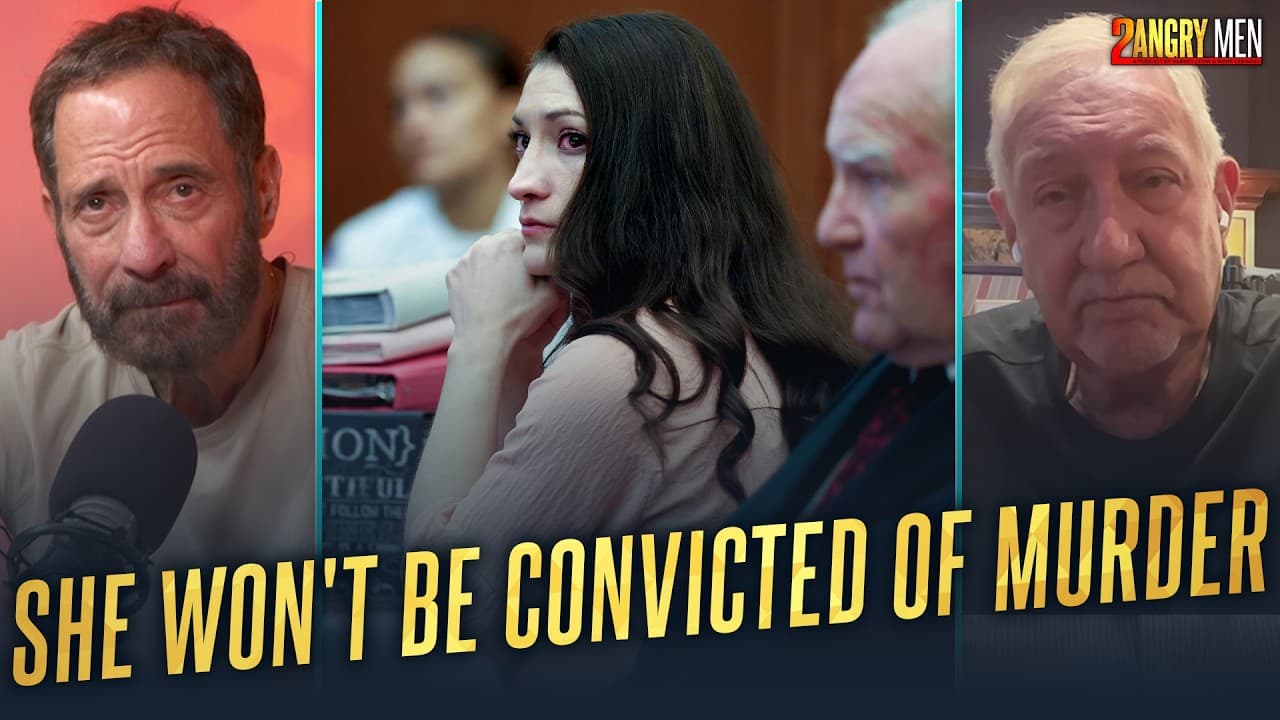
Two veteran trial lawyers told TMZ they don't expect a murder conviction. What the jury's questions actually reveal, and why this case became a referendum on postpartum care, pharmaceutical failure, and prosecutorial overreach.
The jury asked for two bags of pills and a knife. That request, mundane on its face, telegraphed everything. In a trial about whether Lindsay Clancy intended to kill her three children, her eight-month-old among them, the question of what she intended to do to herself afterward suddenly became the contested terrain. Intent was always the whole case. But the physical evidence of a suicide attempt, the empty pill bottles, the knife she allegedly used to stab herself, cuts directly to state of mind in a way that no expert's chart or prosecutor's timeline ever fully could.
By Friday of the first full week of deliberations, court observers were already reading the room. Jurors had arrived that morning conspicuously dressed up, as though expecting a verdict that never came. The day ended with a question to the judge that suggested, at minimum, internal disagreement. Two experienced trial lawyers, speaking on TMZ's legal commentary program, went further than most: they don't believe the prosecution has met its burden. Not on murder. Possibly not even on a conviction at all.
What happened in a Duxbury, Massachusetts home in January 2023 was, by any measure, inexplicable. And that inexplicability, the sheer impossibility of a rational motive, has quietly become the most powerful argument the defense never had to make explicitly. The jury is doing that work on their own.
Why the prosecution likely hasn't proven murder
To secure a murder conviction, the prosecution must prove Lindsay Clancy acted with criminal intent, that she deliberately chose to kill her children. Legal analysts say the evidence presented does not establish that intent beyond a reasonable doubt, making a murder conviction unlikely.
Intent is not a side issue in this case. It is the entire case. Clancy pleaded not guilty by reason of no criminal intent, which means the burden rests entirely with the state to prove she knew what she was doing and chose to do it. That is a high bar under any circumstances. It becomes nearly impossible, the two legal commentators argued, when the defendant's documented mental state at the time of the crime is as severe and as medically corroborated as Clancy's appears to be.
The prosecution's central theory, that Clancy sent her husband out of the house and then methodically killed the children, requires a degree of planning that the evidence, at least as it was received in the courtroom, doesn't appear to support. The lawyers were blunt about it: the timeline doesn't align, the motive is absent, and the medical record cuts directly against premeditation. There is no other man, no financial stake, no recognizable trigger that juries have historically needed to hang a murder narrative on.
What the prosecution did have was a defendant who, once hospitalized, asked for a lawyer. That request, both commentators acknowledged, is a genuine problem for the defense, not legally, since the right to counsel is absolute, but psychologically. Jurors have been shown for decades to read that ask as an admission of guilt, regardless of what the judge instructs them. Law enforcement has long deployed the implication deliberately. 'Only guilty people want a lawyer' is not law. It is, however, remarkably durable persuasion.
What the jury's evidence requests actually reveal
The jury's request to review the two bags of pills and the knife points directly to Lindsay Clancy's alleged suicide attempt, suggesting deliberations have centered on her state of mind at the time of the killings rather than on the act itself.
Jury notes are, as one of the lawyers put it, the most unfulfilling yet engaging thing a trial lawyer encounters. They are a single static snapshot of a dynamic, invisible conversation. But the specific items requested here carry clear interpretive weight. The pill bottles and the knife both connect to Clancy's apparent attempt to take her own life in the immediate aftermath. They are state-of-mind evidence, not crime-scene evidence.
The suicide attempt, and whether it was genuine, became a contested point at trial. The prosecution at various stages appeared to suggest, before the judge pushed back, that it wasn't serious. That framing matters enormously, because if the attempt was performative, it might support a theory of calculated action. If it was sincere, it devastates the prosecution's premeditation argument entirely. A person who has just murdered her children and immediately tries to die alongside them is not a person who planned a murder. The jury appears to be working through exactly that logic.
The fact that the judge declined to allow the jury to actually see those items adds another layer of ambiguity. Under Massachusetts's three-factor test for evidence review, the ruling was within the court's discretion. But it left jurors holding a question mark where they expected an answer, and may have reinforced whatever doubts were already circulating in the room.
One of the lawyers made a sharp observation about the pill bottles specifically: the police failed to collect one of the bags at the scene, and it was later surrendered separately. That gap in procedure became part of the defense's broader argument about the integrity of the investigation. The jury asking to revisit that evidence suggests at least some jurors want to interrogate not just what happened, but how the case was built.
"The sheer impossibility of a rational motive has quietly become the most powerful argument the defense never had to make explicitly."
The hung jury scenario is more likely than any clean verdict
With multiple charge options, murder, manslaughter, and not guilty, and deliberations extending past a full day into a Friday, the statistical and behavioral signs point toward a hung jury as the most probable outcome, though a manslaughter finding remains possible.
One of the lawyers invoked a rule he said he'd held for thirty years: if a jury deliberates past Friday at 3:30, and has already logged more than a full day, the hung-jury probability climbs to roughly 80 percent. The Clancy jury had done exactly that. They went home for the weekend with no verdict.
The multiplicity of options is itself a structural problem for unanimity. Some jurors may believe she is not guilty of anything. Others may land on manslaughter, a finding that acknowledges the act without ascribing full premeditated intent. A smaller faction may hold for murder. Getting twelve people to agree on which of those three boxes applies, in a case this emotionally complex and medically layered, is genuinely hard. And the longer it goes, the harder the path to consensus becomes.
Stacking that difficulty is the weekend itself. Both lawyers were unambiguous: the instruction not to consume media about the case is a legal formality, not a behavioral reality. Social media algorithms do not respect judicial orders. A juror who opens Instagram to look at something else and sees Clancy's name in a suggested reel has already, in the practical sense, been exposed. The potato-chip quality of algorithmic feeds, each piece of content pulling you toward the next, makes genuine information isolation close to impossible in 2026.
How the defense turned a murder trial into a healthcare indictment
Defense attorney Kevin Readington reframed the Clancy case as a systemic failure, presenting evidence that Clancy was prescribed 13 medications by multiple doctors who never properly diagnosed her underlying postpartum condition, a narrative that gave jurors a second entity to hold responsible.
Thirteen medications. Prescribed by multiple physicians across overlapping periods. Ambien, Klonopin, Valium, Prozac, Ativan, Zoloft, and more. Some of those prescriptions came from a single doctor who had recently taken on her care. The picture the defense constructed was not of a woman who was being treated for postpartum psychosis. It was of a woman being chemically managed, repeatedly and inadequately, by a system that was more comfortable adding a prescription than reckoning with a diagnosis it had missed.
The power of that framing is that it gives jurors who cannot acquit on pure sympathy a structural reason to be skeptical of conviction. They are not saying Clancy is blameless. They are saying the chain of causation runs through a series of institutional failures that preceded the night of January 24, 2023, by months. If she was never properly diagnosed, if the interplay between those thirteen drugs was never properly assessed, then what she did may have been a pharmacological event as much as a volitional one.
Nine of the twelve jurors are women. The commentators were careful not to overdetermine what that means, but the observation carries weight. Postpartum mental illness is not an abstract policy debate for people who have been pregnant or who know someone who has. The inadequacy of maternal mental health care in American medicine is lived experience for a substantial portion of the population. When a defense attorney puts that inadequacy on trial alongside his client, he is speaking a language that does not require translation.
There is a parallel here that one of the lawyers drew explicitly: the Luigi Mangione case, in which the alleged UnitedHealthcare shooter's defense was expected to put the insurance industry on trial using an extreme emotional disturbance framework. The Clancy case arrived at something similar through a different legal door, and actually got there. The healthcare system, in this courtroom, has effectively been a co-defendant. That is a remarkable strategic achievement.
Why Kevin Readington was the right lawyer, and where he shifted
Criminal defense attorney Kevin Readington is widely credited with executing a case that outperformed expectations, constructing a medical-failure narrative that gave jurors permission to acquit without requiring them to excuse the act itself.
The commentary on Readington was largely admiring, with one pointed observation. Early in the trial, he appeared to take a slight detour, pressing the police investigation's procedural failures and seeking a specific jury instruction, in a way that felt like a tactical pivot mid-game. In hindsight, the lawyers suggested, it reflected the fact that the case was playing out better than Readington had likely anticipated. When a defense unfolds more favorably than expected, there is a temptation to press the advantage. The question is whether pressing the police angle muddied waters that were already clearing.
One exchange drew particular attention: during cross-examination of the state's expert, Readington challenged the sourcing of certain testimony, suggesting it had originated with Patrick Clancy, Lindsay's husband, and asking whether the expert had actually reviewed the 911 tape or Lindsay's injuries before accepting that account. The implication was that the prosecution's evidentiary chain contained a broken link at a critical moment. That is the kind of cross-examination that sticks.
On the question of whether a female attorney might have served the client better, given the nine-woman jury and the explicitly gendered nature of the defense, the answer that emerged was nuanced. For certain sex crimes, a male attorney is structurally disadvantaged in ways that have more to do with optics than competence. But this case turned not on gender identification but on medical expertise and systemic critique. Readington appears to have prosecuted that argument effectively enough that the demographics of the bench may matter less than the quality of the medicine on display.
The psychological trap at the center of every inexplicable crime
When a crime defies rational explanation, as killing one's own infant children does, jurors face contradictory impulses: the act's incomprehensibility argues for the defendant's mental illness, but the crime's horror creates a competing demand for accountability that reason alone cannot satisfy.
This is the paradox the Clancy jury is living with. The very quality that makes the crime seem like evidence of profound mental illness, its utter irrationality, its devastation, the eight-month-old, also generates a gravitational pull toward punishment. Jurors are not robots processing evidence charts. They are people who have spent weeks absorbing the weight of three dead children, and some fraction of them may find that no explanation, however medically rigorous, satisfies the need to assign responsibility to a human being.
The lawyers were careful here, and right to be. There is a long history of commentators badly misreading jury rooms from the outside. In the early weeks of the Clancy trial, multiple analysts reportedly told one of the commentators that the jury hated her. He pushed back then. He is pushing back now. Hatred and horror are not the same thing. A juror who is visibly disturbed by the evidence is not necessarily a juror moving toward conviction. Sometimes disturbance is the precondition for mercy.
The support that gathered outside the courthouse, overwhelmingly female, growing daily, speaks to something the defense attorney himself noticed with what the commentators described as barely concealed awe. In a triple-murder case, a constituency had formed for the defendant. That is, by any historical measure, extraordinary. Defense lawyers in high-profile homicide cases do not expect public sympathy. They manage its absence. Readington got something different, and the lawyers suggest it registered on his face when he saw it.
Should the jury have been sequestered from the start
Legal analysts argue the judge should have sequestered the Clancy jury given the trial's national profile, because the assumption that jurors can independently wall themselves off from social media coverage is, in 2026, functionally unrealistic.
The answer both lawyers landed on was yes, unequivocally. In the United Kingdom, the Contempt of Court Act effectively shuts down trial coverage in ways that would be constitutionally impermissible in the United States. America chose the First Amendment, and has been grappling with the consequences ever since. The gap between what a judge instructs a jury to do and what a jury is humanistically capable of doing has never been wider than it is in an era of push notifications and recommendation algorithms.
The Scott Peterson case offered a cautionary data point: seven days, sequestered, and the foreperson still came into chambers on the record to say he felt threatened by community pressure over the verdict. Two jurors were removed for conducting independent online searches despite being locked away from the general public. If sequestration cannot guarantee insulation, the honor-system approach the Clancy court employed almost certainly cannot either.
The Meta settlement over social media addiction, which was finalized in the same week the jury went out, provided an almost too-perfect backdrop. The science underlying that lawsuit, that these platforms are engineered to create compulsive use, that the scroll is not neutral, is precisely what makes judicial instructions to avoid coverage so structurally hollow. A juror who opens Instagram and sees the Clancy case surface in their feed has not made a moral choice. They have been served by an algorithm that knows what they have been thinking about for weeks.
What happens to Clancy if the jury returns not guilty
If Lindsay Clancy is found not guilty by reason of lack of criminal intent, the judge will almost certainly commit her to a psychiatric facility for evaluation rather than release her directly, a decision driven by judicial caution rather than any clinical assessment of her current mental state.
The judge in this case has already signaled his temperament: he declined to grant a mistrial at a point where at least one of the lawyers believed he should have. He is a conservative judicial actor in the most precise sense of that term. He will not be the person who sends Lindsay Clancy home — see The Lindsay Clancy Holdout Juror and the Race Narrative Nobody Wanted to Name. The political and institutional exposure of doing so is too great, regardless of what any psychiatrist says about her current condition.
That calculation is not, strictly speaking, a legal one. It is an institutional one. A judge who releases a woman acquitted of killing her three children, even a woman who, by 2026, has spent years in psychiatric care and may be clinically stable, cannot control what happens next in the media environment. The safer path is commitment for evaluation, which buys time, distributes responsibility to mental health professionals, and insulates the court from the most extreme forms of public reaction.
There is a cruel irony in that outcome, if it comes to pass. The defense spent weeks arguing that Lindsay Clancy was a victim of institutional medical failure, that the system prescribed her into a pharmacological crisis it never adequately managed. If she is acquitted and committed, she returns to the custody of institutions whose competence is precisely what this trial put on trial. The case for systemic reform that the defense built so carefully in the courtroom does not automatically become policy. It becomes a headline, and then, eventually, a footnote.
Those larger questions, about postpartum psychiatric care, about pharmaceutical polypharmacy, about what accountability looks like when the responsible party is a hospital system and not an individual, are not resolved by any verdict. They are the substrate on which the next Lindsay Clancy case will be built — see The Lindsay Clancy Jury Is Deadlocked. That Outcome Was Always Likely.. That is the part of this story that the jury cannot decide.
Why this case will outlast its verdict
The Clancy trial has functioned as a public reckoning with postpartum mental healthcare failures and pharmaceutical over-prescription, meaning its cultural and policy resonance will persist regardless of the jury's finding, and may drive legislative or medical reform in the years ahead.
The lawyers drew a distinction that is worth taking seriously: the O.J. Simpson trial was a tabloid case, built on sex, betrayal, celebrity, and violence. The Clancy case has tabloid elements, the horror of the crime guarantees that, but its gravitational center is elsewhere. It is about what happens when medicine fails a mother so completely that the failure becomes criminal. That is a different kind of story, and it has a different kind of shelf life.
Public dissatisfaction with healthcare delivery in America is not a niche sentiment. It is one of the most broadly shared frustrations across income levels, political affiliations, and geographies. A case that dramatizes that failure, that puts 13 prescription bottles on a courtroom table and asks a jury to reckon with who is actually responsible for what followed, lands differently than a case built on jealousy or greed. It gives people with no connection to Duxbury, Massachusetts a reason to feel personally implicated.
Patrick Clancy's civil lawsuit, which the lawyers referenced, will carry that argument into a new forum regardless of what the criminal jury decides. Civil litigation has a lower burden of proof and a different purpose. It is designed not to punish Lindsay Clancy but to force an accounting from the institutions that treated her. That accounting, if it comes, is where the real systemic pressure will originate, in discovery, in depositions, in the documents that civil litigation compels institutions to produce. You can follow the broader arc of those cases and others like them in our latest reporting, and the wealth and power structures underneath them in the Atlas.
For now, a jury in Massachusetts is spending a weekend with a question that may be unanswerable in the terms the law provides. They were asked to determine whether Lindsay Clancy intended to kill her children. The evidence, the medication history, the suicide attempt, the absence of any recognizable motive, all of it suggests that the intent the prosecution needed to prove was simply not there to be found. What was there, and what no verdict will fully address, is a failure of care so profound that it ended three lives and destroyed several more. That is the case this trial actually made. The legal verdict, whatever it turns out to be, is almost secondary.