Pharrell Williams Net Worth 2026: A $250M Empire Built Beat by Beat
From a housing project in Virginia Beach to the creative helm of Louis Vuitton, Pharrell Williams has assembled a fortune that spans royalties, runways, and real estate.
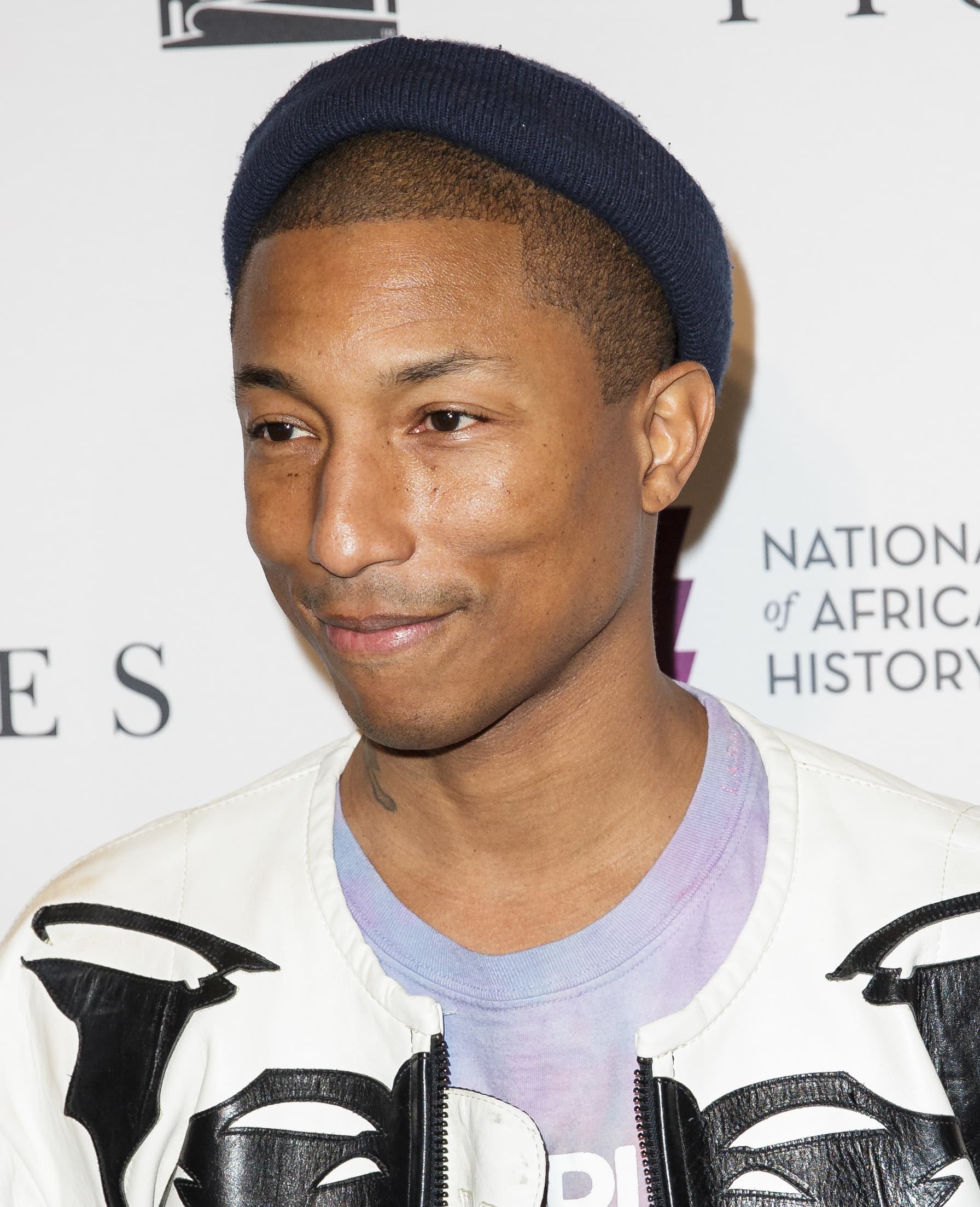
Pharrell Williams turns 53 this year with a fortune our analysis places at $250 million. Celebrity Net Worth landed at that same figure in January 2026. Fortune confirmed it weeks later. Highsnobiety split its own coverage between $250 million and a slightly higher $270 million read. Weighted by recency and source authority, we settle on $250 million as the defensible midpoint.
That figure is not one thing. It is four decades of stacking: hit-making royalties that keep paying long after the sessions end, a streetwear brand built before luxury houses cared about streetwear, a seat at the top of the world's most valuable fashion group, and a live-performance résumé that stretches from club residencies to Super Bowl stages. Each stream feeds the next.
What makes the number interesting is its architecture. Pharrell has never been purely a musician who licensed his name to a sneaker. He built real operational stakes in each category. That stacking logic. Catalog income reinvested into brand equity, brand equity amplifying touring demand. Is why $250 million, for this particular creator, feels like a floor rather than a ceiling.
How $250M Ranks Pharrell Among Hip-Hop's Wealthiest Creators
At $250M, Pharrell ranks among hip-hop's wealthiest multi-hyphenates, sitting well above most producers and below only a handful of artist-entrepreneurs who crossed into nine-figure territory via ownership stakes.
Most producers never crack eight figures. Pharrell cleared nine. The gap between him and peer beatmakers comes down to one decision repeated across decades: keep the backend. Co-writing credits, publishing splits, master royalties. He retained them when newer artists signed them away.
His $250 million places him in a rarefied tier of hip-hop adjacent wealth. Jay-Z and Dr. Dre operate above him, each having converted catalog and brand assets into billion-dollar-range territory. But Pharrell's figure stands well clear of the $30 million range Social Life Magazine cited for earlier, pre-fashion-era snapshots of his career. A reminder of how sharply the Louis Vuitton appointment revalued the whole portfolio.
The peer comparison that matters most isn't other producers. It's other creative directors at luxury houses. Most of them are salaried employees. Pharrell arrived at Vuitton with an existing brand infrastructure. That asymmetry is precisely why the number is where it is.
The Neptunes Catalog: Why Songwriting Royalties Form the Bedrock
Music production and songwriting. Primarily via The Neptunes. Account for roughly $100M of Pharrell's estimated wealth, built on decades of royalties from hundreds of charting records across multiple genres.
Our analysis attributes about $100 million. 40 percent of the total. To music production and songwriting. That is the largest single pillar. The Neptunes produced records for artists across pop, hip-hop, and R&B through the late 1990s and into the 2000s. Those records still stream. Streaming still pays.
Royalties are a slow drip that never stops. A producer who owns co-writing credits on a standard that gets synced in a film trailer, sampled on a newer record, or added to a brand campaign earns again without entering a studio. Pharrell has hundreds of those assets. The catalog functions like a bond portfolio. Low drama, steady yield.
The 'Blurred Lines' lawsuit introduced real risk to that pillar. Years of litigation over the 2013 Robin Thicke collaboration resulted in a substantial damages award against Pharrell and Thicke. The payout was painful. It also served as a market signal: his publishing assets were valuable enough to fight over. Royalties from uncontested catalog continued to accumulate regardless.
A 2026 royalties dispute noted by Celebrity Net Worth shows litigation risk hasn't disappeared. But it also shows the catalog remains active and commercially relevant. Assets that are no longer generating income don't attract lawsuits.
“The $250 million figure is not a reward for fame. It is the product of four decades of choosing ownership over access, every single time.”
Louis Vuitton, Billionaire Boys Club, and the $75M Fashion Stack
Fashion and brand partnerships. Anchored by the Louis Vuitton Men's Creative Director role and the Billionaire Boys Club streetwear label. Contribute an estimated $75M, or 30% of Pharrell's total wealth.
Pharrell's fashion wealth, which our analysis puts near $75 million, arrived in two distinct phases. Phase one was Billionaire Boys Club (BBC), the streetwear label he co-founded in the early 2000s. BBC built a loyal, premium-paying customer base before luxury houses acknowledged streetwear existed.
Phase two began in 2023. LVMH, the conglomerate behind Louis Vuitton, appointed Pharrell as Men's Creative Director following Virgil Abloh's death. That appointment was not ceremonial. The role carries operational weight: design direction, show concepts, brand positioning for one of the highest-revenue luxury labels on earth. The income structure likely combines a base fee with equity-like performance components.
Long-running sneaker and apparel collaborations with Adidas added a third layer. Limited-edition drops in the sneaker market carry resale premiums that function as brand-equity multipliers. Each sell-out collab raises the asking price of the next one.
The fashion stack is now the fastest-appreciating segment of his portfolio. Each Vuitton show he directs reaches a global audience that dwarfs most music releases. The brand amplification feeds back into every other line of his business.
Touring and Live Performance: The $37M That Keeps the Engine Loud
Live performance. Across solo tours, N.E.R.D. Runs, and festival headlining. Contributes roughly $37M, or 15% of Pharrell's estimated net worth, making it a consistent but not dominant revenue stream.
Live performance accounts for about $37 million of our $250 million estimate, or 15 percent of the total. That share is smaller than it would be for a touring-first artist. Pharrell has never built his business around road income alone.
Still, the live segment is not trivial. N.E.R.D., his band with Chad Hugo, produced headline festival slots across two decades. Solo touring around album cycles added additional gross. High-profile one-off appearances. Award shows, halftime performances, private events. Carry per-show fees that accumulate quickly.
The use here is brand, not volume. Pharrell doesn't need 200 tour dates a year to justify a top-tier performance fee. The Louis Vuitton Creative Director title, the Grammy wins, the catalog depth. Each raises what a promoter will pay for a single night. Scarcity amplifies the price.
Business Ventures and Investments: The $25M Diversification Layer
Business ventures and investments. Spanning music publishing, entertainment production, and entrepreneurial co-ventures. Add roughly $25M to Pharrell's wealth, diversifying beyond his core creative income.
About $25 million of the total. 10 percent. Flows from business investments and ventures outside music and fashion. These include stakes in music publishing vehicles, entertainment production projects, and entrepreneurial partnerships across adjacent industries.
Publishing ownership is the highest-conviction bet in this category. A producer who also controls publishing rights on his own compositions earns on multiple tracks simultaneously: performance royalties, mechanical royalties (fees paid when a song is copied or distributed), and sync fees when a song appears in media. Pharrell structured early deals to retain those rights where possible.
The Something in the Water festival, his Virginia Beach cultural event, belongs in this bucket too. It started as a homecoming show. It grew into a multi-day destination event with brand sponsorship income and a civic mission. That kind of venture doesn't just generate revenue. It builds community equity that translates back into personal brand value.
Real Estate: The $12M Anchor and What a $30M Mansion Actually Signals
Real estate makes up roughly $12M. About 5%. Of Pharrell's estimated wealth, anchored by a confirmed $30M Coral Gables waterfront mansion that represents a real but modest share of his total holdings.
Real estate is the smallest slice of our breakdown, at about $12 million net contribution to estimated wealth. The crown asset is a waterfront mansion in Coral Gables, Florida. A purchase confirmed across multiple sources at a price of $30 million.
Wait. How does a $30 million home contribute only $12 million to net worth? Property ownership carries debt, maintenance costs, and illiquidity. A $30 million mansion with a significant mortgage nets out differently than a $30 million stock position. Our $12 million figure reflects the portfolio's net equity contribution, not gross asset value.
Coral Gables is a telling location choice. Miami's luxury real estate market has appreciated sharply over the past five years. Waterfront properties in particular have held premium pricing. The asset is likely worth at least what was paid for it. And possibly more. But in a $250 million wealth picture, real estate is a store of value, not the growth engine.
How Pharrell Allocates Capital: The Logic Behind the Portfolio
Pharrell's capital allocation strategy favors brand equity and catalog ownership over liquid assets, with each business pillar designed to amplify the others rather than operate independently.
The architecture of this fortune is on purpose interlocking. Catalog income funds the lifestyle that makes the personal brand credible. The personal brand commands higher fashion fees. Higher fashion visibility sells more Billionaire Boys Club units. More BBC units make the catalog look culturally relevant again. Each wheel turns the next.
This is different from a celebrity who licenses their name for a fee and moves on. Pharrell retained operational involvement at every stage. BBC wasn't a logo deal. He co-designed it. The Vuitton role isn't a spokesperson arrangement. He sets creative direction. That depth of ownership is why the income holds up when trends shift.
The investment layer. Publishing vehicles, production stakes, festival infrastructure. Adds ballast. These assets don't move in lockstep with music charts or fashion cycles. When streaming royalties dip after a catalog's peak relevance, a well-structured publishing deal still pays. Diversification here is defensive, not speculative.
Litigation Risk and the Threats to the $250M Figure
Ongoing royalty litigation and the inherent volatility of luxury fashion appointments represent the two most credible downside risks to Pharrell's $250M net worth estimate.
Two risks stand out. The first is legal. Pharrell's catalog is large enough to attract ongoing disputes. A 2026 royalties lawsuit, flagged by Celebrity Net Worth, is the latest in a pattern. Adverse rulings cost money. They also cloud the valuation of catalog assets that might otherwise be sold or securitized.
The second risk is structural. Creative director roles at luxury houses are not permanent appointments. They are renewed. Or not. At the pleasure of LVMH leadership. If the Vuitton role ends, the $75 million fashion pillar contracts sharply. BBC and Adidas partnerships would remain, but the halo effect from a top-tier luxury house is not easily replicated.
Neither risk is immediate or certain. But both are real. A net worth estimate is a snapshot, not a guarantee. The $250 million figure holds as long as the catalog keeps earning and the Vuitton contract keeps running.
Where the Number Goes From Here: Pharrell's Wealth Trajectory to 2030
Pharrell's wealth trajectory points upward through 2030, driven by Vuitton brand appreciation, catalog stacking, and potential Broadway revenue. With litigation the principal variable that could blunt the climb.
Highsnobiety's higher estimate of $270 million. Published alongside its $250 million figure. Suggests some analysts already see upside. Our analysis holds at $250 million for now, but the directional case for growth is solid.
The Broadway musical Pharrell has been developing, reportedly inspired by his Atlantis Apartments upbringing, opens a new revenue category entirely. A successful run generates ticket income, cast recording royalties, and licensing fees for years. It also deepens the biographical narrative that makes his personal brand durable.
Catalog value tends to appreciate as an artist's legacy hardens. The market for music publishing rights has been red-hot. If Pharrell ever chose to sell a portion of his catalog. As many artists have done in recent years. The transaction price could reset this entire analysis upward in a single event.
By 2030, the realistic range sits between $250 million and $300 million, assuming no catastrophic litigation outcome and continued tenure at Louis Vuitton. The floor is defensible. The ceiling is genuinely open.
How the $250M adds up
- Music production & songwriting (The Neptunes / solo)Decades of royalties, advances, and backend income from producing and co-writing hundreds of chart-topping hits across pop, hip-hop, and R&B represent the foundational pillar of his wealth.$100M40%
- Fashion & brand partnerships (Louis Vuitton, Adidas, Billionaire Boys Club, etc.)His appointment as Men's Creative Director at Louis Vuitton and long-running streetwear and sneaker collaborations generate significant equity-like income and brand fees.$75M30%
- Performing & touring (solo, N.E.R.D.)Live performance revenue from solo tours, N.E.R.D. projects, and high-profile festival appearances contributes a material ongoing income stream.$37.5M15%
- Business ventures & investmentsPharrell has invested in and co-founded various ventures including music publishing, entertainment production, and other entrepreneurial projects that diversify his wealth base.$25M10%
- Real estateA confirmed $30 million waterfront Coral Gables mansion anchors a real estate portfolio that adds a modest but tangible share to his overall net worth.$12.5M5%
Ezra Linwood — Ezra Linwood covers celebrity wealth, music industry economics, and luxury brand finance for Neon Hollywood.
Disclaimer: Net-worth figures are editorial estimates built from publicly available reporting, filings, and market data — see our methodology. They are not verified statements of any person’s finances and nothing here is financial advice.