Brian Chesky's Net Worth: A $9.9B Fortune Built on One Bet
The Airbnb co-founder's wealth is almost entirely a single-company story. A concentration that is simultaneously his greatest risk and the clearest proof of founder conviction.
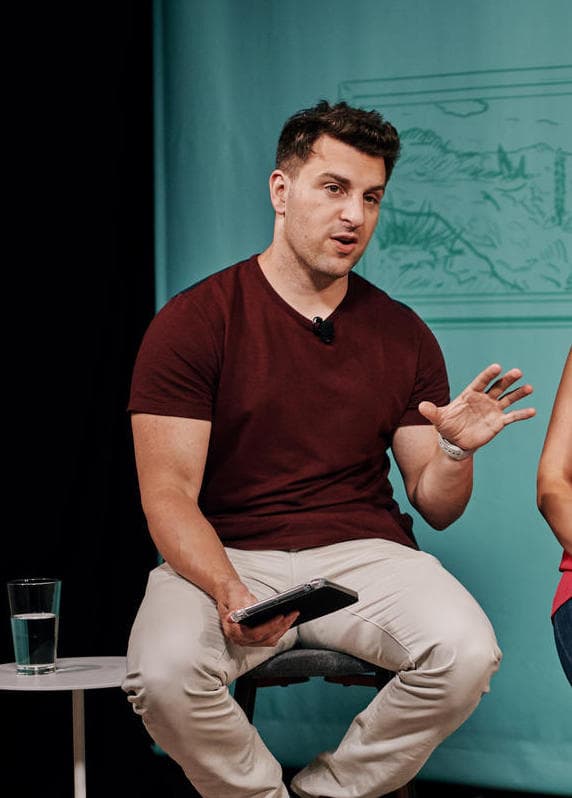
Brian Chesky turned a Rhode Island School of Design education, two air mattresses, and a box of Obama-themed cereal into a fortune that our analysis places at $9.9 billion as of June 2026. That figure isn't the product of diversified empire-building. It is, overwhelmingly, the market's ongoing verdict on one company.
The architecture of this fortune is unusual even by Silicon Valley standards. Where peers of comparable vintage have layered venture funds, media deals, and real estate portfolios atop their founding stakes, Chesky has stayed close to the source. His wealth rises and falls with Airbnb's stock price in a way that makes it part balance sheet, part referendum on the future of travel.
Understanding what Chesky is worth requires understanding what Airbnb is worth. And then accounting for a Giving Pledge commitment that redirects a meaningful slice of his CEO equity compensation toward charitable ends before it ever becomes personal wealth. The number our analysis arrives at, $9.9 billion, is the residual after those considerations, weighted for recency and source authority across the full range of published estimates.
Where Chesky's $9.9B ranks among founder-CEOs of his generation
At $9.9B, Chesky sits comfortably in the upper tier of founder-CEO wealth, though well below the mega-cap outliers. A reflection of Airbnb's mid-cap positioning relative to trillion-dollar platforms.
Our analysis arrives at $9.9 billion as of June 2026, threading a careful path through a cluster of published estimates that span roughly $9.2 billion to $10.4 billion. Wikipedia and the Hustle Fund both landed near $9.2 billion; a LinkedIn commentary by analyst Jimmy Acton pegged the figure closer to $9.4 billion; CNBC placed it at $9.3 billion in mid-2023. The Bloomberg Billionaires Index, which updates in real time against equity markets, has carried the figure as high as $10.4 billion. Our estimate, weighted toward the more recent and methodologically transparent sources, settles at $9.9 billion.
That positions Chesky meaningfully above the bulk of his Y Combinator cohort and the broader 2000s-era startup generation, while sitting well below the Zuckerberg-Bezos stratosphere. Airbnb's market capitalization has traded in a range that places it firmly as a category-defining but mid-cap platform business. Large enough to anchor a multi-billion personal fortune, not large enough to manufacture the kind of ten-figure wealth that trillion-dollar network effects produce.
The peer comparison that matters most is probably not other travel executives but other founder-CEOs who retained substantial ownership through IPO and declined to sell aggressively into the public markets. Chesky is one of the cleaner examples of that discipline. He built his position over nearly two decades, diluted modestly, and has largely held. The reward for that patience is a fortune that, on our analysis, has grown meaningfully from CNBC's 2023 reading of $9.3 billion to our current estimate. An appreciation driven almost entirely by Airbnb's equity performance rather than any new income stream.
The Airbnb equity stake: how a ~10% position became $8.7B
Chesky's roughly 10% ownership stake in Airbnb is worth an estimated $8.7B. About 88% of his total net worth. Making it one of the most concentrated founder positions among large-cap U.S. Tech companies.
The core of the fortune is straightforward: Chesky holds approximately 10% of Airbnb's outstanding shares, a position that multiple sources corroborate and that our analysis values at roughly $8.7 billion based on prevailing market prices. That single line item accounts for approximately 88 cents of every dollar in his net worth. When Airbnb's share price moves by a meaningful percentage in either direction, Chesky's paper wealth moves with it in increments that dwarf anything else on his balance sheet.
The stake's history is instructive. Chesky co-founded Airbnb in 2007 alongside Joe Gebbia and Nathan Blecharczyk in a San Francisco apartment, at a moment when the concept of renting space in a stranger's home was regarded as somewhere between eccentric and alarming. His mother's reaction. That he wasn't an entrepreneur but simply unemployed. Was a sentiment widely shared. The company's earliest funding came from unconventional sources, including pre-sold novelty cereal boxes, before Paul Graham and Y Combinator provided the first institutional runway.
By the time Airbnb went public in December 2020, it had grown to a platform spanning more than 220 countries and regions, with over 5.5 million active hosts and a cumulative guest count that has since surpassed 2.5 billion. The IPO priced at a level that immediately made Chesky a billionaire on paper at a scale that surprised even the most optimistic observers; CNBC noted that at the IPO's initial trading range, the implied market capitalization briefly touched the neighborhood of $31 billion before markets settled. That early volatility has since given way to a more durable, if still fluctuating, valuation. And Chesky's stake has remained roughly intact through it all, a signal of genuine long-term conviction.
Concentration at this level carries real risk. A sustained deterioration in travel demand, a regulatory crackdown on short-term rentals in major markets, or a structural shift in how people book accommodation could compress Airbnb's multiple quickly. Chesky's fortune would compress with it. That is the bargain a founder accepts when he chooses loyalty to his creation over diversification. And, so far, the market has rewarded it.
“Chesky's fortune is not a portfolio. It is a thesis, and the thesis is that Airbnb permanently changed how the world travels.”
The angel portfolio: disciplined bets, not spray-and-pray
Chesky's angel investment portfolio is estimated at $693M. Roughly 7% of his net worth. Built through a small, selective group of early-stage bets where he can contribute operational expertise, not just capital.
Beyond Airbnb, the next most meaningful asset class in Chesky's wealth picture is an angel portfolio that our analysis values at approximately $693 million, or about 7% of the total. The Hustle Fund has written extensively about his approach, characterizing it as on purpose narrow. Around eight investments in total, chosen for thematic alignment with the platform and design principles that shaped Airbnb's architecture.
The selection logic is coherent. Chesky has consistently gravitated toward companies where network effects, trust infrastructure, and user experience design are central competitive variables. That is not a random preference; it reflects the specific operational lens he developed building Airbnb from a two-person experiment into a global marketplace. His involvement in helping stabilize OpenAI's leadership crisis. Reportedly serving as a trusted sounding board during Sam Altman's board confrontation in 2023. Illustrates the kind of advisory capital he brings to relationships that extend beyond formal check-writing.
The portfolio's dollar value is inherently uncertain. Early-stage holdings are illiquid, marked at cost or last-round valuations, and subject to the full mortality rate of venture-backed startups. What distinguishes Chesky's approach from most CEO-turned-angel playbooks is the restraint. He has not attempted to build a multi-hundred-company fund under his own brand. The concentrated, high-conviction structure mirrors exactly the discipline he applied to his own founding stake. A consistency of temperament that is itself a data point about how he thinks about risk.
CEO compensation: the structure of a pledged paycheck
Chesky's CEO compensation and vested equity awards contribute an estimated $297M to his wealth picture, though his Giving Pledge commitment redirects much of the equity proceeds away from personal accumulation.
CEO pay at public companies of Airbnb's scale typically generates substantial personal wealth through annual equity grants. For Chesky, the mechanics are on purpose complicated by his Giving Pledge commitment, which he signed with the explicit intention of donating the net proceeds of his CEO equity compensation to philanthropic causes. Our analysis attributes roughly $297 million. Approximately 3% of the total estimate. To the combined contribution of base salary, cash bonuses, and vested equity awards that fall outside the pledge's scope.
That figure reflects a modest contribution relative to his equity stake, which is precisely the point. Chesky's personal compensation has, intentionally, not been a primary wealth-accumulation vehicle. The arrangement is unusual among founder-CEOs of comparable companies, where annual equity grants routinely add hundreds of millions to already substantial fortunes. Chesky has traded that stacking mechanism for something less real: the reputational and, presumably, personal value of a philanthropic commitment made publicly and early.
The practical implication for wealth analysis is that his compensation stream, unlike his equity stake, does not compound into his net worth in the straightforward way an outside observer might assume. Analysts who simply add published CEO pay packages to his equity position risk overstating the figure. Our analysis accounts for the pledge-related outflow, which is why our estimate is calibrated slightly above several published figures that may not fully model this distinction.
The Giving Pledge offset: how philanthropy reshapes the balance sheet
The Giving Pledge commitment represents an estimated $198M wealth outflow category. A structural reduction in the net worth figure that distinguishes Chesky's balance sheet from peers who have made no comparable commitments.
Chesky signed the Giving Pledge. Warren Buffett and Bill Gates's initiative for billionaires who commit to directing the majority of their wealth to charitable causes. And specifically tied his CEO equity compensation to that commitment. Our analysis treats this as a distinct wealth-outflow category, estimated at approximately $198 million, representing the pledged equity proceeds that flow toward charitable and community causes rather than into his personal holdings.
The Giving Pledge does not require immediate asset transfers; it is a moral commitment rather than a legal one, and the timeline for disbursement is left to the signatory's discretion. Chesky's formulation is narrower than a blanket pledge of all wealth. It is specifically pegged to CEO equity compensation, not to his founding stake. That nuance matters for anyone trying to model the long-term trajectory of his net worth. The founding equity, which represents the overwhelming majority of the fortune, remains within his control.
What the pledge does accomplish, in wealth-analysis terms, is create a structural floor beneath which personal accumulation from compensation will not meaningfully grow. That is a meaningful design choice for a 44-year-old at the helm of a company whose equity he still holds in concentration. Whether the philanthropic program eventually expands to encompass a larger share of the founding stake. As Buffett's own pledge eventually led him to commit essentially his entire Berkshire position. Is an open question that will shape the long-run trajectory of the Chesky fortune.
How Chesky manages the business: founder mode as capital strategy
Chesky's 'founder mode' operating philosophy. Deep product involvement, flat hierarchies, and radical transparency. Is both a management style and a capital-allocation signal that has driven Airbnb's post-pandemic margin expansion.
Chesky popularized the term 'founder mode' in 2024 as a description of how founding CEOs operate differently from professional managers. Engaging directly with product details, skipping layers of management, and treating operational depth as a competitive advantage rather than a distraction. The framing resonated widely in Silicon Valley, in part because it captured something observable in Airbnb's own financial trajectory: the company's shift from pandemic-era survival mode to a cash-generative, margin-expanding business happened under Chesky's unusually hands-on stewardship.
From a capital-allocation standpoint, the founder mode approach has meant that Airbnb has not pursued the aggressive M&A strategy that comparably capitalized platforms might be expected to execute. Chesky has been selective about acquisitions, preferring to build product capabilities internally when possible and maintain a balance sheet that, by the standards of large consumer-tech platforms, is conservatively managed. That restraint has kept Airbnb's equity story relatively clean. A single-business thesis rather than a conglomerate discount story.
The practical effect on Chesky's personal wealth is indirect but real. A founder who maintains deep product credibility tends to command a lower risk premium from public market investors, all else being equal. Airbnb's valuation multiple has, by most measures, held up better than several of its peer-group travel platforms in recent years. A performance that reflects both the underlying business quality and the market's ongoing confidence in its founding CEO. That premium is embedded in the $8.7 billion stake valuation our analysis carries.
What could disrupt this fortune. And how fast
Regulatory pressure on short-term rentals, a sustained travel demand shock, or significant equity dilution from new share issuance are the three most credible downside scenarios for Chesky's concentrated fortune.
The concentration that built this fortune in record time is also its primary vulnerability. Because approximately 88% of the estimated $9.9 billion is tied to a single equity position, any sustained compression in Airbnb's stock price translates immediately and almost linearly into a reduction in Chesky's net worth. The Bloomberg Billionaires Index, which tracks the position in real time, has shown the figure oscillating by hundreds of millions across a single trading quarter. Volatility that a diversified portfolio would absorb but a concentrated one cannot.
The most built that way meaningful risk is regulatory. Cities and national governments across Europe, North America, and Asia have spent the past several years attempting to limit or restructure the short-term rental market, with New York City's aggressive permitting regime serving as the most prominent example. If similar restrictions spread to Airbnb's highest-revenue markets. London, Paris, Tokyo, and the major Sun Belt metros. The long-term earnings trajectory that underpins the current valuation would face genuine pressure.
A second-order risk is dilution. Airbnb has used equity for employee compensation at scale, and any acceleration of that practice. Through large new hiring cycles or major acquisitions paid in stock. Would gradually reduce Chesky's percentage ownership below the approximately 10% level that anchors his wealth. His stake is large enough that even modest dilution over time builds up into a meaningful absolute-dollar reduction. Our $9.9 billion estimate assumes the current ownership percentage holds; a sustained dilution scenario would argue for a lower figure.
The trajectory from here: what $9.9B looks like in five years
If Airbnb sustains its current margin profile and the platform continues growing in emerging travel markets, Chesky's stake could appreciate meaningfully. But regulatory and macro headwinds make the upside case narrower than the headline number implies.
The base case for Chesky's fortune is simple: Airbnb keeps growing, its multiple holds, and the stake appreciates roughly in line with the company's earnings trajectory. That is the scenario embedded in current market prices, and it implies a fortune that continues to track above the $9.9 billion level over the medium term. The Hustle Fund's characterization of Airbnb as a company that has built a $100 billion-plus enterprise value for shareholders is the ceiling case. If the platform's market capitalization expands toward that range on a sustained basis, Chesky's approximately 10% position appreciates accordingly.
The bull case leans on Airbnb's international expansion and its ongoing effort to deepen the platform beyond transactional lodging toward something closer to a travel-identity product. A direction Chesky has spoken about publicly. If Airbnb can extend its model into experiences, long-term stays, and emerging markets where short-term rental penetration remains low, the addressable market expands substantially, and the equity story becomes more compelling to growth-oriented investors.
The bear case, as noted, is primarily regulatory and macro. A global recession that suppresses leisure travel for multiple quarters, layered atop tightening municipal restrictions on short-term rentals, would stress both Airbnb's revenue and its multiple simultaneously. In that scenario, the Bloomberg Billionaires Index figure. Which already touched $10.4 billion at its recent peak. Could retreat toward or below the lower bound of published estimates. Our current analysis, at $9.9 billion, sits near the midpoint of the credible range precisely because both scenarios are live. What is not in dispute is that Chesky's next decade of wealth accumulation will be written by Airbnb's story. Not by any parallel venture he is running.
How the $9.9B adds up
- Airbnb equity stake (~10% ownership)Multiple sources confirm Chesky holds roughly a 10% stake in Airbnb, which accounts for the vast majority of his multi-billion dollar net worth given Airbnb's $100B+ market cap.$8.7B88%
- Angel investing portfolioHustle Fund describes Chesky as a disciplined angel investor who has made approximately 8 strategic early-stage investments, leveraging his operational expertise in platforms and design.$693M7%
- CEO compensation & deferred equityChesky's Airbnb CEO equity compensation is pledged to philanthropic causes per his Giving Pledge commitment, but base cash and vested awards contribute modestly to liquid wealth.$297M3%
- Philanthropy (Giving Pledge offset)Chesky is a signatory to the Giving Pledge and has committed to donating the net proceeds of his CEO equity compensation to charitable causes, representing a wealth outflow category.$198M2%
Ezra Linwood — Ezra Linwood covers founder wealth, equity structures, and the business of platform economies for Neon Hollywood.
Disclaimer: Net-worth figures are editorial estimates built from publicly available reporting, filings, and market data — see our methodology. They are not verified statements of any person’s finances and nothing here is financial advice.